What Is Autism? Signs, Causes, Types & Support
Learn what autism is, common signs, causes, types, diagnosis, and when to seek autism assessment or therapy support for your child.

If your child has delayed speech, avoids eye contact, does not respond to name, repeats the same actions, gets upset with small routine changes, or struggles to play with other children, you may be wondering: “Is this autism?”
That question can feel heavy for any parent. But understanding autism early does not mean labelling your child. It means getting clarity, knowing what your child needs, and starting the right support at the right time.
Quick Answer: Autism, also called autism spectrum disorder or ASD, is a neurodevelopmental condition that affects how a person communicates, interacts, behaves, learns and responds to sensory input. Autism is not a disease, not poor parenting, and not something caused by lack of love. It is called a spectrum because every child’s strengths, challenges and support needs can look different.
The CDC describes autism spectrum disorder as a developmental disability caused by differences in the brain, while WHO describes autism as a diverse group of conditions related to brain development.
If you are worried about your child’s speech, behaviour, sensory needs or social development, you can start with Aaryavart’s autism therapy services or online autism therapy and screening.
What Is Autism?
Autism is best understood as a difference in development, not as one fixed set of symptoms. Two autistic children may look very different from each other, which is why many parents feel confused in the beginning.
Autism spectrum disorder can affect:
- Social communication
- Eye contact and gestures
- Speech and language development
- Play and interaction
- Behaviour flexibility
- Sensory processing
- Attention and learning
- Daily routines and independence
Some autistic children speak fluently but struggle with social understanding. Some have delayed speech. Some are non-speaking and communicate through gestures, pictures or devices. Some children need support in daily life, while others need help mainly with social situations, flexibility or sensory regulation.
The CDC notes that autism begins before age 3 and can last throughout life, although symptoms may change over time.
Why Is It Called a Spectrum?
The word “spectrum” does not simply mean mild to severe. It means autism can affect different areas of development in different ways.
One child may have strong memory and early reading skills, but poor social communication. Another child may have speech delay, sensory sensitivity and frequent meltdowns. Another may talk well, but struggle with friendships, routine changes and understanding social cues.
Autism can vary in:
- Language ability
- Social interaction
- Learning style
- Sensory needs
- Behaviour patterns
- Independence level
- Daily living skills
- Support required at home and school
This is why a proper autism assessment should not only ask, “Does the child have autism?” It should also ask, “What does this child need to communicate, learn, regulate and participate better?”
Common Signs of Autism in Children
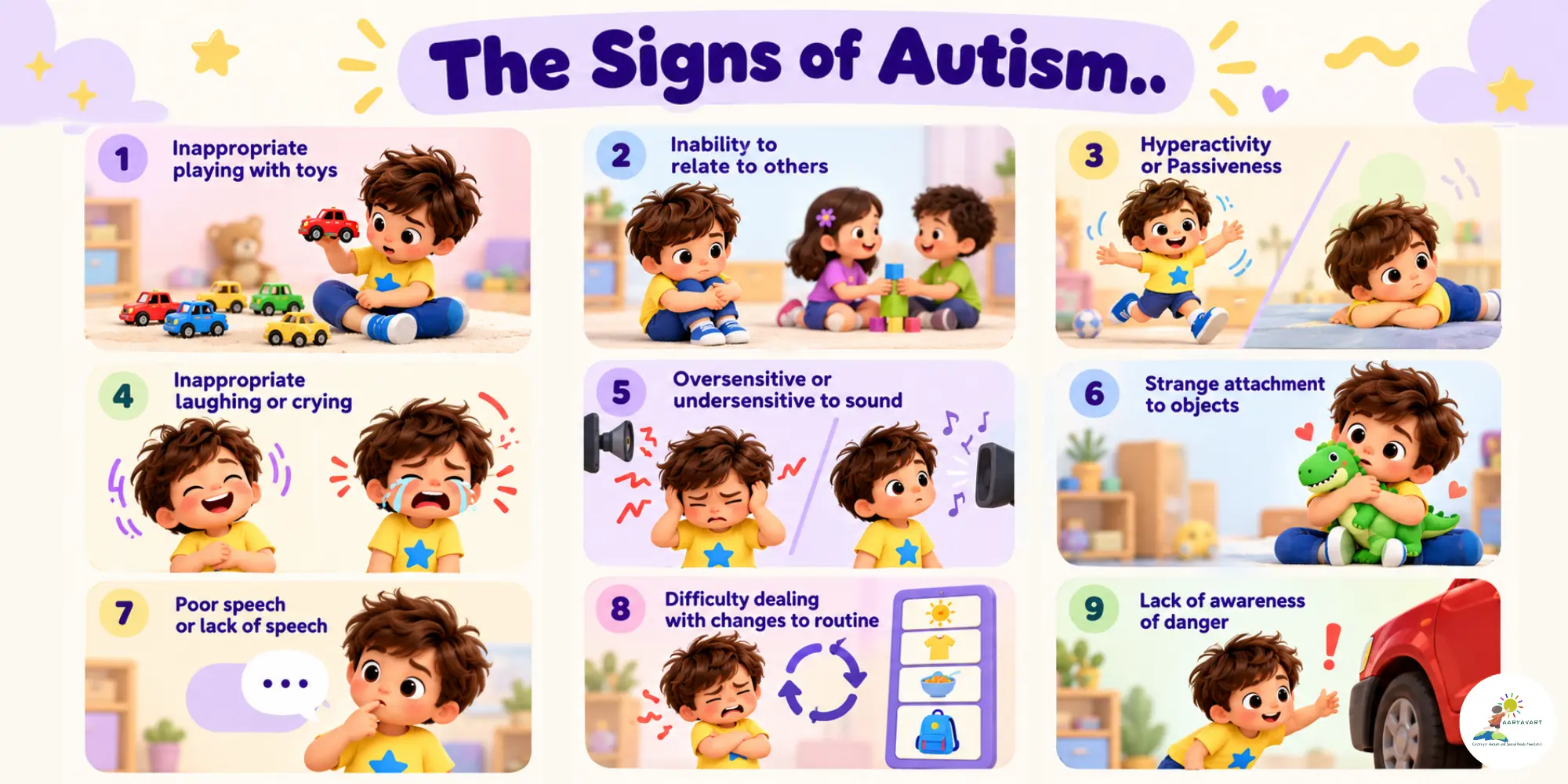
Autism signs are usually seen as a pattern. One behaviour alone does not confirm autism. Concern increases when several signs appear together and affect communication, play, learning or daily life.
The CDC says people with ASD often have challenges with social communication and interaction, restricted or repetitive behaviours or interests, and may also have different ways of learning, moving or paying attention.
Social Communication Signs
These signs are often noticed by parents during daily interaction, playtime or when calling the child by name.
Possible signs include:
- Limited or inconsistent eye contact
- Not responding to name
- Limited pointing, waving or showing objects
- Less interest in sharing enjoyment
- Limited back-and-forth interaction
- Difficulty copying actions or sounds
- Playing alone most of the time
- Difficulty understanding emotions or social cues
If your child does not respond to name consistently, read Aaryavart’s guide on child not responding to name.
Speech and Language Signs
Speech delay is one of the most common reasons parents first seek help. But speech delay alone does not always mean autism. The bigger question is how the child uses communication socially.
Possible signs include:
- No speech or very few words for age
- Repeating words or phrases
- Not using words to request or share
- Difficulty following simple instructions
- Limited gestures
- Pulling parents by hand instead of communicating
- Loss of previously used words
If speech delay is your main concern, you can also read Child Not Speaking at 3 Years.
Behaviour and Play Signs
Many autistic children show repetitive behaviours, strong interests or difficulty with flexible play.
Possible signs include:
- Hand flapping, spinning, rocking or jumping
- Lining up toys
- Spinning wheels or watching moving objects
- Repeating the same play pattern
- Strong distress when routines change
- Intense interest in specific objects or topics
- Limited pretend play
- Difficulty shifting from one activity to another
These behaviours are not “bad behaviour.” Many times, they are the child’s way of seeking predictability, comfort or sensory regulation.
Sensory Signs
Sensory differences are common in autism. Some children are very sensitive to input, while others seek more movement, pressure or sound.
Possible signs include:
- Covering ears for everyday sounds
- Disliking certain clothes or textures
- Strong food texture preferences
- Smelling or touching objects repeatedly
- Seeking spinning, jumping or deep pressure
- Distress in crowded places
- Strong reaction to lights, sounds or smells
- High or low response to pain
Sensory concerns can affect sleep, feeding, school readiness, behaviour and family routines. This is why occupational therapy and parent guidance often become part of autism support.
Autism Signs by Age
Parents often ask, “At what age can autism be noticed?” Some signs may appear in the first year, while others become clearer between 18 months and 3 years.
The CDC and AAP recommend autism-specific screening at 18 and 24 months, and earlier assessment if parents or doctors notice concerns.
Signs Around 12 Months
At this age, parents may notice early differences in social response, sound, gestures and shared attention.
Possible signs include:
- Limited response to name
- Little or no babbling
- Less social smiling
- Limited eye contact
- Limited pointing or waving
- Not showing objects to parents
- Less interest in interactive games
Signs Around 18 Months
By 18 months, communication, imitation and early play usually become clearer. Delays at this age should not be ignored.
Possible signs include:
- Few meaningful words
- Limited pointing to show interest
- Less imitation
- Limited pretend play
- Not following simple instructions
- Repetitive actions
- Strong sensory reactions
Signs Around 2 to 3 Years
At this age, autism signs may become more visible because speech, social play and routines are expected to grow quickly.
Possible signs include:
- Not using two-word phrases meaningfully
- Playing alone most of the time
- Difficulty communicating needs
- Frequent meltdowns
- Strong resistance to changes
- Limited social interaction
- Repeating words without using them meaningfully
- Loss of words or social skills
For a deeper age-wise guide, read early signs of autism in toddlers and when should my child be screened for autism.
What Causes Autism?
Parents often search for autism causes because they want one clear reason. But autism does not have one single cause.
Current research suggests autism is linked to differences in brain development, with genetic, biological and early developmental factors playing a role. The CDC says there is not just one cause of ASD, and multiple factors may make a child more likely to have autism.
Possible risk factors studied in autism include:
- Having a sibling with autism
- Certain genetic or chromosomal conditions
- Complications at birth
- Low birth weight
- Premature birth
- Older parental age
- Differences in early brain development
WHO also notes that autism is related to brain development and that the abilities and needs of autistic people vary and can change over time. WHO estimates that about 1 in 127 people worldwide had autism in 2021.
Important: autism is not caused by poor parenting, lack of affection, discipline style or vaccines. HealthyChildren.org from the American Academy of Pediatrics states that decades of high-quality, large-scale studies show vaccines do not cause autism.
For a focused explanation, read Aaryavart’s guide on is autism genetic.
Types of Autism: What Parents Should Know
Parents often ask about different “types of autism.” This can be confusing because older terms are still used online, even though modern diagnosis uses autism spectrum disorder.
Earlier terms included:
- Autistic disorder
- Asperger’s syndrome
- Pervasive developmental disorder not otherwise specified
- Childhood disintegrative disorder
Today, these are generally included under the broader diagnosis of autism spectrum disorder. The American Psychological Association notes that ASD is now the official DSM-5 term and includes conditions formerly known as autism, Asperger’s disorder and childhood disintegrative disorder.
So instead of asking only “What type of autism is this?”, parents should ask:
- How does my child communicate?
- What sensory needs does my child have?
- How much support is needed at home and school?
- Are there speech, motor, behaviour or learning concerns?
- What therapy plan will help my child function better?
Autism Level 1, Level 2 and Level 3
Autism levels describe the amount of support a person may need. They are not a judgment of the child’s value, intelligence or potential.
- Level 1: Requires support
- Level 2: Requires substantial support
- Level 3: Requires very substantial support
A child’s support needs can change over time, especially with early intervention, therapy, parent guidance and school support.
Autism vs Speech Delay, ADHD and Developmental Delay
Many parents feel confused because autism signs can overlap with other developmental concerns. This is why professional assessment matters.
Speech delay alone does not always mean autism. A child may have language delay, hearing difficulty, developmental language disorder or limited exposure to communication opportunities. Autism is more likely when speech delay appears with social communication differences, repetitive behaviours or sensory concerns.
ADHD can affect attention, sitting, impulse control and activity level. Some children have both autism and ADHD. Developmental delay may affect multiple milestones such as speech, motor skills, learning and daily living skills.
A child who does not respond to name may have autism, but may also have hearing concerns, attention difficulties, language understanding issues or sensory processing differences.
A proper assessment helps separate these possibilities and avoids guessing.
How Is Autism Diagnosed?
Autism is not diagnosed through one symptom, one blood test or one online quiz. A proper autism diagnosis or developmental assessment looks at the full picture.
The assessment may include:
- Parent interview
- Developmental history
- Observation of play and interaction
- Speech and language review
- Behaviour and sensory profile
- Daily living skills
- School or home concerns
- Screening tools when needed
- Clinical judgement by qualified professionals
The CDC states that diagnosing autism can be difficult because there is no medical test, such as a blood test, and diagnosis is based on developmental history and behaviour.
Screening is not the same as diagnosis. A screening result only tells whether further evaluation is needed. If you are unsure, start with autism screening test for toddlers.
Can Autism Be Treated?
Autism is not something to “cure.” But the right support can help children build communication, social skills, learning readiness, behaviour regulation, sensory comfort, independence and daily living skills.
CDC explains that autism intervention can include behavioural, developmental, educational, social-relational, pharmacological and psychological approaches. Speech and language therapy can help improve communication.
Support may include:
- Speech therapy
- Occupational therapy
- ABA-based intervention
- Behaviour support
- Sensory integration support
- Parent training
- Early intervention
- School readiness support
- Home development programs
- Visual schedules and routines
For structured visual support at home, parents can explore Sarya, a visual schedule app for autism, ADHD and neurodiverse children. The Sarya autism app can help with daily routines, ADL skills, visual steps and home practice. If attention and transitions are also difficult, the Sarya ADHD app may also be useful.
Sarya is not a replacement for assessment or therapy. It can support home routines after a child’s needs are understood.
When Should Parents Seek Help?
You do not need to wait for a confirmed diagnosis before asking for help. If your child’s development is worrying you, an assessment can give clarity.
Seek professional guidance if your child has:
- Delayed speech
- Poor eye contact with other signs
- Not responding to name
- Limited pointing or gestures
- Repetitive behaviours
- Sensory sensitivity
- Frequent meltdowns
- Limited play skills
- Poor social interaction
- Difficulty following instructions
- Loss of words or skills
- Daily routine difficulties
CDC notes that getting services as early as possible can make a difference, and support for specific symptoms such as speech therapy often does not need to wait for a formal ASD diagnosis.
How Aaryavart Supports Children With Autism
At Aaryavart Centre, the goal is not to label a child and leave parents confused. The goal is to understand the child’s needs and build a practical therapy plan.
Aaryavart supports children through:
- Autism assessment
- ABA-based therapy
- Speech therapy
- Occupational therapy
- Sensory support
- Behaviour guidance
- Parent training
- Home development program
- Online autism therapy
- Progress tracking
- Centre-based and online support
Families can visit Aaryavart centres in Lucknow, Gorakhpur, and Unnao. Families outside these cities can start with online autism therapy and screening.
Final Takeaway
Autism is a neurodevelopmental condition that affects communication, interaction, behaviour, sensory processing, learning and daily routines. Every autistic child is different. Some children need speech support, some need sensory regulation, some need behaviour guidance, and many need a combined plan.
If your child shows signs of autism, do not wait in confusion. Start with a professional assessment. The aim is not to label your child. The aim is to understand your child and begin the right support early. Book Autism Assessment with Aaryavart today.
What Is Autism FAQs
What is autism in simple words?
Autism is a neurodevelopmental condition that affects how a person communicates, interacts, behaves, learns and responds to sensory input.
What is autism spectrum disorder?
Autism spectrum disorder, or ASD, is the medical term used for autism. It is called a spectrum because symptoms, strengths and support needs vary from person to person.
What are the first signs of autism in a child?
Common early signs include delayed speech, limited eye contact, not responding to name, limited gestures, repetitive actions, sensory sensitivity and limited social interaction.
What causes autism?
There is no single cause of autism. Research suggests that genetic, biological and early developmental factors may all play a role.
Is autism genetic?
Genetics can play an important role in autism, but autism is complex. Not every autistic child has a clear family history.
Are there different types of autism?
Older terms like Asperger’s syndrome and autistic disorder are now generally included under autism spectrum disorder. Today, autism is described more by support needs and developmental profile.
What are autism levels?
Autism levels describe support needs. Level 1 means requiring support, Level 2 means requiring substantial support, and Level 3 means requiring very substantial support.
Can autism be cured?
Autism is not considered something to cure. However, therapy and early support can help children build communication, behaviour, learning, social and daily living skills.
Does speech delay mean autism?
No. Speech delay can happen for many reasons. Autism is more likely when speech delay appears with social communication differences, repetitive behaviours or sensory concerns.
When should my child be screened for autism?
Children are commonly screened for autism at 18 and 24 months, but parents should seek assessment earlier if clear concerns appear.
What should I do if I suspect autism?
Book a professional developmental assessment. The goal is not to label the child, but to understand the child’s needs and start the right support.
Does Aaryavart provide autism therapy?
Yes. Aaryavart provides autism assessment, ABA-based therapy, speech therapy, occupational therapy, sensory support, parent training, online autism therapy and home development support.