When Should My Child Be Screened for Autism? A Parent's Age-by-Age Guide
If your toddler is behind on milestones, don't wait. Learn the right age for autism screening, red flags to watch, and how to book an assessment.

Your child should have a formal autism-specific screening at their 18-month and 24-month well-child checkups, and sooner, at any age, if you or your pediatrician notice a concern. That's the guidance from the American Academy of Pediatrics (AAP), and it determines whether your child is meeting every other milestone or not.
If you've landed here because something feels different about how your toddler plays, points, or responds to their name, this guide walks you through exactly when should my child be screened for autism, what the screening actually involves, the early signs worth watching for by age, and what to do the moment you have a concern, including how Aaryavart Centre can get you a clear answer fast.
What Does "Autism Screening" Actually Mean?
Pediatricians work in two layers. The first is developmental surveillance: the ongoing, informal observation that happens at every well-child visit, where the doctor watches how your baby "giggles, points, waves, or responds to their name," per HealthyChildren.org, the AAP's parent-facing publication.
The second layer is formal screening: a standardized questionnaire given at specific ages, designed to flag children who need a closer look. It's important to know that a screening tool doesn't diagnose autism. It simply tells you whether a fuller evaluation is worth doing; that distinction matters, because a "positive screen" is a prompt to investigate further, not a diagnosis to panic over.
When Should My Child Be Screened for Autism? (The Official Age Guidelines)
According to the CDC, the American Academy of Pediatrics recommends that all children be screened specifically for autism spectrum disorder (ASD) at their 18-month and 24-month well-child visits, regardless of whether a parent has raised any concern. On top of that, children should get broader general-developmental screening at 9, 18, and 30 months.
There's a third rule that overrides every calendar-based guideline: screening should happen at any age the moment a parent or caregiver shares a concern about their child's development, per both the CDC and HealthyChildren.org. You do not need to wait for the 18-month appointment if something feels off at 14 months. Trust that instinct: it's usually right.
Early Signs of Autism by Age (12–24 Months)
Screening timelines are built around real developmental checkpoints. Per the CDC's Learn the Signs. Act Early. milestones:
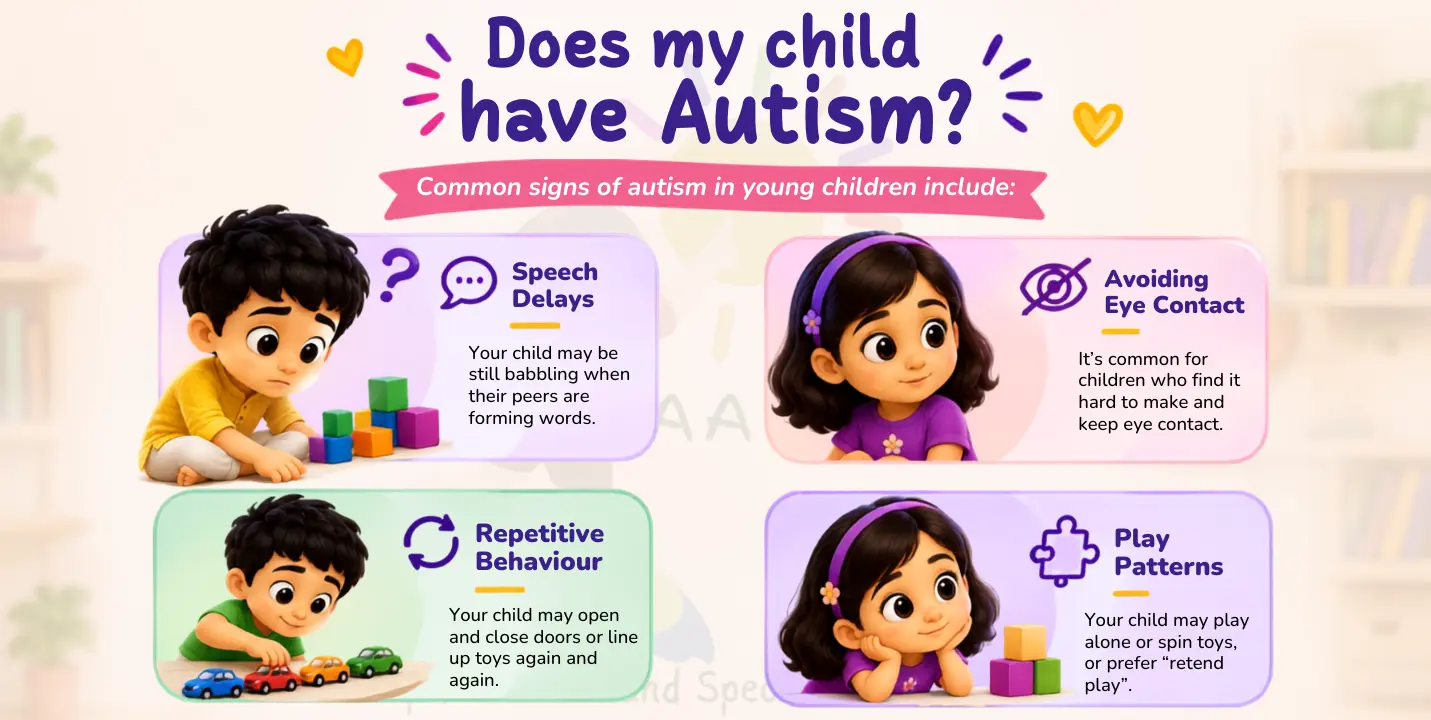
- By 12 months: most toddlers wave "bye-bye," call a parent "mama" or "dada," play simple back-and-forth games like pat-a-cake, and understand "no." Limited response to their name or little interest in these shared games is worth mentioning to your pediatrician.
- By 18 months: most toddlers point to show you something interesting (not just to request it), try to say three or more words beyond "mama/dada," and follow a one-step direction without a gesture, like handing you a toy when asked. Pointing purely to _share_ interest, not just to get something, is one of the behaviors doctors specifically watch for.
- By 24 months: most toddlers combine two words ("more milk"), have a vocabulary of 50–100 words, and use gestures beyond waving and pointing, such as nodding or blowing a kiss, per CDC milestones.
At any age, the CDC's own guidance is unambiguous: if your child is not meeting milestones, has lost a skill they once had, or you simply have a concern: don't wait, act early. Regression (losing words or skills) deserves an immediate call to your pediatrician, not a "let's monitor it" approach.
Common Autism Screening Tools Doctors Use
You don't need to memorize these, but recognizing them helps you understand what's happening at your child's appointment. Per the CDC and HealthyChildren.org:
- M-CHAT-R/F (Modified Checklist for Autism in Toddlers, Revised with Follow-Up): a 23-item parent-completed questionnaire, described as the most commonly used autism screening tool in pediatric offices.
- ASQ / ASQ-SE-2 (Ages and Stages Questionnaires): broader general-development and social-emotional screeners.
- STAT (Screening Tool for Autism in Toddlers and Young Children): an interactive, clinician-administered assessment.
- CSBS DP Infant-Toddler Checklist and POSI: additional communication-focused options.
How AI and Eye-Tracking Are Changing Autism Screening
Traditional screening relies on parent-reported checklists: useful, but subjective by nature. A newer wave of AI-based developmental screening tools is emerging in India specifically to make early autism screening faster, more objective, and more accessible before a family ever reaches a specialist's waiting room.
Aignosis, is one of the more notable examples of this shift. Its tool uses eye-tracking and eye gaze tracking combined with computer vision and machine learning: a child watches a short, five-minute video on a standard webcam, while the system analyzes eye movements, attention patterns, and facial expressions to flag developmental risk. This kind of non-invasive autism detection is built to work as a digital biomarker-based pre-screen: quick, low-cost, and designed to complement, not replace, a pediatrician's evaluation.
Aignosis has publicly stated it does not provide therapy directly; instead, it refers families onward to specialists and therapy centres, and the approach has earned enough industry attention to secure Shark Tank India funding, as covered by Zee Business.
Two other India-based tools worth knowing: Kidaura has built game-based screening apps that flag developmental concerns through structured play, and Sarya offers an app and routine-builder that supports neurodiverse children and their parents day to day.
Here's the important caveat, precisely because this is a medical topic: an AI or eye-tracking screen, like a paper checklist, is a screening tool, not a diagnosis. Whatever the result, the next right step is the same: a comprehensive, in-person developmental or autism assessment with a qualified professional, which is exactly what Aaryavart Centre's assessment program provides.
What Happens After a Positive Autism Screening?
A "positive" screen (or a flag from an AI tool) simply means your child needs a closer look; it is not a diagnosis, and it's not a reason to panic. The typical next steps are:
- Referral to a comprehensive developmental evaluation, often involving a developmental pediatrician, psychologist, or a multidisciplinary team.
- Structured diagnostic observation (such as the ADOS), combined with parent interviews and a review of developmental history.
- A written report and therapy roadmap: the actual diagnosis is only the starting point; what matters next is a personalized plan.
At Aaryavart Centre, this evaluation takes the form of a focused 2–3 hour assessment, in person at our Lucknow, Gorakhpur, or Unnao centres, or online for families anywhere in India or abroad, ending in a clear, personalized therapy plan rather than just a label.
Why Acting Early Matters
The AAP and CDC are consistent on this point: the earlier autism is identified, the earlier a child can start therapy during the years when the brain is most adaptable to new skills. A "wait and see" approach, once common advice, has been steadily replaced by "screen early, refer early," because outcomes are measurably better the earlier structured support begins. Screening at 18 and 24 months exists precisely to close that gap before school age.
How Aaryavart Centre Can Help
If a screening (whether from your pediatrician, an M-CHAT questionnaire, or an AI-based tool like Aignosis) has raised a flag, the next step is a real, comprehensive evaluation, not more googling. Aaryavart Centre offers:
- A free, no-cost screening call to help you understand whether a full assessment is the right next step
- A comprehensive 2–3 hour autism and child development assessment, in person or online
- Direct pathways into autism therapy, ABA therapy, speech therapy, occupational therapy, and early intervention, all under one roof, so a diagnosis is immediately followed by a plan
- Online therapy for families outside Uttar Pradesh or abroad, and in-centre care at Lucknow, Gorakhpur, and Unnao
Call or WhatsApp +91 76072 93336 (or +91 97938 88698), email wecare@aaryavart.org, or use the online assessment booking form to book this week.
Simple Things Parents Can Do While Waiting for an Appointment
Waiting for an appointment doesn't mean waiting to help your child:
- Keep a simple log of what you're noticing: specific examples help the clinician far more than "he just seems different."
- Get face-to-face during play and talk time; reduce passive screen time in favor of interactive games.
- Follow your child's lead in play, and narrate what you're both doing.
- Don't wait for the appointment to start engaging: early stimulation and responsive interaction help regardless of the eventual outcome.
- Talk to your partner or family about what you're noticing; you don't have to carry the observation alone.
Right Age for Autism Screening FAQs
When should my child be screened for autism?
The American Academy of Pediatrics recommends formal autism-specific screening at 18 months and 24 months during routine well-child visits, plus screening at any age the moment a parent raises a developmental concern.
What is the difference between autism screening and an autism diagnosis?
Screening is a quick, standardized check (like the M-CHAT-R/F questionnaire) that flags children who may need a closer look. A diagnosis comes only after a comprehensive evaluation by a qualified specialist; a positive screen simply means "let's look further," not "your child has autism."
What are the earliest signs of autism parents should watch for?
Per CDC milestones, watch for limited response to their name or reduced interest in shared games by 12 months, pointing only to request (not to share interest) or fewer than three words by 18 months, and no two-word phrases or limited gestures by 24 months. Losing previously learned skills at any age is always worth an immediate check.
Can autism be detected using AI or eye-tracking tools?
Emerging tools like Aignosis use eye-tracking, computer vision, and machine learning through a short webcam-based video to flag developmental risk quickly and non-invasively. These are screening aids, not diagnostic replacements; a flagged result should always be followed by a full clinical evaluation.
What screening tools do doctors actually use for autism?
The most common is the M-CHAT-R/F, a 23-item parent-completed questionnaire. Others include the ASQ/ASQ-SE-2, STAT, and the CSBS DP Infant-Toddler Checklist.
My child failed the M-CHAT screening. Does that mean they have autism?
No. A positive M-CHAT result means a follow-up interview and, usually, a referral to a comprehensive developmental evaluation. Many children who screen positive are later found not to have autism, while others benefit enormously from the early referral it triggers.
Is it too early to worry at 18 months?
No. 18 months is exactly when formal autism screening is recommended, precisely because it's early enough to act on. Raising a concern at this age is not "too early"; it's the system working as designed.
What happens after a positive autism screening?
Your child is typically referred for a comprehensive developmental or autism evaluation, which may include structured observation (such as the ADOS), parent interviews, and a review of developmental history, ending in a diagnosis (or ruling one out) and a personalized therapy plan.
Where can I get my child screened or assessed for autism near me?
Start with your pediatrician for a standard M-CHAT-based screen, or book a comprehensive assessment directly with a center like Aaryavart Centre, available in person in Lucknow, Gorakhpur, and Unnao, or online for families elsewhere in India or abroad.
Why does early screening matter so much?
Because outcomes improve the earlier structured support begins. The 18- and 24-month screening checkpoints exist to catch developmental concerns while the brain is most responsive to intervention; waiting even a year can mean losing valuable early progress.