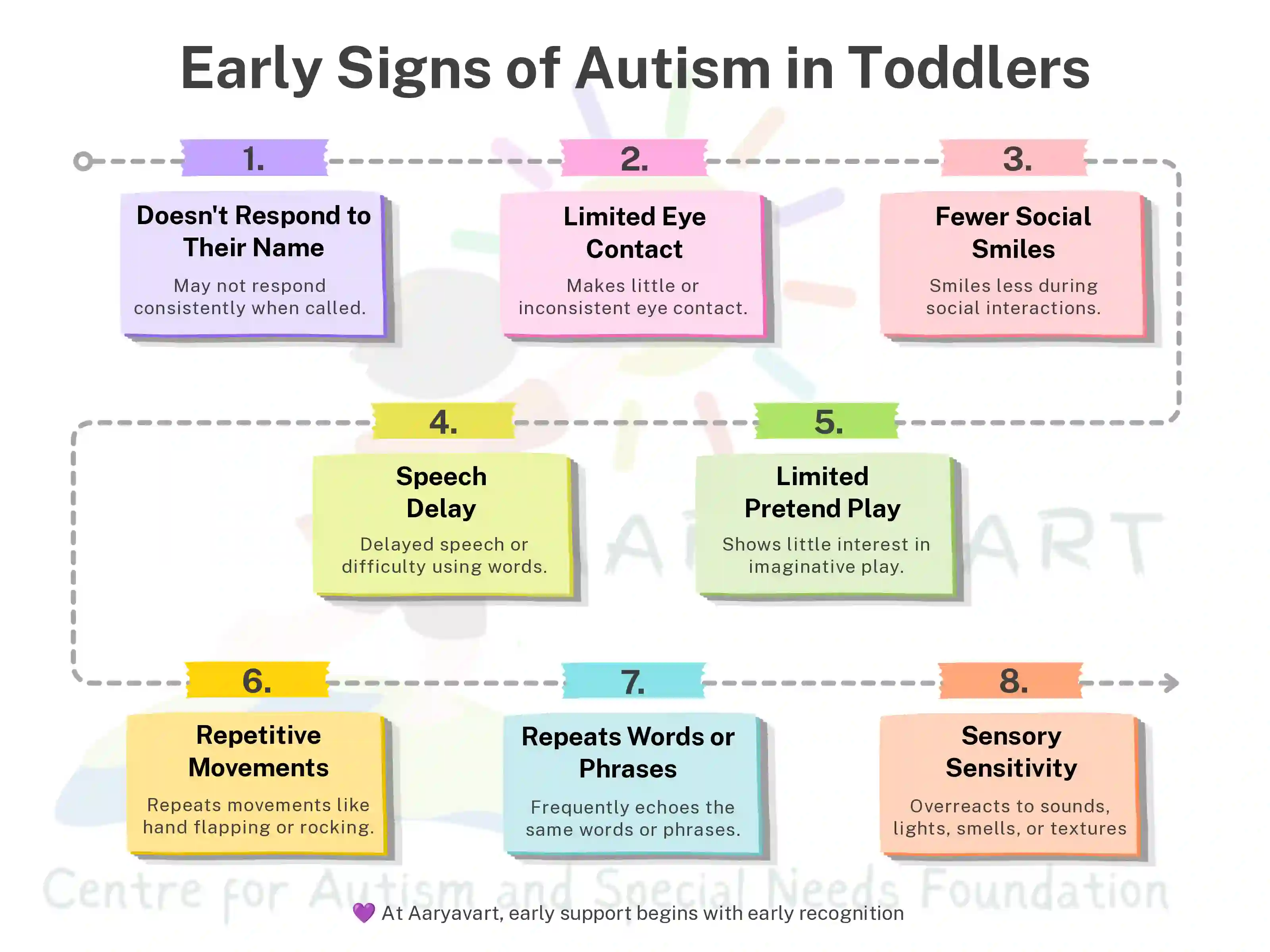
Early Signs of Autism in Toddlers: When You Should be Worried
Learn early signs of autism in toddlers, including speech delay, poor eye contact, no response to name, sensory issues and when to book an assessment.

Many parents first notice autism signs during the toddler years. A child may not respond to their name, speak very few words, avoid eye contact, repeat actions, resist change, or seem unusually sensitive to sounds, textures, lights, or crowded places.
One sign alone does not confirm autism. Some toddlers may have speech delay, hearing difficulty, sensory concerns, ADHD-like attention issues, or developmental delay. But when several signs appear together, it is important to seek a professional developmental assessment instead of waiting in confusion.
This blog explains the early signs of autism in toddlers, what parents should observe, and when to book an assessment.
What is Autism in Toddlers?
Autism spectrum disorder is a developmental condition that can affect social communication, interaction, behaviour, learning, sensory processing, movement, and attention. The CDC explains that people with autism often have differences in social communication and interaction, along with restricted or repetitive behaviours or interests.
Autism is called a spectrum because every child is different. Some toddlers may speak, some may not. Some may be very active, while others may appear quiet. Some may enjoy routines strongly, while others may struggle with sensory overload or social interaction.
Why Early Signs Matter
Early signs matter because they help parents understand whether a child needs support for communication, behaviour, sensory needs, learning, or daily living skills.
The CDC notes that some children show autism symptoms within the first 12 months, while others may show signs later, around 24 months or after. Some children may also stop gaining skills or lose skills they previously had around 18-24 months. (cdc.gov)
The goal of early assessment is not to label the child. The goal is to understand the child’s needs and begin the right autism therapy, parent guidance, and home support early.
Early Signs of Autism in Toddlers
Following are some of the most common early signs of autism in toddlers:
1. Not Responding to Name
A common early sign is when a toddler does not consistently respond when called by name. Parents may notice that the child responds to music, TV, or favourite snacks, but not to their name.
The CDC lists not responding to name as one possible early autism sign.
2. Limited Eye Contact
Some toddlers on the autism spectrum may avoid eye contact, make very brief eye contact, or not look toward parents during interaction.
Mayo Clinic notes that some children show early signs such as reduced eye contact, not responding to their names, or seeming less interested in caregivers.
3. Speech Delay or Few Words
Speech delay is one of the most common concerns parents notice. A toddler may not speak, may use very few words, may not form two-word phrases, or may repeat words without using them meaningfully.
Speech delay alone does not always mean autism, but when it appears with poor social response, limited gestures, or repetitive behaviour, assessment is important.
4. Limited Gestures
Toddlers usually use gestures like pointing, waving, showing objects, reaching, or nodding. A toddler showing early autism signs may use fewer gestures or may not point to share interest.
The American Academy of Pediatrics notes that many children on the autism spectrum show developmental differences during infancy and toddler years, especially in social and language skills.
5. Not Sharing Interest
A toddler may not bring toys to show parents, point at things to share excitement, or look back and forth between an object and parent.
This is different from simply being quiet. It may suggest difficulty with joint attention, which is an important social communication skill.
6. Repetitive Movements
Some toddlers may flap hands, spin, rock, jump repeatedly, line up toys, open and close doors, or repeat the same action again and again.
The CDC lists repetitive movements, lining up toys, repeating words or phrases, and unusual interests as examples of restricted or repetitive behaviours related to autism.
7. Strong Resistance to Change
A toddler may become very upset when routines change, toys are moved, food is different, or a path is changed. Some children may need sameness to feel calm and regulated.
This does not automatically mean autism, but if it appears with communication and social concerns, it should be evaluated.
8. Sensory Sensitivity
Some toddlers may cover their ears, dislike certain clothes, avoid messy textures, be sensitive to lights, smell objects, seek spinning, or react strongly to crowded places.
The CDC notes that autistic people may have different ways of learning, moving, paying attention, and responding to sensory input.
9. Limited Pretend Play
A toddler may not pretend to feed a doll, talk on a toy phone, copy household actions, or create simple play stories. Instead, they may focus on spinning wheels, arranging objects, or repeating the same play pattern.
Limited pretend play can be an important developmental sign when seen with speech and social communication concerns.
10. Loss of Words or Skills
If a child is using words, gestures, social smiles, or play skills and then loses them, parents should seek professional guidance quickly.
Mayo Clinic notes that some children may develop as expected initially and then become withdrawn, lose language skills, or show changes in behaviour.
Autism Signs by Age
Here are some signs of autism that you can observe if it is present in your baby depending upon its age:
Signs Around 12 Months
- Little or no babbling
- Limited response to name
- Limited gestures like pointing or waving
- Less social smiling
- Limited back-and-forth interaction
Signs Around 18 Months
- Few meaningful words
- Limited imitation
- Less pretend play
- Difficulty following simple instructions
- Repetitive actions or strong sensory reactions
Signs Around 24-36 Months
- Not forming meaningful phrases
- Limited social interaction
- Playing alone most of the time
- Repeating words or phrases
- Strong resistance to change
- Sensory sensitivity
- Difficulty communicating needs
The CDC states that all children should be screened specifically for autism during well-child visits at 18 and 24 months, and additional screening may be needed if symptoms are present.
When Should Parents Seek Assessment?
Parents should consider assessment if their toddler:
- Does not respond to name
- Has speech delay
- Does not point, wave, or show objects
- Avoids eye contact often
- Repeats actions or words
- Has sensory sensitivity
- Does not play with other children
- Has frequent meltdowns
- Struggles with change
- Has lost words or social skills
Do not wait for “school age” if you are concerned. Early assessment can help identify whether the child needs speech therapy, autism therapy, occupational therapy, ABA-based support, parent training, or home development guidance.
How Aaryavart Centre Can Help
At Aaryavart Centre, we support children with autism, speech delay, ADHD, sensory concerns, behavioural challenges, and developmental delays through assessment-led care.
Our team looks beyond one symptom. We assess communication, social interaction, behaviour, sensory needs, attention, play, motor skills, learning, and daily living skills. Based on the child’s needs, we may recommend autism therapy, speech therapy, occupational therapy, ABA-based intervention, parent training, early intervention, online therapy, or a home development program.
Families can visit Aaryavart centres in Lucknow, Gorakhpur, and Unnao, or start online support from anywhere in India or abroad.
Conclusion
Early signs of autism in toddlers can look different from child to child. Some children may show speech delay, some may avoid eye contact, some may not respond to name, and some may struggle with sensory overload or change.
One sign alone is not a diagnosis. But if you notice several signs together, professional assessment can bring clarity and help your child receive the right support early. Worried about early signs of autism in your toddler? Book a child development assessment with Aaryavart Centre today.
Early Signs of Autism in Toddlers FAQs
What are the earliest signs of autism in toddlers?
Early signs may include not responding to name, limited eye contact, speech delay, limited gestures, repetitive movements, sensory sensitivity, difficulty with change, and limited social interaction.
Does speech delay mean autism?
No. Speech delay does not always mean autism. But if speech delay appears with poor eye contact, no response to name, limited gestures, repetitive behaviour, or sensory concerns, an autism assessment may be helpful.
At what age can autism signs appear?
Some signs may appear in the first 12 months, while others become clearer around 18-24 months or later. Some children may also lose skills they previously had.
Should I wait if my toddler is not speaking?
If your toddler is not speaking, using very few words, or not communicating needs, it is better to seek assessment rather than wait in confusion.
Can autism therapy help toddlers?
Autism therapy can support communication, behaviour, sensory regulation, learning readiness, daily living skills, and parent-guided development. The therapy plan should be based on assessment.
Does Aaryavart offer online support?
Yes. Aaryavart Centre offers online assessment guidance, parent training, and home development programs, along with centre-based support in Lucknow, Gorakhpur, and Unnao.