
Autism Screening Test for Toddlers: Early Signs, the M-CHAT-R Test & What to Do Next
Worried about your toddler's development? Learn the M-CHAT-R screening test, early autism red flags & how to book an expert assessment.

If you've been searching for an autism screening test for toddlers, you're probably watching your child closely — noticing whether they respond to their name, make eye contact, or point at things they want — and wondering if what you're seeing is "just a phase" or something that needs attention.
That instinct is worth trusting. Pediatric research consistently shows that early screening and early intervention lead to significantly better developmental outcomes for children later diagnosed with Autism Spectrum Disorder (ASD). This guide explains what a toddler autism screening test actually involves, the early signs pediatricians look for, and how to take the next confident step for your child — including a free professional assessment at Aaryavart Centre.
What is an Autism Screening Test for Toddlers?
An autism screening test is a short, standardized questionnaire that helps parents and pediatricians identify whether a toddler shows early behavioral patterns associated with autism. It is not a diagnosis — it's a first-step tool that flags whether a child should receive a full developmental evaluation.
The most widely used and clinically validated screening tool is the Modified Checklist for Autism in Toddlers, Revised, with Follow-Up (M-CHAT-R/F). According to the Modified Checklist for Autism in Toddlers, Revised, with Follow-Up is a screener that asks a series of 20 questions about a child's behavior, intended for toddlers between 16 and 30 months of age, with results indicating whether further evaluation may be needed. It's a parent-reported checklist, meaning you answer based on what you observe in your child's everyday behavior — no clinical setting required to begin.
The CDC lists the M-CHAT among the core recommended tools, noting that all children should be screened specifically for autism spectrum disorder during well-child doctor visits at 18 months and 24 months, using tools such as the parent-completed M-CHAT questionnaire.
Beyond traditional parent-reported checklists, newer game-based developmental screening tools are increasingly being used alongside the M-CHAT-R to support earlier identification. Aaryavart uses these AI-assisted tools through our technology partner Aignosis, to give families another data point before moving to a full clinical assessment.
Why Screening Happens at 16–30 Months
This age window isn't arbitrary. The American Academy of Pediatrics recommends that all children receive autism-specific screening at 18 and 24 months of age, in addition to broad developmental screening at 9, 18, and 24 months.
Two screenings — not one — matter because development isn't always linear. Research has found that repeated ASD-specific screening at 24 months detects children who were missed at their 18-month screening, supporting the value of screening at both ages to maximize identification of toddlers who need intervention. Some toddlers appear typically developing at 18 months and show clearer signs only a few months later — which is exactly why a single "clean" screening shouldn't be the final word if new concerns appear.
If your toddler is between 16–30 months and hasn't been screened yet, book a professional child assessment with Aaryavart Centre — our team combines standardized screening tools with clinical observation by child psychologists and a paediatric neurologist.
Early Signs of Autism Parents Can Watch For
While only a qualified professional can interpret a screening result, these are common early indicators noted across social communication and behavior domains:
Social & Communication Signs
- Limited or inconsistent response to their name by 12 months
- Reduced eye contact during play or conversation
- Not pointing to show interest (e.g., pointing at a plane or a toy) by 18 months
- Not engaging in pretend play (feeding a doll, "talking" on a toy phone) by 24 months
- Little interest in showing or sharing enjoyment with caregivers
Behavioral & Sensory Signs
- Strong preference for routines; distress with small changes
- Repetitive movements — hand-flapping, spinning, lining up toys
- Unusual reactions to sound, light, texture, or taste
- Intense, narrow interests in specific objects or topics
Developmental Signs
- Delayed speech or loss of previously acquired words (regression)
- Difficulty following simple instructions
- Limited imitation of gestures or facial expressions
None of these signs alone confirms autism — many toddlers show one or two transiently. But a cluster of these signs, or any regression in language/social skills, is a clear reason to complete a screening and speak with a professional.
How the M-CHAT-R Works — And What Results Mean
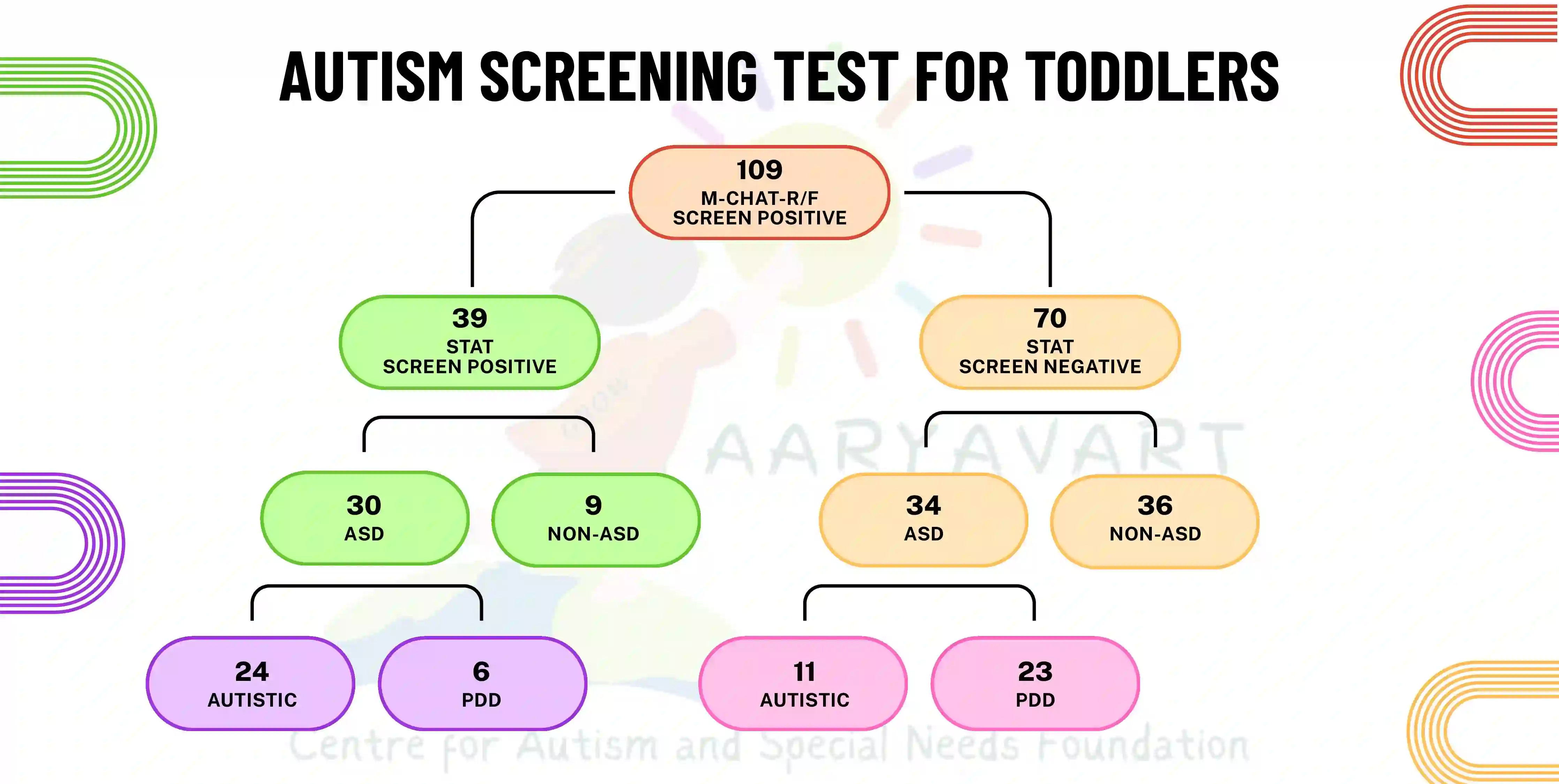
The M-CHAT-R/F is short by design. As one clinical summary notes, a parent or caregiver answers 20 yes/no questions about their child's behavior, and the questionnaire takes less than five minutes to complete and about two minutes to score.
Results generally fall into three categories:
- Low risk — Continue routine developmental monitoring at future visits.
- Medium risk — A structured follow-up interview is recommended before deciding on referral.
- High risk — Referral for a full diagnostic evaluation is recommended without delay.
It's worth being transparent here: no screening tool is perfect. Comparative research on toddler screeners has found that the M-CHAT-R/F may be less accurate for 18-month-olds than 24-month-olds, and its accuracy for children screening negative before age two is not fully established. This is precisely why parental observation and clinical judgment remain essential alongside any checklist — a "low risk" score isn't a reason to dismiss ongoing concerns you may have.
Screening vs. Diagnosis vs. Therapy: Understanding the Path
A lot of parents get stuck here, so let's simplify the journey:
- Screening (M-CHAT-R or similar) → flags possible risk in minutes
- Diagnostic Evaluation → a comprehensive assessment by a developmental pediatrician, child psychologist, or paediatric neurologist confirms or rules out ASD
- Therapy & Intervention → speech therapy, occupational therapy, ABA-based behavioral therapy, and parent training begin based on the child's specific needs
Screening is the doorway — but it only helps your child if you walk through it. This is where many families either delay out of fear or don't know where to go next. Aaryavart Centre's assessment process is designed to take you from that first flag of concern to a clear, personalized therapy roadmap — without the confusion.
What to Do If Your Toddler Screens "At Risk"
If a screening test — or simply your own observation — suggests risk, here's the responsible next step:
- Don't wait for the next well-child visit. Early evaluation shortens the path to support.
- Get a comprehensive developmental assessment, not just another checklist. At Aaryavart, assessments are guided by our child psychologists and Dr. Diksha Gupta, a paediatric neurologist trained at AIIMS and PGI Chandigarh.
- Ask about early intervention options immediately — even before a final diagnosis, targeted speech, sensory, and behavioral support can begin.
- Involve the whole family in learning simple home strategies — this accelerates progress between therapy sessions.
Book a free child assessment or message us directly on WhatsApp if you'd like guidance today rather than waiting.
Why Early Intervention Changes the Trajectory
Delay is common — and costly. National data cited in clinical literature shows that the median age of ASD diagnosis in the U.S. is still 47 months, with only half of children diagnosed by age 3 — more than two years after the recommended first screening. That gap represents real, recoverable developmental time. Develo
Children who begin therapy earlier — while the brain's neuroplasticity is highest — tend to show stronger gains in communication, social engagement, and independence. This is the single biggest reason screening at 16–30 months matters: it's not about labeling a child, it's about opening the window for support while it's widest.
How Aaryavart Centre Supports Families After Screening
Aaryavart Centre for Autism and Special Needs Foundation works with families across Lucknow, Gorakhpur, Unnao, and online across India and abroad. Our approach includes:
- Professional assessment combining validated screening tools with expert clinical judgment
- A multidisciplinary team of 30+ therapists, psychologists, and special educators
- Speech therapy, occupational therapy, ABA-based behavioral therapy, and sensory integration support — see our full Services
- AI-assisted developmental screening through our technology partner Aignosis, supporting earlier identification through game-based autism screening for toddlers
- Parent training and a structured Home Development Program so progress continues beyond the therapy room
- Progress tracking through the Sarya app, keeping you informed at every stage
We're a government-registered NGO, recognized in our approach to early screening awareness, and trusted by 1,500+ families — including many who found us after their toddler flagged "at risk" on a home screening test.
Get a Free Assessment for Your Toddler →
Autism Screening Test for Toddlers FAQs
What is the best autism screening test for toddlers?
The M-CHAT-R/F (Modified Checklist for Autism in Toddlers, Revised, with Follow-Up) is the most widely used and clinically validated screening tool for children 16–30 months old. It's recommended by the CDC and AAP as a first step, followed by a full assessment if results indicate risk.
At what age should my toddler be screened for autism?
The AAP recommends autism-specific screening at both 18 months and 24 months, alongside general developmental screening at 9, 18, and 24 months. If you notice concerning signs earlier, don't wait for these checkpoints — book an assessment sooner.
Can I do an autism screening test at home?
Yes, parent-reported tools like the M-CHAT-R can be completed at home in under five minutes, and game-based tools such as those from Aignosis can offer an additional early signal. However, results should always be discussed with a pediatrician or child development specialist — home screening is a starting point, not a final answer.
Does a "high risk" screening result mean my child has autism?
No. A screening test only indicates that a full diagnostic evaluation is recommended. Many children who screen "at risk" are later found to have speech delay, sensory processing differences, or no diagnosis at all — while others are confirmed with ASD. Only a qualified professional evaluation can determine this.
What happens after a positive autism screening?
The next step is a comprehensive developmental evaluation by a paediatrician, child psychologist, or developmental specialist. At Aaryavart Centre, this includes clinical observation, parent interviews, and guidance from our paediatric neurologist to build a clear, personalized therapy plan.
What are the earliest signs of autism in toddlers?
Common early signs include limited response to name, reduced eye contact, lack of pointing or showing objects, delayed or lost speech, limited pretend play, and repetitive movements. A cluster of these signs — rather than one isolated behavior — is what typically warrants screening.
Is early intervention effective if my toddler is diagnosed with autism?
Yes. Children who begin therapy earlier generally show stronger progress in communication, social skills, and independence, because early childhood is a period of high neuroplasticity. This is the core reason screening at 16–30 months is recommended rather than waiting until preschool age.
Where can I get my toddler assessed for autism in India?
Aaryavart Centre offers in-person assessments at our Lucknow, Gorakhpur, and Unnao centres, as well as online assessments for families across India and abroad. Book your free assessment here.