Digital Biomarkers for Autism: Can Technology Help Early Screening?
Learn how digital biomarkers for autism use eye tracking, video and AI to support early screening, what they can detect, and when to book assessment.

If your child avoids eye contact, does not respond to name, has delayed speech, repeats actions, or struggles with social interaction, you may be wondering: "Can technology help me know if this is autism?"
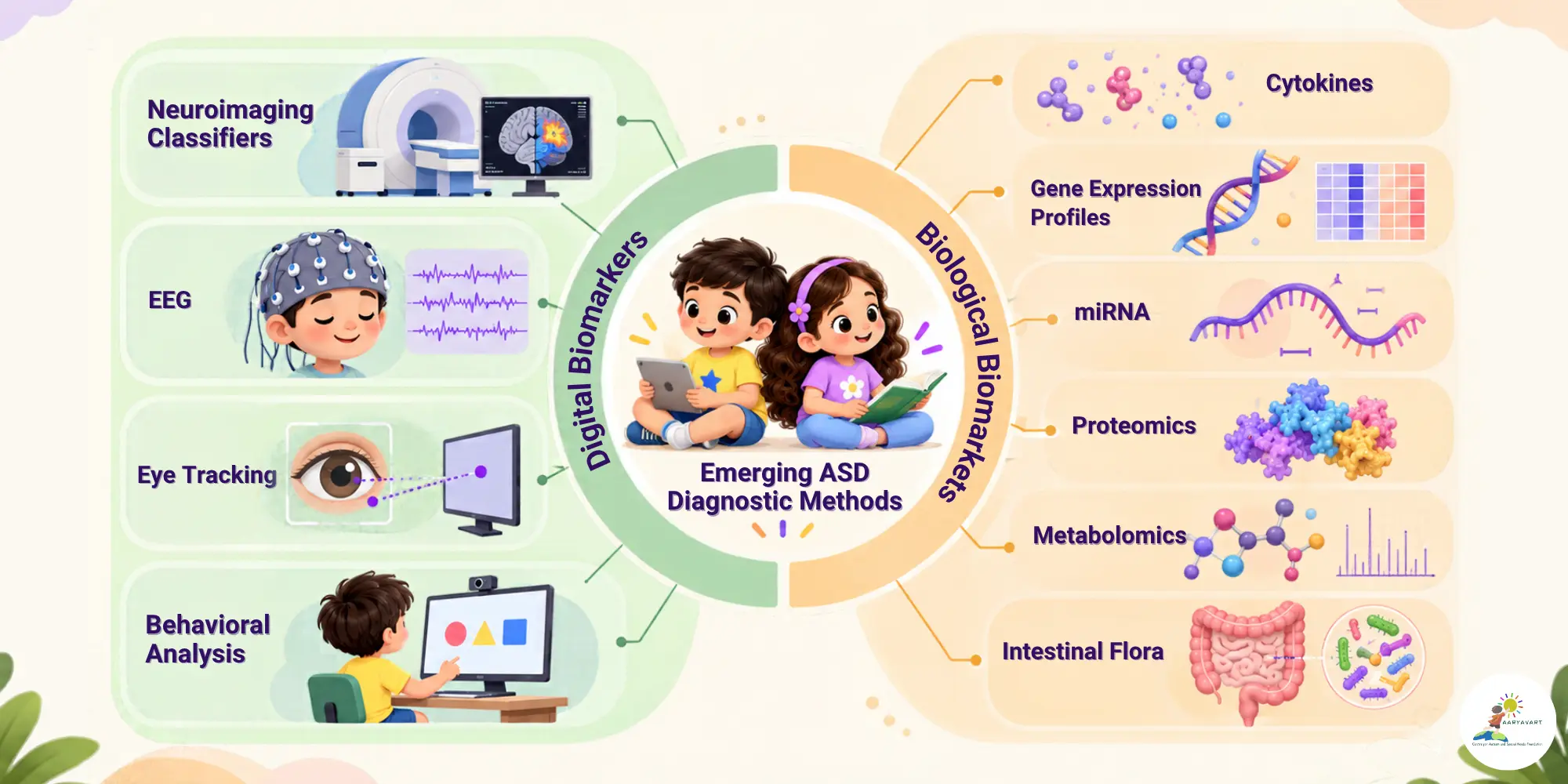
This is where digital biomarkers for autism are becoming important. They do not replace a doctor, therapist, or developmental assessment. But they can add objective information through tools like eye tracking, video-based behaviour analysis, facial expression tracking, voice patterns, movement data and AI-supported screening.
Quick Answer: Digital biomarkers for autism are measurable behaviour signals collected through digital tools. They may help identify early autism-related patterns, but they are not a final diagnosis. If your child shows developmental concerns, the right next step is a professional autism assessment and therapy roadmap.
If you are worried about your child's development, you can start with Aaryavart's autism therapy and assessment support or begin with online autism therapy and screening.
What Are Digital Biomarkers for Autism?
A biomarker is a measurable sign that can give useful health or developmental information. In autism, there is no single blood test or scan that confirms autism. Diagnosis is still based on developmental history and behaviour, according to the CDC.
Digital biomarkers are different from medical blood markers. They are behaviour-based signals captured through technology.
Examples include:
- Where a child looks during a video
- How long the child looks at faces or eyes
- Whether the child responds to name
- Facial expressions during social scenes
- Head movement and attention shifts
- Speech, sound or vocal patterns
- Repetitive movement patterns
- Parent-reported developmental data through apps or screeners
In simple words, digital biomarkers help measure behaviours that parents and clinicians may already notice, but in a more structured and objective way.
Why Are Digital Biomarkers Being Used in Autism Screening?
Traditional autism screening often depends on parent questionnaires and clinician observation. These are important, but some early signs can be subtle, especially in toddlers, girls, or children with mild social communication differences.
The CDC says children should be screened for developmental delays at 9, 18 and 30 months, and specifically for autism at 18 and 24 months. Additional screening may be needed earlier if symptoms are present.
Digital biomarkers are being studied because they may support early autism screening in three useful ways.
They Add Objective Data
Parents often say, "Sometimes my child looks at me, sometimes they don't. I am confused."
Digital tools can measure patterns more consistently. For example, eye tracking can show whether a child looks more at objects than faces, or whether they follow social scenes differently from other children.
This does not prove autism by itself, but it adds another layer of information.
They May Help With Earlier Identification
NIMH has highlighted research on tablet-based digital autism screening tools that analyze behaviours such as gaze patterns, facial expressions, head movement, blink rate and response to name. The goal is to improve early screening and reduce delays in identification.
For parents, the value is simple: if technology helps identify risk earlier, families can move faster toward assessment and early support.
They Can Reduce "Wait and Watch" Confusion
Many parents delay assessment because relatives say, "He will speak later," or "She is just shy."
Digital autism screening cannot give a final answer, but it can help parents take concerns seriously. If screening suggests risk, the next step should be a professional developmental assessment, not panic and not delay.
Types of Digital Biomarkers Used in Autism Screening
Digital biomarkers for autism can come from different tools. The most useful ones for parents to understand are eye tracking, video behaviour analysis, speech patterns and movement markers.
Eye Tracking Biomarkers
Eye tracking autism screening measures where a child looks, how long they look, and how they shift attention between people, objects and social scenes.
This matters because many autistic children show differences in social attention, eye contact and joint attention. For example, they may not consistently look where someone is pointing, follow gaze, or focus on faces during interaction.
If your concern is mainly poor eye contact, read Aaryavart's guide on poor eye contact in toddlers.
Video-Based Behaviour Biomarkers
Video-based tools may observe how a child responds to social videos, name calls, facial expressions, gestures or movement cues.
NIMH describes digital tools that use a tablet camera and AI to capture several behaviours together, such as gaze, facial expressions, head movement and response to name.
This is useful because autism is not identified through one behaviour alone. It is the pattern across communication, social interaction, behaviour, sensory needs and development that matters.
Speech and Voice Biomarkers
Some digital tools study vocal patterns, speech delay, sound production, rhythm, response to language and communication attempts.
For parents, this is especially relevant when a child:
- Is not speaking as expected
- Uses very few words
- Repeats words or phrases
- Does not use language socially
- Struggles to follow simple instructions
If speech delay is your main concern, Aaryavart's autism therapy services can help you understand whether your child needs speech therapy, autism assessment, occupational therapy, or a combined plan.
Movement and Motor Biomarkers
Movement-based digital biomarkers may look at repetitive movements, body posture, motor coordination, gesture use, or activity patterns.
These signals are not enough to diagnose autism, but they can support a broader developmental picture, especially when combined with speech, social and sensory concerns.
Parent-Reported Digital Data
Some digital screening tools use parent answers about milestones, behaviour, play, communication and daily routines.
These are helpful because parents see the child in real life, not just inside a clinic. But parent-reported tools should still be interpreted carefully, especially if the child has speech delay, ADHD-like attention issues, hearing concerns, sensory challenges, or developmental delay.
For a broader screening explanation, read Aaryavart's guide on autism screening test for toddlers.
Can Digital Biomarkers Diagnose Autism?
No. Digital biomarkers alone should not be treated as a final autism diagnosis.
They can support screening, identify risk, and guide whether a child needs further assessment. But autism diagnosis still requires professional evaluation, developmental history, clinical observation and specialist judgement.
The CDC clearly states that diagnosing autism can be difficult because there is no medical test, such as a blood test, to diagnose autism. Doctors look at developmental history and behaviour.
So if a digital tool shows concern, it should be seen as a starting point. The next step is a full developmental assessment.
How Accurate Are Digital Autism Screening Tools?
The research is promising, but accuracy depends on the tool, age group, setting, dataset, and how the result is interpreted.
A JAMA Network Open study found that a composite eye-tracking biomarker had 78% sensitivity and 77% specificity. When combined with primary care clinician diagnosis and certainty, performance improved to 91% sensitivity and 87% specificity.
This tells us two important things:
- Digital biomarkers can add useful information.
- They work best when combined with clinical judgement, not used alone.
NIMH also notes that digital screening should be part of a multi-step pathway that includes parent questionnaires, objective tools, clinical judgement and links to support services.
What Should Parents Do If a Digital Screening Shows Risk?
A risk result is not a label. It is a signal to take the next step.
Here is the responsible path:
- Do not panic over one result.
- Do not ignore repeated concerns.
- Book a professional developmental assessment.
- Share your observations clearly with the specialist.
- Ask for a therapy roadmap, not just a label.
- Start support early if speech, behaviour, sensory or social concerns are present.
If your child has signs such as poor eye contact, no response to name, delayed speech or repetitive behaviours, you can also read Aaryavart's guide on early signs of autism in toddlers.
How Aaryavart Uses Screening to Guide the Next Step
At Aaryavart Centre, screening is not used as a shortcut to diagnosis. It is used to help families move from confusion to clarity.
Aaryavart combines:
- Parent concerns
- Developmental history
- Therapist observation
- Screening inputs
- Speech and communication review
- Sensory and behaviour concerns
- Daily routine challenges
- Therapy planning
After assessment, the child may be guided toward autism therapy, speech therapy, occupational therapy, ABA-based support, parent training, online autism therapy, or a home development program.
Families can visit Aaryavart centres in Lucknow, Gorakhpur, and Unnao, or start with online autism therapy and screening.
Digital Biomarkers vs Traditional Autism Screening
Both have value. The best approach is not "technology versus clinician." It is technology plus clinical judgement.
Traditional autism screening may include:
- Parent questionnaires
- Developmental history
- M-CHAT-R/F
- Clinical observation
- Speech and language review
- Occupational therapy review
- Behaviour and play observation
Digital autism screening may include:
- Eye tracking
- Facial expression analysis
- Video behaviour analysis
- Movement patterns
- Speech or vocal pattern data
- AI-supported risk scoring
Best use: digital biomarkers can support early concern detection, while professional assessment decides the care plan.
Where Sarya Fits After Screening and Therapy Planning
Digital biomarkers may help identify developmental concerns, but parents also need daily tools to support progress at home.
This is where Sarya can help. Sarya is a visual schedule app for autism, ADHD and neurodiverse children that supports daily routines, ADL skills, visual steps, voice prompts and progress tracking.
After a child's assessment, families can use Sarya to support:
- Morning routines
- Brushing and bathing
- Dressing
- Mealtime routines
- School preparation
- Therapy home practice
- Bedtime routines
- Daily living skills
For autism-specific routine support, explore the Sarya autism app. For children who also struggle with attention, transitions and executive function, explore the Sarya ADHD app.
Sarya does not replace assessment, therapy or medical guidance. It supports home follow-through between therapy sessions.
When Should Parents Seek an Autism Assessment?
You should consider an autism assessment if your child shows a cluster of concerns, especially if they continue over time.
Watch for:
- Poor eye contact
- Not responding to name
- Delayed speech
- Limited gestures or pointing
- Limited pretend play
- Repetitive actions
- Strong resistance to change
- Sensory sensitivity
- Frequent meltdowns
- Limited social interaction
- Regression of words or skills
The AAP recommends autism-specific screening at 18 and 24 months, but parents should not wait if concerns appear earlier.
Final Takeaway
Digital biomarkers for autism are a promising part of early autism screening. They can help measure behaviours such as eye gaze, facial expressions, movement, speech patterns and response to social cues.
But they are not a final diagnosis.
The real value comes when digital screening leads to the right next step: professional assessment, clear therapy planning, parent guidance and early support.
If you are worried about your child's speech, eye contact, behaviour, sensory needs or social development, start with an assessment. Aaryavart can help you understand your child's needs and build a practical therapy roadmap.
Book an Autism Assessment at Aaryavart Centre.
Digital Biomarkers for Autism FAQs
What are digital biomarkers for autism?
Digital biomarkers for autism are measurable behaviour signals collected through digital tools. These may include eye gaze, facial expression, movement, speech patterns, attention shifts and response to name.
Can digital biomarkers detect autism early?
They may help identify autism-related risk earlier, especially when combined with parent concerns and clinical screening. They cannot confirm autism alone.
Is eye tracking useful for autism screening?
Yes, eye tracking can be useful as an additional screening tool because it measures how a child looks at faces, people, objects and social scenes. It should be interpreted by professionals.
Can AI diagnose autism?
No. AI can support autism screening and risk identification, but autism diagnosis still requires a professional developmental evaluation.
Are digital autism screening tools accurate?
Some tools show promising results, but accuracy varies. Digital screening is strongest when combined with parent questionnaires, clinical observation and specialist judgement.
What should I do if my child shows risk on a digital autism test?
Book a professional developmental assessment. A screening result should guide you toward evaluation, not be treated as a final diagnosis.
Does Aaryavart provide autism screening and assessment?
Yes. Aaryavart supports families with autism screening, developmental assessment, therapy planning, centre-based therapy and online autism support.
Are digital biomarkers better than M-CHAT?
Not necessarily. They answer different parts of the screening picture. A combined approach is better: parent questionnaires, clinical observation, developmental history and digital screening data where appropriate.
Can digital biomarkers help after diagnosis?
They may help track patterns and support therapy planning in some settings, but day-to-day progress still depends on a structured therapy plan, parent guidance and consistent home practice.
Can Sarya help after autism screening?
Yes. After assessment and therapy planning, Sarya can help parents build visual routines, ADL practice, voice-guided steps and progress tracking at home. It is a support tool, not a diagnostic or therapy replacement.