Poor Eye Contact in Toddlers: Is It a Sign of Autism, and What Should Parents Do?
Is your toddler avoiding eye contact? Learn what it may mean, other signs to watch for, and how to get an expert developmental assessment near you.

You call your toddler's name across the room, and they don't look up. During playtime, they seem to look past you rather than at you. If you've found yourself wondering about poor eye contact in toddlers, you're not alone — and you're not overreacting. Eye contact is one of the earliest tools children use to connect socially, and its absence is often the first thing parents notice, sometimes even before language delays become obvious.
This guide breaks down what the research actually says about eye contact and autism, what else to look for, and how to move from concern to clarity — including how Aaryavart Centre can help you get a professional answer.
When Does Eye Contact Typically Develop in Toddlers?
Eye contact isn't something children learn overnight — it develops in stages from infancy. According to developmental research summarized by Healthline, babies typically make eye contact with other people from a very young age, and by 2 months, infants can typically locate faces and make eye contact skillfully, with eye contact later becoming a way of building social relationships and gaining information about their surroundings.
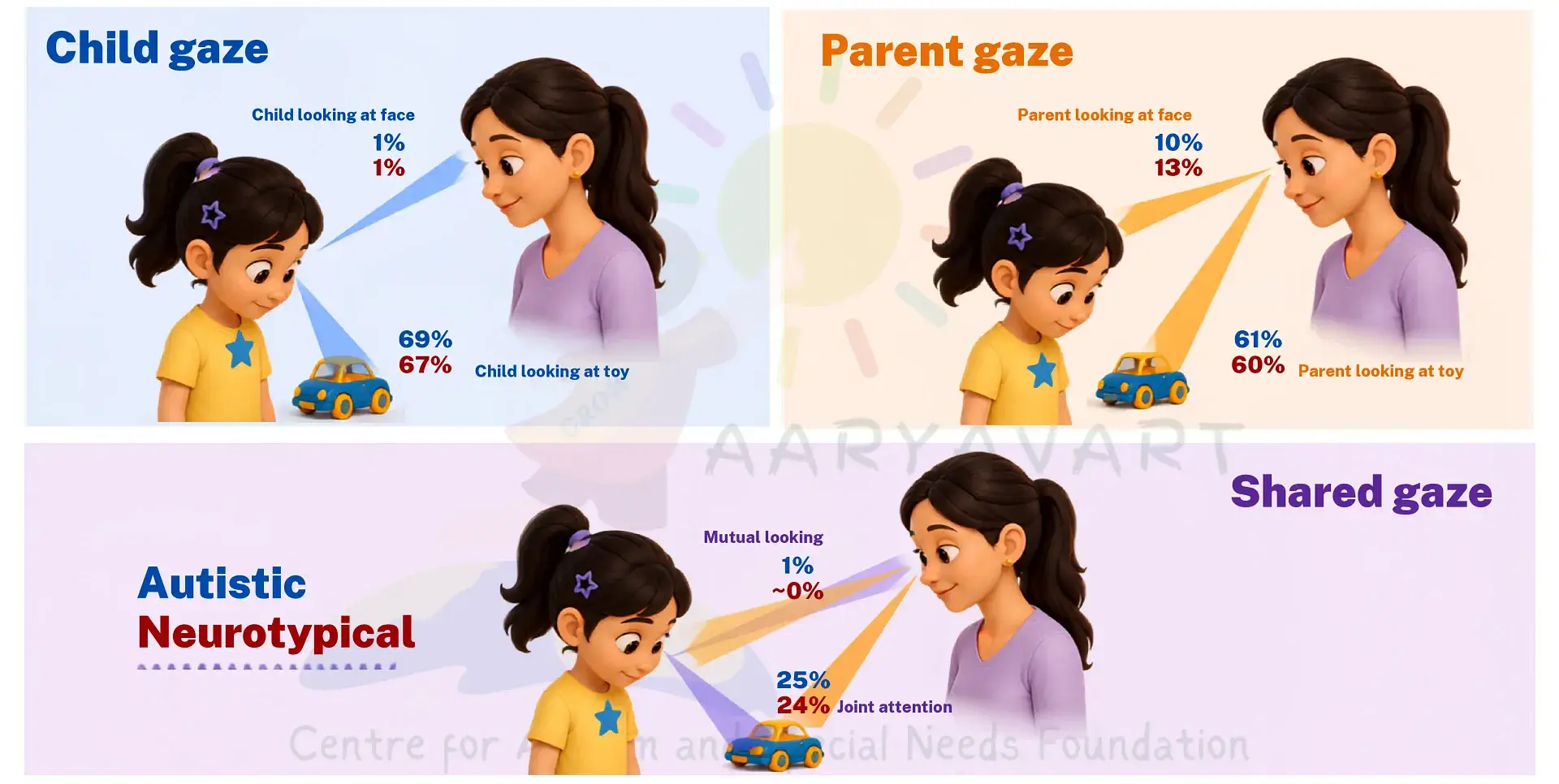
By toddlerhood (12–24 months), most children use eye contact purposefully — checking in with a caregiver during play, following where an adult is looking (called joint attention), and making eye contact while requesting something they want. If your toddler rarely does any of this, it's worth paying closer attention — not panicking, but paying attention.
Is Poor Eye Contact Always a Sign of Autism?
No — and this is the most important nuance for parents to understand. Reduced eye contact can stem from shyness, temperament, fatigue, or simply being absorbed in an activity. As one parent-focused clinical resource explains, some toddlers avoid eye contact simply because they are shy or focused on something else, though by six to nine months many children are using eye contact to connect — smiling back at a parent, seeking reassurance, or engaging during playtime.
That said, research does confirm a real association. The same source notes that avoiding eye contact can sometimes be an early sign of autism spectrum disorder, but it's never the only indicator — meaning it should always be considered alongside other developmental signs, not in isolation.
Why Some Autistic Toddlers Struggle With Eye Contact
For years, researchers debated whether autistic children avoid eye contact because they find it distressing, or simply because they don't register its social importance. A study from Marcus Autism Center helped resolve this question. Their research found that young children with autism do not actively avoid eye contact on purpose, and other people's eyes are not aversive to young children with autism — instead, they miss the significance of social information in others' eyes.
This matters for how parents and therapists respond. As lead researcher Warren Jones put it, if children with autism dislike making eye contact, treatments could incorporate ways to alleviate the discomfort, but if eye contact is merely unimportant to the children, parents and therapists could help them understand why it is important in typical social interactions.
Even more strikingly, eye contact differences may begin far earlier than most parents realize. A landmark longitudinal study following infants from birth found that researchers describe measurable decreases in eye contact between 2 and 6 months of age in babies who went on to develop autism spectrum disorder, with these babies starting out with typical eye-gaze patterns before showing steady month-by-month decline — a pattern not seen in babies who did not develop autism. This is exactly why early, ongoing observation — not a single moment of judgment — is so valuable.
Other Signs to Watch Alongside Poor Eye Contact
Poor eye contact rarely appears alone. Clinical guidance recommends watching for a broader pattern, including:
- Limited gestures — reduced pointing, waving, or clapping
- Limited response to your gestures — not responding when you point or say "come here"
- Inconsistent response to name, especially by 12 months
- Reduced joint attention — not following your gaze or point when you're sharing interest in something
- Delayed or regressed speech
- Limited pretend play by 24 months
- Repetitive movements or strong resistance to routine changes
As one clinical resource summarizes, difficulty following simple instructions, or not responding to their name by looking up or towards you, along with not often following a parent's gaze or point when sharing interest in an object or activity, are additional signs worth watching alongside eye contact.
If you're noticing two or more of these alongside poor eye contact, this is a strong signal to move from observation to a professional developmental assessment — not a home checklist alone.
How Eye Contact Is Assessed in Professional Screening
Eye contact isn't just something a parent notices casually — it's a formally assessed item in validated autism screening tools. As one research summary on toddler eye-gaze studies confirms, lack of eye contact is among the earliest signs of autism, and its assessment is part of autism screening and diagnostic tools.
Traditionally, this assessment relied on clinician observation and parent-report questionnaires like the M-CHAT-R. But screening has evolved. Researchers have used objective eye-tracking technology in clinical studies — showing toddlers social videos and precisely measuring where and how long they look — to detect subtle gaze patterns that a caregiver might miss in daily life.
How AI and Eye-Tracking Technology Are Changing Early Screening
This is where modern developmental screening is moving beyond checklists alone. Eye tracking autism screening tools use the same principle as clinical research studies — measuring precisely where a toddler looks, for how long, and how their gaze shifts during social and non-social visual stimuli — to generate objective, data-backed indicators alongside clinical judgment.
Aaryavart Centre works with Aignosis, a technology partner that supports AI-based developmental screening and game-based, non-invasive tools designed to help families identify early developmental concerns through measurable, objective data rather than relying on observation alone. Unlike a one-time checklist, Aignosis eye gaze tracking technology captures naturalistic gaze behavior in a low-pressure, game-like format that toddlers respond well to — giving parents and clinicians an additional, objective layer of information before deciding on next steps.
This doesn't replace a clinical evaluation — but it can meaningfully strengthen the picture your child's care team is building, especially in the earliest, most ambiguous stages when parents are unsure whether what they're seeing needs a formal assessment.
What to Do If Your Toddler Avoids Eye Contact
If you've noticed persistent poor eye contact — with or without other signs — here's the responsible path forward:
- Track the pattern, don't panic over a single moment. Note when it happens (playtime, name-calling, mealtimes) and whether other social signs are also present.
- Don't wait for the next well-child visit if your concern is building. Early evaluation shortens the path to support.
- Get a comprehensive developmental assessment — combining clinical observation with tools like eye-tracking screening for a fuller picture.
- Start early intervention conversations immediately, even before a final diagnosis. Speech, sensory, and social engagement therapy can often begin in parallel with evaluation.
Book a free child assessment or message us on WhatsApp if you'd like expert guidance today.
How Aaryavart Centre Supports Families Through This Journey
Aaryavart Centre for Autism and Special Needs Foundation works with families across Lucknow, Gorakhpur, Unnao, and online across India and abroad. Our approach to concerns like poor eye contact includes:
- Comprehensive developmental assessment by child psychologists and a paediatric neurologist, combining clinical observation with structured screening tools
- AI-assisted, game-based screening through our technology partner Aignosis, supporting objective, early identification of gaze and attention patterns
- Therapy planning and clinician workflows supported by Kidaura, our technology partner for digital assessment documentation and structured therapy planning
- Speech therapy, occupational therapy, and ABA-based social engagement therapy designed around your child's specific needs — see our full Services
- Parent training and a structured Home Development Program, so you have simple, guided ways to build connection and joint attention at home
- Progress tracking through the Sarya app, keeping you updated on goals, activities, and milestones between sessions
We're a government-registered NGO trusted by 1,500+ families — many of whom first came to us after noticing exactly this: a toddler who just wasn't quite meeting their eyes the way they expected.
Get a Free Assessment for Your Toddler →
Poor Eye Contact in Toddlers FAQs
Is poor eye contact always a sign of autism in toddlers?
No. Reduced eye contact can occur due to shyness, temperament, tiredness, or absorption in an activity. It becomes a more meaningful signal when it appears consistently alongside other signs like limited gestures, delayed speech, or reduced response to name — which is why a professional assessment, not a single observation, gives the clearest answer.
At what age should my toddler be making regular eye contact?
Many children begin using eye contact socially — smiling back, seeking reassurance, checking in during play — by six to nine months, with more purposeful use (like joint attention) developing through the second year. If your toddler rarely does this by 18–24 months, it's worth discussing with a developmental specialist.
Do autistic children avoid eye contact because it's uncomfortable?
Research is mixed and evolving. Some studies suggest young children with autism don't actively avoid eye contact due to discomfort but rather don't register its social significance, while some autistic adults report finding eye contact genuinely stressful. Both experiences are valid and inform different therapeutic approaches.
What other signs should I watch for alongside poor eye contact?
Look for reduced response to name, limited pointing or gesturing, reduced joint attention (not following your gaze), delayed or regressed speech, and limited pretend play. A cluster of these signs is more meaningful than eye contact alone.
How is eye contact assessed in a professional autism screening?
Clinicians assess eye contact through structured observation and parent-report tools like the M-CHAT-R. Increasingly, objective eye-tracking technology is also used to measure gaze patterns precisely, offering data-backed insight alongside clinical judgment.
Can technology like eye-tracking really help detect autism early?
Eye-tracking based screening tools, including those used by Aaryavart's technology partner Aignosis, measure gaze behavior objectively and can support earlier identification of developmental concerns. These tools are designed to complement — not replace — a full clinical evaluation.
My toddler makes eye contact sometimes but not consistently — should I be worried?
Inconsistent eye contact alone is common in many typically developing toddlers, especially when tired, shy, or engrossed in play. If this inconsistency is paired with other social communication differences, a professional assessment can give you clarity rather than continued uncertainty.
Where can I get my toddler assessed for eye contact and developmental concerns in India?
Aaryavart Centre offers in-person assessments at our Lucknow, Gorakhpur, and Unnao centres, as well as online assessments for families across India and abroad. Book your free assessment.