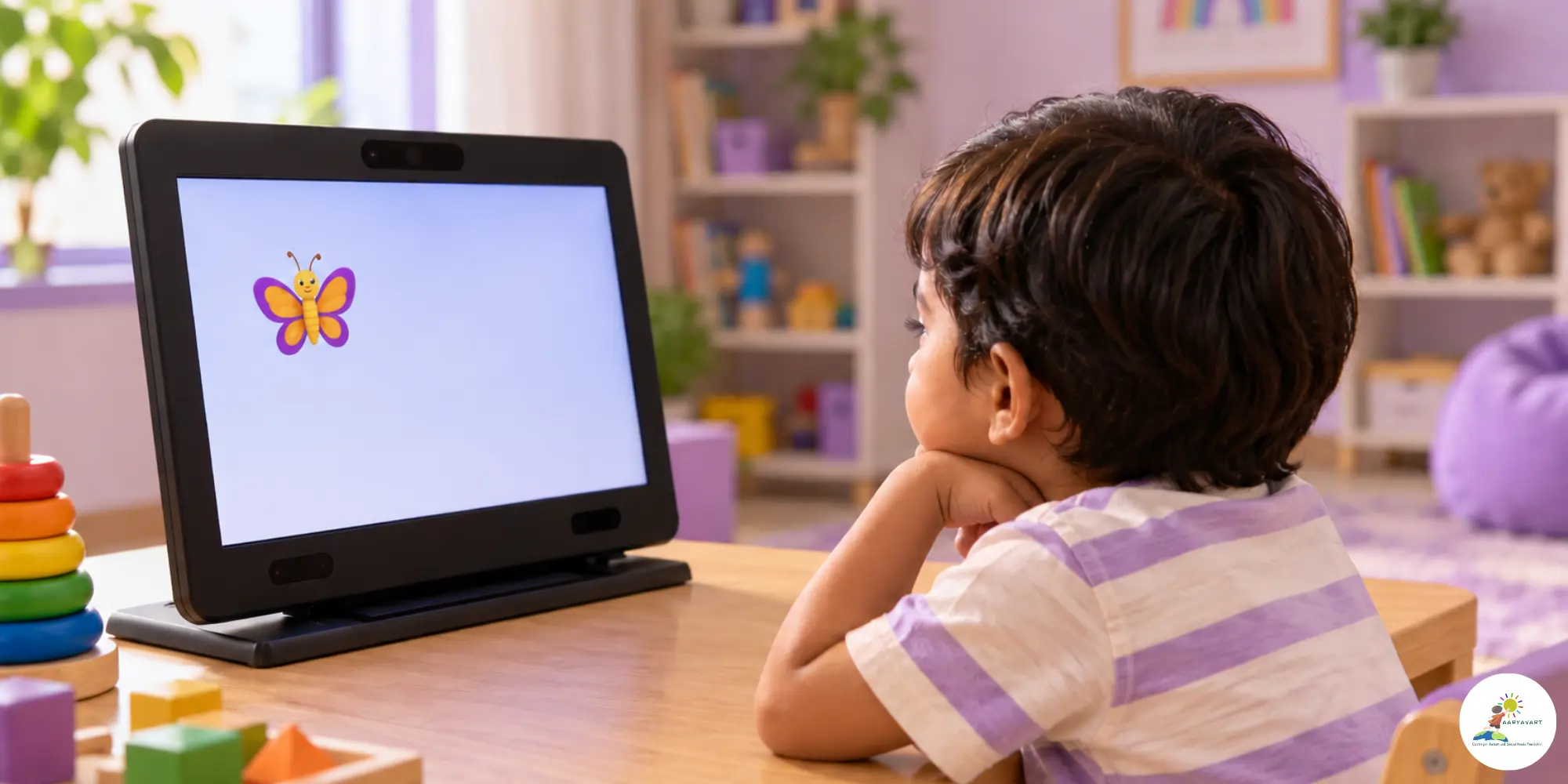
Eye Tracking Autism Screening: Can It Help Detect Early Signs?
Learn how eye tracking autism screening works, what it can and cannot diagnose, and when to book a child development assessment at Aaryavart.

If your child avoids eye contact, does not respond to name, watches objects more than people, or seems delayed in speech and social interaction, you may wonder if technology can give you an early answer.
Eye tracking autism screening is a newer screening approach that studies where a child looks, how long they look, and how they respond to social information on a screen. It can help identify autism-related gaze and attention patterns, but it cannot confirm autism on its own.
The responsible next step after any screening concern is a professional child development assessment, where experts review your child’s communication, behaviour, sensory needs, play, learning, and daily living skills.
What is Eye Tracking Autism Screening?
Eye tracking autism screening is a technology-assisted method that measures a child’s gaze while they watch videos, pictures, games, faces, or social scenes.
The tool may track:
- Whether the child looks at faces or objects
- Whether they look at the eyes, mouth, or moving parts of a scene
- How long they attend to social information
- How their gaze shifts between people, objects, and movement
- Whether their visual attention pattern suggests developmental risk
Research shows that many autistic children may process social visual information differently. A systematic review found eye tracking promising as a diagnostic or predictive tool, but also warned that interpretation should be cautious because methods and validation differ across studies.
Why Eye Movement Matters in Autism Screening
Eye movement matters because autism often affects social communication, and gaze is one way children learn from people around them.
A child’s gaze can show how they attend to faces, follow social cues, respond to shared attention, and notice people during everyday interaction. But one sign alone, such as poor eye contact, does not diagnose autism.
Poor eye contact becomes more meaningful when it appears with:
- Speech delay
- Not responding to name
- Limited gestures or pointing
- Limited social interaction
- Repetitive behaviours
- Sensory sensitivity
- Frequent meltdowns
- Delayed milestones
CDC describes autism as a developmental disability that can affect how people communicate, interact, behave, and learn. CDC also notes that some children show symptoms within the first 12 months, while others show symptoms later.
Related guide: poor eye contact in toddlers
How Does an Eye Tracking Autism Test Work?
Different tools work differently, but most eye tracking autism tests follow a similar parent-friendly process.
Step 1: The Child Watches a Screen-Based Activity
The child may watch videos, faces, animations, social scenes, or simple interactive tasks.
The goal is not to “test” the child like an exam. The goal is to observe natural looking patterns in a structured setting.
Step 2: The System Records Gaze Patterns
A camera, webcam, or eye-tracking device measures where the child looks and for how long.
This can help identify whether the child is attending more to social cues, objects, movement, or non-social visual details.
Step 3: The Tool Flags Developmental Risk
The system may use gaze patterns, behavioural markers, or AI-based analysis to flag whether a child may need a closer developmental evaluation.
For example, NIH reported a tablet-based app study where a screening tool measured eye gaze, facial expressions, attention, head movement, and other behaviours in toddlers during well-child visits. The app correctly identified about 88% of children later diagnosed with autism in that study, but larger studies were still needed across diverse populations.
Step 4: A Professional Reviews the Next Step
This is the most important part.
An eye tracking screen should not end with a score alone. Parents need expert interpretation, developmental history, child observation, and a clear next step.
At Aaryavart, families can start with child development assessment, where the team reviews speech, behaviour, sensory needs, social interaction, play, learning readiness, and daily living skills before suggesting therapy or home support.
Can Eye Tracking Diagnose Autism?
No. Eye tracking alone should not be presented as a final autism diagnosis.
Eye tracking can support screening or act as a diagnostic aid in some settings, depending on the tool, child’s age, testing conditions, and professional interpretation. But autism diagnosis still needs a comprehensive developmental evaluation.
CDC says autism is diagnosed by looking at a child’s behaviour and development, and there is no medical test like a blood test to diagnose autism. CDC also says diagnosis by an experienced professional can be considered reliable by age 2, although many children are diagnosed later.
FDA’s device classification for pediatric autism spectrum disorder diagnosis aids also describes these tools as aids in diagnosis, not replacements for qualified professionals.
Eye Tracking vs M-CHAT-R: Which Is Better?
Parents often hear about both M-CHAT-R and eye tracking. They are not the same, and one does not fully replace the other.
M-CHAT-R is a parent questionnaire used for autism screening in toddlers. It depends on parent responses about everyday behaviour.
Eye tracking measures visual attention more directly. It may capture subtle gaze patterns that parents may not notice at home.
A simple way to understand the difference:
- M-CHAT-R asks what parents observe.
- Eye tracking measures where the child looks.
- A professional assessment explains what the signs mean.
- Therapy planning decides what to do next.
Best approach: use screening tools as starting points, then move to professional assessment if concerns remain.
What Research Says About Eye Tracking and Autism
Research on eye tracking and autism is promising, but it is not a magic shortcut.
Studies suggest that some autistic children show different social visual engagement, such as reduced attention to faces, eyes, or social information in videos. NIH has also covered research on digital screening tools that measure gaze and behaviour to support earlier identification.
At the same time, parents should know the limitation: eye tracking tools are not yet a universal standalone screening method. One systematic review concluded that eye tracking shows potential as a non-invasive way to study early visual attention patterns, but also reported that low pooled sensitivity in some analyses means current measures could miss some autistic children if used alone.
So the safest interpretation is this:
Eye tracking autism screening can add useful information, but it should be combined with developmental history, parent concerns, clinical observation, and expert assessment.
When Should Parents Consider Eye Tracking Autism Screening?
Parents should consider screening when concerns repeat across daily life, not because of one isolated moment.
Screen may be useful if your child shows:
- Poor eye contact
- Speech delay
- Not responding to name
- Limited pointing or gestures
- Repetitive actions
- Sensory sensitivity
- Frequent meltdowns
- Limited pretend play
- Difficulty with social interaction
- Loss of previously learned words or skills
If you notice several of these signs together, do not wait in confusion. Screening can help you decide whether a detailed child development assessment is needed.
Related guides: early signs of autism in toddlers and child not responding to name
What Happens After an Eye Tracking Screening Result?
The result is only useful if it leads to the right next step.
If the result suggests concern:
- Do not panic
- Book a professional developmental or autism assessment
- Share the screening report with the specialist
- Track speech, response to name, play, sensory issues, and daily routines
- Start early support if concerns are clear
If the result does not suggest concern:
- Continue monitoring milestones
- Speak to a professional if your concern remains
- Remember that screening tools can miss some children
- Do not ignore persistent parent instinct
CDC says early intervention services can greatly improve development, and parents should contact a doctor if they have concerns about how a child plays, learns, speaks, or acts.
Book Autism Assessment before its too late.
How Aaryavart Uses Technology Alongside Clinical Care
Aaryavart’s approach is not “technology instead of experts.” It is technology plus expert review.
Aaryavart’s assessment explains that screening tools may help identify early concerns, but the next step is expert review through parent discussion, child observation, developmental review, and therapy planning.
Aaryavart also works with technology-supported pathways:
- Aignosis supports AI-based developmental screening and game-based autism screening tools that can help identify early concerns. Its website describes a process where a child watches a short video and the system identifies developmental biomarkers in about 5 minutes.
- Kidaura supports digital child development and therapy workflows. India’s Science, Technology & Innovation portal describes Kidaura’s ScreenPlay as a digital screening tool for children aged 3 to 6 who may be at risk of autism or another developmental condition.
- Sarya supports the post-assessment journey with visual routines, daily structure, ADL skills, voice prompts, and progress tracking for autistic, ADHD, and neurodiverse children.
After screening, families can use tools like Sarya’s autism app for visual schedules and daily routine support, but home tools should not replace professional assessment, speech therapy, occupational therapy, or autism therapy when those are needed.
Eye Tracking Screening Is a First Step, Not the Finish Line
Eye tracking autism screening can help parents move from doubt to action. But the goal is not just to get a score. The goal is to understand the child and start the right support.
After screening, your child may need:
You can register for Aaryavart’s child development assessment, available online and at Aaryavart centres in Lucknow, Gorakhpur, and Unnao
CDC notes that autism treatment plans are individualized and may include behavioural, developmental, educational, social-relational, and other approaches depending on the child’s needs. CDC also lists speech-language therapy and occupational therapy as common developmental supports for autistic people.
Final Takeaway
Eye tracking autism screening can be a helpful way to identify early developmental risk, especially when parents are unsure whether poor eye contact, speech delay, sensory issues, or social communication concerns need expert review.
But eye tracking is not a final diagnosis. It should be treated as a first step toward clarity.
If your child has poor eye contact, does not respond to name, has delayed speech, shows repetitive behaviours, or struggles with sensory issues, start with a professional assessment.
Book Child Development Assessment for your child today with Aaryavart
Eye Tracking Autism Screening FAQs
Is eye tracking autism screening accurate?
Eye tracking can provide useful information about gaze and social attention patterns, but it should not be used alone to confirm autism. Accuracy depends on the tool, child’s age, test conditions, and professional interpretation.
Can eye tracking diagnose autism?
No. Eye tracking can support screening or act as a diagnostic aid in some settings, but autism diagnosis needs a comprehensive evaluation by qualified professionals.
What does eye tracking measure in autism screening?
It may measure where the child looks, how long they look, whether they attend to faces or eyes, and how they respond to social versus non-social information.
Is poor eye contact always autism?
No. Poor eye contact can happen for many reasons. It becomes more concerning when seen with speech delay, not responding to name, limited gestures, repetitive behaviours, sensory sensitivity, or delayed milestones.
What age is eye tracking autism screening useful for?
Research has studied infants, toddlers, and preschool children, but age suitability depends on the tool. Parents should ask whether the screening method is appropriate for their child’s age.
Is eye tracking better than M-CHAT-R?
Not exactly. M-CHAT-R is a parent questionnaire, while eye tracking measures visual attention. They can complement each other, but neither replaces a professional developmental assessment.
What should I do after an eye tracking screening shows risk?
Book a professional child development or autism assessment. Screening shows possible risk, while assessment explains what support your child may need.
Does Aaryavart provide eye tracking autism screening?
Aaryavart uses technology-supported developmental screening pathways with partners such as Aignosis and Kidaura, along with expert-led child development assessment. Parents can contact Aaryavart to understand the right screening and assessment pathway for their child.
Can I start therapy before a final autism diagnosis?
In many cases, support for speech delay, sensory needs, behaviour concerns, parent training, and daily routines can begin while assessment is ongoing. The right plan depends on the child’s needs and professional guidance.
Where can I book an autism assessment?
You can start with Aaryavart’s child development assessment, available online and at Aaryavart centres in Lucknow, Gorakhpur, and Unnao.