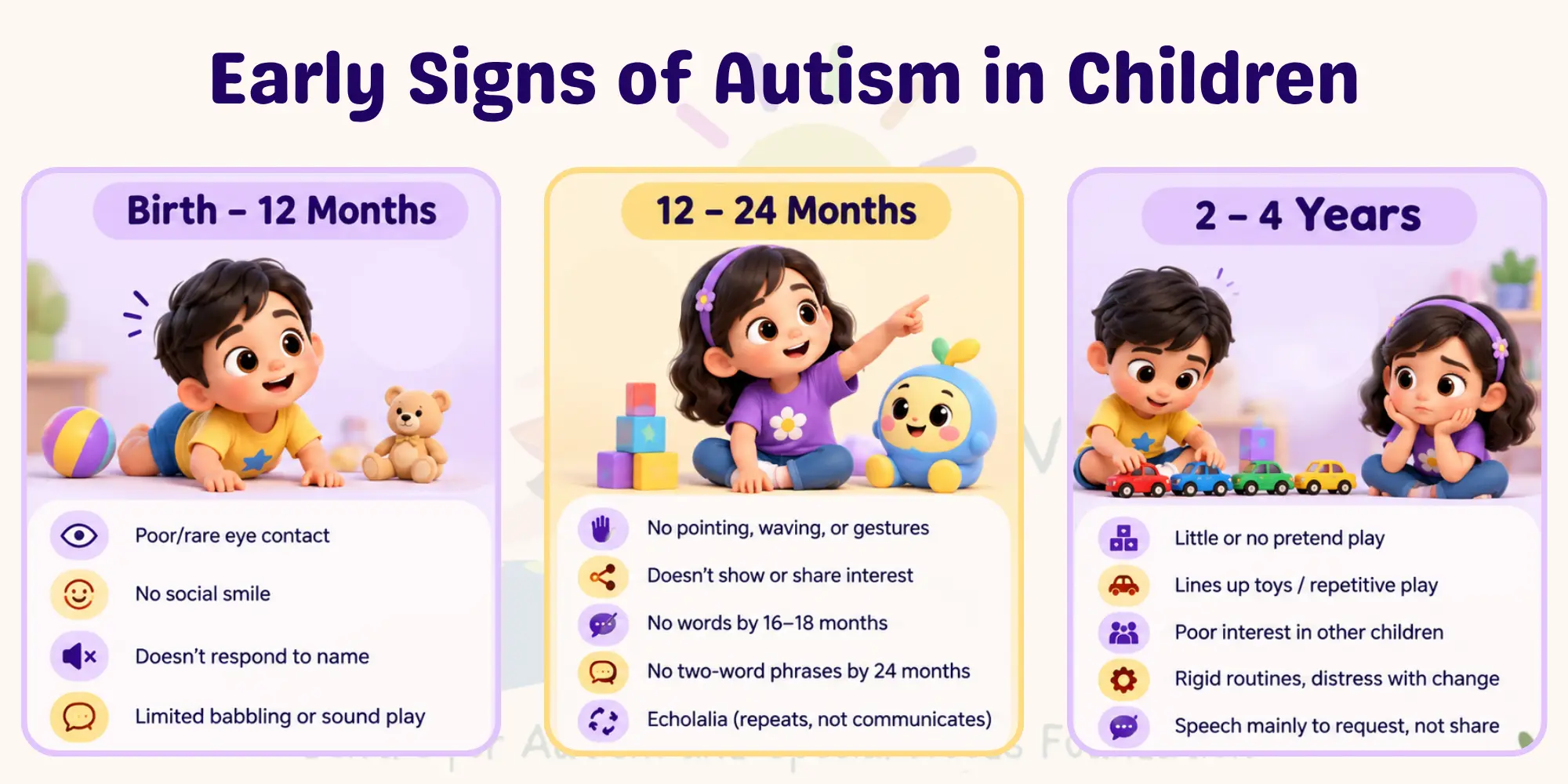
Early Signs of Autism in Children: Parent Guide
Learn early signs of autism in children, including speech delay, poor eye contact, no response to name, sensory issues and when to book assessment.

Many parents first notice something small.
Their child may not respond when called by name. They may avoid eye contact, speak late, repeat the same action, play alone, line up toys, or become very upset when a routine changes.
One sign alone does not confirm autism. But when several signs appear together and affect communication, play, behaviour, sensory response, or daily routines, parents should take it seriously.
Autism spectrum disorder is a developmental condition linked with differences in the brain. The CDC explains that autistic children may have challenges with social communication and interaction, restricted or repetitive behaviours, and different ways of learning, moving, or paying attention.
The goal is not to panic or label your child too early. The goal is to observe carefully, understand the pattern, and get the right assessment if concerns continue.
If you are worried about your child’s development, you can start with Aaryavart Child Assessment.
What Are the Early Signs of Autism in Children?
Autism signs can look different in every child. Some children show signs in infancy, while others appear to develop typically and then show clearer differences around 18 to 24 months.
The CDC says autism begins before age 3, and some children show symptoms within the first 12 months, while others may show signs later. Some children may also stop gaining new skills or lose skills they had earlier.
Social Communication Signs
Social communication signs are often the first area parents notice, but they may also be easy to miss. A child may hear sounds but not respond socially. They may play nearby but not share attention with others.
Possible signs include:
- Limited or inconsistent eye contact
- Not responding to name
- Not pointing to show something interesting
- Few gestures, such as waving or showing
- Limited facial expressions
- Not sharing enjoyment with parents
- Not bringing objects to show
- Limited interest in other children
- Difficulty joining play
- Limited pretend play
The CDC lists early social signs such as not responding to name by 9 months, few or no gestures by 12 months, not sharing interests by 15 months, and not pointing to show something interesting by 18 months.
Speech and Language Signs
Speech delay is one of the most common reasons parents seek help. But autism is not only about late speech. Parents should also notice how the child uses communication.
Possible signs include:
- No words or very few words
- Not using words to ask for things
- Pulling a parent’s hand instead of pointing or asking
- Repeating words or phrases again and again
- Not following simple instructions
- Not responding to simple social words like “bye”
- Speaking but not using language socially
- Difficulty answering or asking questions
If speech delay is a concern, the child may benefit from Speech Therapy and a broader child development assessment.
Behaviour and Play Signs
Autistic children may play differently. The concern is not one unusual play habit. The concern is when play becomes repetitive, restricted, or difficult to shift.
Possible signs include:
- Lining up toys repeatedly
- Spinning wheels instead of playing with the whole toy
- Playing the same way every time
- Getting upset if toy order changes
- Repeating the same movement
- Flapping hands, rocking, or spinning
- Strong attachment to routines
- Intense interest in specific objects or topics
- Difficulty shifting from one activity to another
The CDC lists repetitive behaviours such as lining up toys, repeating words or phrases, playing the same way every time, focusing on parts of objects, hand flapping, rocking, spinning, and getting upset by small changes.
Sensory Signs
Sensory signs are often misunderstood as stubbornness, fussiness, or bad behaviour. In many autistic children, the world may feel too loud, too bright, too rough, too unpredictable, or not stimulating enough.
Possible signs include:
- Covers ears during normal sounds
- Avoids certain clothes, tags, socks, or textures
- Strong food texture preferences
- Smells, licks, or mouths objects
- Seeks spinning, jumping, or deep pressure
- Avoids messy play
- Gets overwhelmed in crowded places
- Has unusual response to pain, light, sound, smell, taste, or touch
The CDC includes unusual reactions to sound, smell, taste, look, or feel among autism-related behaviours.
For sensory-related concerns, parents can explore Sensory Therapy and Occupational Therapy.
Early Signs of Autism by Age
Parents often ask, “At what age can autism signs appear?” The answer is that signs can appear early, but they may become clearer as social and communication expectations increase.
The American Academy of Pediatrics notes that early autism signs may appear in social and language development, especially in gestures, pretend play, and social language, while motor milestones like sitting, crawling, and walking may happen on time.
Signs in Babies Under 12 Months
In babies, autism signs can be subtle. Parents may feel that the baby is “too quiet,” “in their own world,” or not as socially responsive.
Possible signs include:
- Limited eye contact
- Less social smiling
- Limited response to name
- Limited babbling
- Less interest in interactive games
- Less back-and-forth interaction
- Limited facial expressions
- Does not look where parent points
These signs do not confirm autism by themselves, but they are worth discussing with a doctor or developmental professional if they continue.
Signs in Toddlers 12 to 24 Months
Toddler years are often when parents start noticing clearer social and communication differences.
Possible signs include:
- No meaningful words
- Does not point to show interest
- Does not bring objects to show parents
- Limited imitation
- Limited gestures
- Repetitive play
- Strong distress with changes
- Limited response to social interaction
- Plays alone most of the time
- Does not follow simple instructions
If your child is in this age range and you are unsure, read Autism Screening Test for Toddlers.
Signs in Preschool Children 2 to 5 Years
Preschool is when social play, speech, routines, and classroom readiness become more visible. Some children who were missed earlier may show clearer signs at this stage.
Possible signs include:
- Speech delay or unusual speech
- Limited pretend play
- Difficulty joining other children
- Repetitive questions or phrases
- Difficulty with change
- Sensory issues
- Meltdowns during transitions
- Strong preference for sameness
- Difficulty with group activities
- Trouble following classroom routines
CDC notes that ASD can sometimes be detected at 18 months or younger, and by age 2, a diagnosis by an experienced professional can be considered reliable.
Signs in School-Age Children
Some children, especially those with milder or masked signs, may not be identified until school age. This is often when social expectations become more complex.
Possible signs include:
- Difficulty making friends
- Very literal understanding
- Strong specific interests
- Social exhaustion
- Trouble with group play
- Sensory overload in school
- Difficulty with routine changes
- Anxiety around social expectations
- Difficulty understanding jokes or indirect language
- Needs extra support with daily routines
These children may be misunderstood as shy, rigid, inattentive, rude, or stubborn. A careful assessment can help understand what is really happening.
Is One Sign Enough to Suspect Autism?
A single sign is not enough to confirm autism. Many children may occasionally avoid eye contact, ignore their name, prefer solo play, or become upset with changes.
The concern increases when signs appear repeatedly and across different settings, such as home, school, play, social interaction, and daily routines.
One Sign Alone Does Not Confirm Autism
For example:
- A child may not respond to name because of hearing issues, attention difficulty, or being deeply focused.
- A child may speak late but still use gestures, eye contact, and social interaction well.
- A child may dislike loud sounds but not have social communication difficulties.
- A child may line up toys once in a while as part of normal play.
This is why assessment is important. Autism is diagnosed by looking at patterns in development, communication, social interaction, behaviour, sensory response, and daily functioning.
Patterns Matter More Than Isolated Traits
Parents should look for combinations of signs.
More concerning patterns may include:
- Speech delay plus poor response to name
- Limited eye contact plus no pointing
- Repetitive play plus sensory distress
- Difficulty with change plus limited social interaction
- Few gestures plus limited sharing of interest
- Frequent meltdowns plus rigid routines
If your main confusion is whether the concern is autism or only speech delay, read Autism vs Speech Delay.
Autism Signs vs Speech Delay: What Is the Difference?
Speech delay and autism can overlap, but they are not the same. Some children with speech delay are socially engaged and communicate well through gestures, expressions, and play. Some autistic children may speak, but still struggle with social communication.
| Speech Delay | Possible Autism Signs |
|---|---|
| Child wants to communicate but speaks late | Child may not use gestures, pointing, or shared attention |
| Uses eye contact and expressions socially | May avoid eye contact or not respond to name |
| Uses gestures to compensate | Limited gestures or limited social sharing |
| Plays flexibly | Repetitive or restricted play |
| Usually interested in people | May prefer solitary or repetitive activity |
| Communication improves with speech support | Needs broader developmental support |
Helpful related reads:
Daily Routine and Behaviour Signs Parents Often Miss
Some autism signs show up most clearly in daily routines. Parents may notice that the child becomes upset when the order of activities changes, wants the same route, eats from the same plate, wears the same clothes, or insists that toys stay arranged in a particular way.
These signs are not automatically autism. But when rigid routines appear with speech delay, poor social response, sensory issues, or repetitive play, they should be evaluated.
Rigid Routines and Repetitive Patterns
Some children strongly prefer sameness. They may struggle when a routine changes without warning.
Examples include:
- Same cup, plate, or spoon every day
- Same route to school
- Same bedtime steps
- Same toy order
- Same clothing preference
- Same video repeated many times
- Distress when objects are moved
A daily schedule for autistic child can help reduce confusion because the child can see what is happening now and what comes next. Visual routines do not “cure” autism, but they can make transitions easier and reduce stress.
Parents can explore Parent Training for Autism for help with routines, transitions, and home strategies.
Visual Routine Support at Home
Visual schedules can be helpful when children struggle with transitions, instructions, or daily independence.
Parents can use Sarya as an autism app or ADHD app for visual schedules, voice prompts, and progress tracking. It can support daily routines such as brushing, dressing, meals, school prep, therapy practice, and bedtime.
When Should Parents Book an Autism Assessment?
Parents do not need to wait until every sign is present. If concerns are repeated and affecting the child’s communication, behaviour, play, learning, or daily life, assessment is the safer step.
Early assessment does not mean rushing to label the child. It means understanding the child better and starting the right support earlier.
Do Not Wait If You Notice These Red Flags
Book an assessment if your child has:
- No response to name
- No words or very limited speech
- Loss of speech or social skills
- Poor eye contact with other signs
- No pointing or showing
- Limited pretend play
- Repetitive behaviours
- Severe sensory issues
- Frequent meltdowns
- Difficulty with daily routines
- Strong distress with small changes
- Delayed self-care skills
CDC says delayed diagnosis can mean delayed support, and early intervention services can greatly improve a child’s development.
You can begin with Aaryavart Child Assessment.
What Happens During an Autism Assessment?
Many parents hesitate because they fear assessment means a permanent label. A good assessment is not just about naming a condition. It is about understanding the child’s strengths, challenges, and support needs.
Assessment Is Not Just a Label
An autism assessment may help understand:
- Communication skills
- Social interaction
- Play skills
- Behaviour patterns
- Sensory profile
- Learning style
- Motor skills
- Daily living skills
- Parent concerns
- Therapy needs
At Aaryavart, assessment may include parent discussion, child observation, developmental history, communication review, sensory and behaviour review, therapy roadmap, and parent guidance.
You can read more about the care pathway on Aaryavart Therapy Process.
How Aaryavart Supports Children With Early Autism Signs
Aaryavart Centre supports children with early autism signs through assessment-led therapy, parent guidance, and personalised developmental plans.
The aim is not to make every child follow the same program. The aim is to understand the child’s actual needs and create support around communication, behaviour, sensory regulation, learning, daily routines, and independence.
Aaryavart services include:
- Autism Therapy
- Speech Therapy
- Occupational Therapy
- Sensory Therapy
- Behaviour Therapy
- Parent Training
- Online Autism Therapy
Aaryavart provides centre-based support in Lucknow, Gorakhpur, and Unnao, along with online guidance for families across India and abroad.
Conclusion
Early signs of autism in children can be subtle. A child may not always look “different,” but parents may notice differences in communication, eye contact, response to name, play, behaviour, sensory reactions, or daily routines.
Do not panic and do not self-diagnose. But do not ignore repeated concerns either.
If your child shows a pattern of speech delay, poor response to name, limited gestures, repetitive play, sensory issues, or frequent distress with routines, book an assessment and get clear guidance.
Concerned about your child’s speech, behaviour, eye contact, sensory needs, or response to name? Book a child development assessment with Aaryavart Centre and understand the right next step.
Early Sign of Autism in Children FAQs
What are the early signs of autism in children?
Early signs may include poor response to name, limited eye contact, speech delay, few gestures, repetitive play, sensory sensitivities, difficulty with change, and limited social interaction.
At what age do autism signs appear?
Some children show signs within the first 12 months. In others, signs may become clearer around 18 to 24 months or later. CDC says autism begins before age 3.
Does speech delay always mean autism?
No. Speech delay alone does not always mean autism. Autism is more likely when speech delay appears with social communication differences, poor response to name, limited gestures, repetitive behaviours, or sensory issues.
Is poor eye contact always a sign of autism?
No. Poor eye contact alone does not confirm autism. It becomes more concerning when seen with other signs like no response to name, speech delay, limited gestures, repetitive play, or sensory issues.
What is the difference between autism and developmental delay?
Developmental delay means a child is slower in one or more areas such as speech, motor, social, or learning skills. Autism includes social communication differences and restricted or repetitive behaviours, though developmental delays may also be present.
Can a daily schedule help an autistic child?
Yes. A daily schedule for autistic child can help make routines predictable and reduce transition stress. Visual schedules can be useful for brushing, dressing, meals, school prep, therapy practice, and bedtime.
When should I book an autism assessment?
Book an assessment if your child has repeated concerns like no response to name, speech delay, limited gestures, poor eye contact with other signs, repetitive behaviours, sensory issues, frequent meltdowns, or loss of skills.
Does Aaryavart provide autism assessment and therapy?
Yes. Aaryavart provides child assessment, autism therapy, speech therapy, occupational therapy, sensory therapy, behaviour therapy, parent training, and online support through centres in Lucknow, Gorakhpur, and Unnao.