Autism vs Speech Delay: Key Differences Parents Should Know
Learn the difference between autism and speech delay, key signs parents should watch, and when to book speech or autism assessment for your child.

Many parents first become concerned when their child is not speaking clearly, uses very few words, does not form sentences, or does not respond when called. One common question is: Is this just speech delay, or could it be autism?
The answer is not always simple. Some children have speech delay without autism. Some children with autism also have delayed speech or communication challenges. The important thing is not to guess or panic, but to understand the overall pattern of your child’s communication, social interaction, behaviour, sensory needs, and development.
This blog explains the difference between autism vs speech delay, the signs parents should watch, and when a professional assessment can help.
What is Speech Delay?
Speech delay means a child is not developing speech and language skills as expected for their age. A child may speak late, use fewer words, struggle to form sentences, speak unclearly, or have difficulty expressing needs.
Children develop speech and language at different speeds, but milestones help parents and professionals understand when a child may need extra support. NIDCD notes that children follow a natural progression for speech and language development, and milestone checklists help identify when a child may need help.
Speech delay may involve:
- Late talking
- Few meaningful words
- Unclear speech
- Difficulty forming sentences
- Trouble understanding instructions
- Limited vocabulary
- Difficulty expressing needs
Speech delay alone does not mean autism. It can happen due to hearing difficulty, language delay, oral-motor concerns, limited stimulation, developmental delay, or other reasons.
What is Autism?
Autism spectrum disorder is a developmental condition related to differences in brain development. It can affect social communication, interaction, behaviour, sensory processing, learning, movement, and attention. CDC explains that autistic people often have differences in social communication and interaction, along with restricted or repetitive behaviours or interests.
Autism is called a spectrum because every child is different. Some children may speak fluently but struggle socially. Some may have delayed speech. Some may repeat words, avoid eye contact, prefer routines, or have sensory sensitivities.
Autism does not have one single known cause. Mayo Clinic notes that autism is complex, and both genetic and environmental factors may play a role.
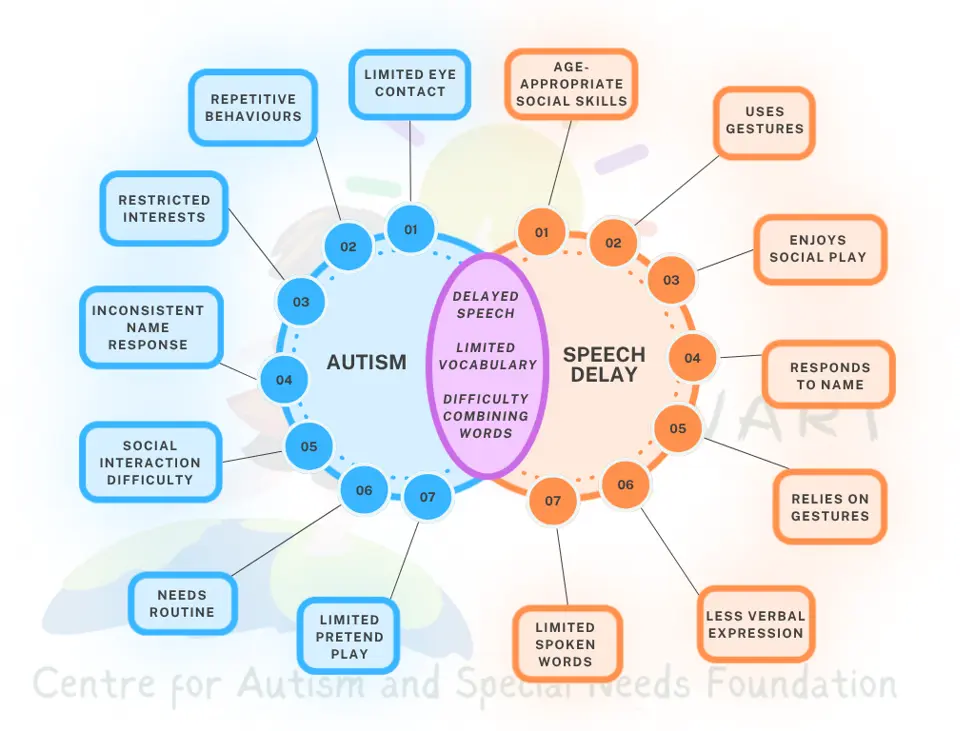
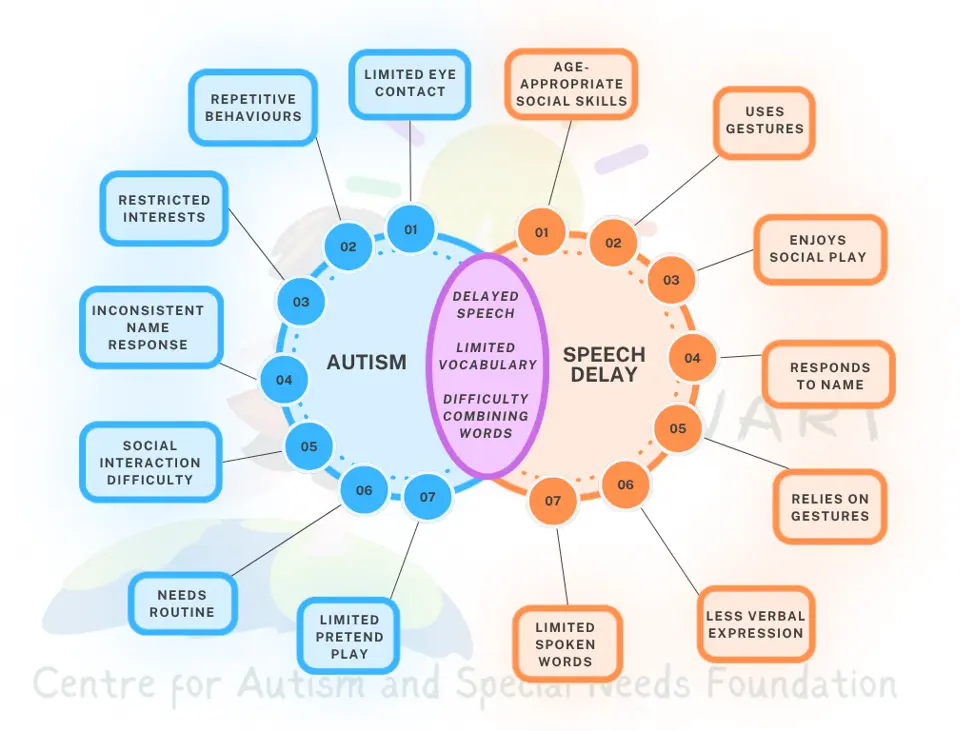
Autism vs Speech Delay: Key Differences
Following are some of the key differences between autism and speech delay that parents should know:
1. Speech Delay Mainly Affects Speech and Language
A child with speech delay may want to communicate but struggles to use words clearly or age-appropriately. They may still point, show things, make eye contact, imitate others, respond to name, and enjoy social interaction.
2. Autism Affects Social Communication Too
In autism, the concern is not only speech. A child may also show differences in eye contact, response to name, gestures, pretend play, social interest, repetitive behaviour, sensory needs, or routines. CDC lists signs such as limited response to name, limited gestures, reduced sharing of interests, repetitive behaviours, and sensory differences among possible autism signs.
3. A Speech-Delayed Child May Use Gestures
A child with only speech delay may point to what they want, wave bye-bye, bring objects to show parents, imitate actions, and use facial expressions to communicate.
In autism, gestures may be limited or used differently. The American Academy of Pediatrics notes that children on the autism spectrum may show subtle differences in gestures, pretend play, and social language, which can sometimes be missed early.
4. Response to Name Matters
A child with speech delay may still turn when called, look at parents, and respond socially even if they cannot speak much.
A child with autism may not consistently respond to name, even when hearing seems normal. CDC includes not responding to name by 9 months as one possible early sign of autism.
5. Repetition and Routines May Suggest Autism
Repeating words, lining up objects, hand-flapping, spinning, strong resistance to change, or intense focus on specific interests may suggest a broader developmental pattern beyond speech delay.
These behaviours do not confirm autism by themselves, but they should be assessed when seen along with communication and social concerns.
Can Speech Delay Be a Sign of Autism?
Yes, speech delay can be one possible sign of autism, but speech delay alone does not mean autism.
This is where many parents get confused. A child may be speech delayed but socially engaged. Another child may have delayed speech along with poor eye contact, limited gestures, no response to name, repetitive behaviour, or sensory issues. The second pattern needs deeper developmental assessment.
The American Academy of Pediatrics recommends autism screening at 18 and 24 months and says children should be referred for intervention when developmental delays are identified, without waiting unnecessarily.
Signs Parents Should Not Ignore
Book an assessment if your child:
- Is not speaking by expected age
- Uses very few meaningful words
- Does not respond to name consistently
- Does not point, wave, or show objects
- Avoids eye contact often
- Does not follow simple instructions
- Repeats words without using them meaningfully
- Plays alone most of the time
- Has frequent meltdowns or sensory sensitivity
- Has repetitive body movements
- Has lost words or skills they had earlier
Loss of previously learned language or social skills should always be taken seriously and discussed with a qualified professional.
When Should You Book an Assessment?
You should book an assessment if you are unsure whether your child’s concern is speech delay, autism, ADHD, sensory difficulty, developmental delay, or a combination of needs.
A good assessment should not only check speech. It should also look at:
- Speech and language
- Understanding and expression
- Eye contact and response to name
- Gestures and imitation
- Play and social interaction
- Behaviour and attention
- Sensory processing
- Daily living skills
- Developmental milestones
This gives parents clarity and helps build the right therapy plan.
How Aaryavart Centre Can Help
At Aaryavart Centre, we support children with autism, speech delay, ADHD, sensory concerns, behavioural challenges, and developmental delays through assessment-led care.
If your child is not speaking, not responding to name, speaking unclearly, repeating words, or showing autism-like signs, our team can help you understand the next step. Based on assessment, we may recommend speech therapy, autism therapy, occupational therapy, ABA-based support, parent training, early intervention, online therapy, or a home development program.
Families can visit Aaryavart centres in Lucknow, Gorakhpur, and Unnao, or connect online from anywhere in India or abroad.
Conclusion
The difference between autism and speech delay is not always visible from one symptom. A child who speaks late may only need speech therapy. Another child may need broader autism assessment and developmental support.
Instead of waiting in confusion, observe your child’s communication, social response, gestures, play, behaviour, and sensory needs. Early assessment can help you understand your child better and start the right support at the right time.
Worried about autism vs speech delay? Book a child development assessment with Aaryavart Centre today.
Autism vs Speech Delay FAQs
Is speech delay always autism?
No. Speech delay is not always autism. Some children have speech or language delay without autism. Autism is more likely to be considered when speech delay appears with social communication differences, limited eye contact, poor response to name, repetitive behaviour, or sensory concerns.
How do I know if my child has speech delay or autism?
Look beyond speech. If your child wants to communicate, points, shows things, responds to name, imitates, and engages socially, it may be speech delay. If speech delay appears with limited social response, repetitive behaviours, sensory issues, or poor eye contact, assessment is recommended.
Can a child with autism speak normally?
Yes. Some autistic children speak fluently but may still struggle with social communication, conversation, tone, flexibility, or understanding social cues.
Can speech therapy help autism?
Yes. Speech therapy can help autistic children improve communication, requesting, understanding, social interaction, and functional language. Many children also benefit from occupational therapy, ABA-based support, parent training, and structured home programs.
At what age should parents worry about speech delay?
Parents should not wait too long if a child is not using words, not combining words, not responding, or not communicating needs. Developmental milestones vary, but early assessment is better than waiting in uncertainty.
Does Aaryavart provide online support?
Yes. Aaryavart Centre provides online assessment guidance, online therapy support, parent training, and home development programs for families across India and abroad, along with centres in Lucknow, Gorakhpur, and Unnao.