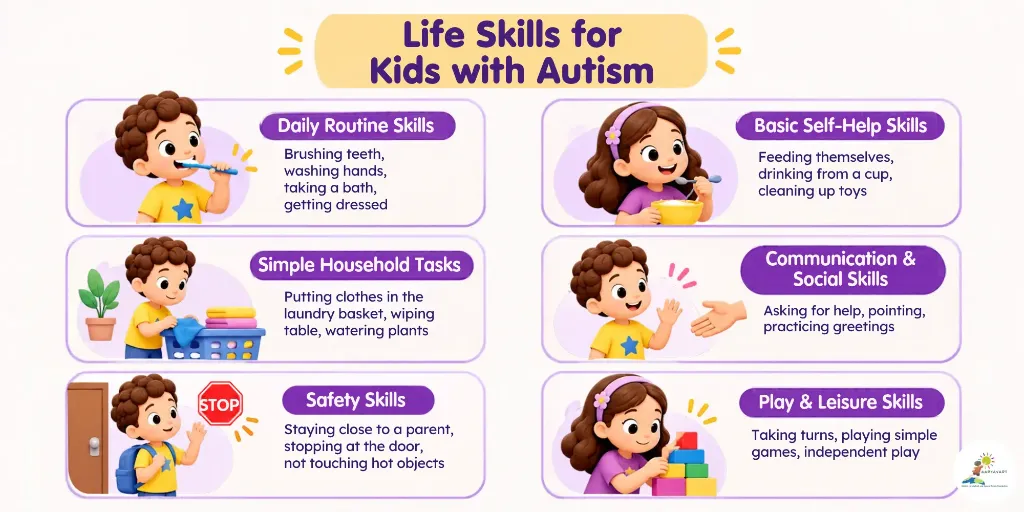
Teaching Life Skills to Children With Autism: A Parent Guide
Learn how to teach life skills to autistic children using small steps, visual cues and everyday practice. Find simple tips for dressing, hygiene and asking for help.

Your child can pull their jacket zip all the way up once you get it started. So what should you practise together? It might be just one step: lining up the two sides of the zip. Or your child might prefer a jacket with an easier fastening.
To teach a life skill to an autistic child, start with one familiar routine and watch for the exact step where they need help. Break the task into small steps, show one step at a time and practise when there is time to pause. A picture, an easier-to-use item or a familiar way to ask for help can make the routine more accessible.
Which life skills should you teach first?
Start with a skill that would make your child’s day easier or help them do something they want to do. Daily living skills include self-care tasks like washing hands and getting dressed. Knowing how to ask for help or take a break can make it easier to participate in these routines.
Choose a skill that matters in your child’s day
Think of a routine that already happens most days. If your child wants to get their own snack, opening the lunchbox may be a more useful first goal than learning to pack the entire school bag. Where possible, let your child choose what they want to practise and what kind of help they prefer.
| Routine | One useful starting goal |
|---|---|
| Getting dressed | Pull a zip up after someone helps join the two sides. |
| Washing hands | Find the towel and dry hands after rinsing. |
| Unpacking after school | Put the lunchbox in a spot marked with a photo. |
| Asking for help | Use a gesture, word, picture or communication device to ask someone to open a container. |
Look for the step where your child needs help
Watch the routine once before deciding what to teach. If your child reaches for the soap and then pulls away when it comes out, the texture or smell may be worth checking. If they finish rinsing and then stop, they may need help finding the towel or remembering what comes next. What you observe can guide which change you try first.
How do you teach a daily living skill step by step?
Break the routine into steps you can see, then work on one manageable part. Try it at a time when you can give your child room to think and try. A familiar jacket at home after school gives you more time to explore what helps than a rushed morning at the door.
Break the routine into steps you can see
Writing out the small actions in a task is called task analysis. For a jacket, use the steps that match your child’s actual jacket and how they put it on. A simple starting sequence might be:
- Put one arm into each sleeve.
- Bring the two sides of the jacket together.
- Slide the pin into the bottom of the zip.
- Hold the bottom steady and pull the zip up.
If your child can already pull the zip, you might start by joining the two sides and letting them finish. This is an example of backward chaining. As that step becomes comfortable, invite them to try an earlier part, such as holding the bottom steady.
Show the step, give time and offer help as needed
Demonstrate the tricky part on your own jacket or lay theirs flat so they can see it. Use a short cue like “hold here,” then pause. If the zip is stiff or the tab is difficult to grip, try an easier fastening or a larger pull tab. If your child signals that they want a break, pause and come back when they’re ready.
Notice what changes across several tries
Keep a short note about the step, the support and what happened. That helps you see whether a change made the routine easier and gives you something specific to share with a teacher or therapist.
| Step practised | Support used | What to try next |
|---|---|---|
| Pulled the zip up | Adult joined and held the bottom | Let the child try holding the bottom if they want to. |
| Held the bottom of the zip | Adult demonstrated once | Try the same cue with the jacket laid flat. |
| Asked for help when the zip caught | Used their usual gesture | Respond in the same way next time so the gesture remains useful. |
Three life skills you can practise at home
Use routines that already fit your day. Changing one thing at a time, such as the soap, the lunchbox or the place where school items go, makes it easier to notice what helps.
Handwashing when the soap or dryer feels uncomfortable
Start with the part your child finds difficult. If the soap feels unpleasant, offer a different one and keep the rest of the routine familiar. If the hand dryer is loud, check whether a towel or paper towel is available. You might notice your child is more willing to use the soap or can show you how they prefer to dry their hands.
Opening a lunchbox and asking for help
Watch whether the lunchbox is hard to hold steady, the latch is stiff or your child is unsure who can help. You could try a lunchbox with a larger latch and practise asking for help in the way your child already communicates. That could be speech, a gesture, a picture or an augmentative and alternative communication (AAC) device. At school, check that a familiar adult knows how to recognise and respond to the request.
Putting school belongings in a predictable place
Choose one easy-to-reach spot for the school bag or lunchbox. Use a photo of the actual spot if a picture would help. Practise just that part of unpacking first. If your child uses the photo to find the spot without an adult reminder, keep it available.
When should you use a visual schedule or a social story?
Choose the support based on the question your child needs answered. Pictures can show what comes next. A personalised story can explain what might happen in a particular situation and what choices your child has.
Use pictures when the sequence is hard to remember
Put a short picture sequence where your child uses it. For handwashing, you can show the main stages from wetting hands and washing with soap to rinsing and drying. Start with photos of your own tap, soap and towel if your child recognises those more easily than illustrations. You can display the pictures by the sink or build the routine in Sarya’s visual schedule app for autistic children.
Use a short story when the situation is unfamiliar
A child may know how to wash their hands and still want to know what a public bathroom will be like. A short story can explain that a dryer may be loud, that paper towels might be available and that the child can signal to their caregiver if they need a quieter option. Use details you can confirm and a way to ask for help that works for your child. If you’re using the formal Social Stories™ approach, follow Carol Gray’s criteria for tailoring the story to the person and situation.
What if your child still gets stuck?
If the same step stays difficult, revisit the task before adding more practice. Look at what your child has to see, hear, grip or remember in that moment. Ask what would help and notice what they show you through their actions or preferred way of communicating.
Check the materials, the environment and how help is offered
Try one change that fits what you’ve noticed. A tight lid may call for a different container. A loud bathroom may call for a quieter place to practise. If several instructions arrive at once, try showing the next step and giving your child time to respond. If the routine causes distress, pause and work out which part feels difficult before trying again.
Read: Aaryavart’s guide to parent training for autism at home
Try the skill in another setting when your child is ready
A lunchbox that’s easy to open at the kitchen table may feel harder to manage in a busy classroom. Keep a familiar support available when you change the setting. Your child could take the same lunchbox to school and use the same gesture or picture to ask for help. Ask the teacher what they notice during lunch and share what works at home.
When should you ask for help with daily living skills?
Consider asking for individual support if dressing, washing, eating or managing everyday items regularly causes distress or limits your child’s participation. An occupational therapist can look at the task, the materials and the setting with you to explore where support could help.
What should you bring to a life skills assessment at Aaryavart?
Bring one routine you want help with and describe it as it usually happens. For example, “My child gets both arms into the jacket and pulls the zip once I start it. Joining the two sides is the part they struggle with.” Share what you’ve already tried and what matters to your child. Aaryavart Centre begins its life skills programme with an assessment of the child’s strengths, daily routines and family goals.
Request a life skills assessment
Teaching life skills to autistic children FAQs
What life skill should I teach my autistic child first?
Pick a familiar task that would make a difference to your child’s day. For one child, that might be drying their hands. For another, it might be asking someone to open their lunchbox. Start with a part they’re comfortable trying and choose the goal together where possible.
How often should we practise daily living skills at home?
Use natural opportunities when you and your child have time and your child is comfortable taking part. It may be easier to try the zip after school than when you’re rushing out the door. If your child is tired or wants a break, you can help them finish and try another time.
What is a simple example of backward chaining?
If your child is learning to put on socks, you might help get the sock over the toes and heel, then let them pull it up to finish. Once that feels familiar, you can offer them the chance to take over an earlier step.
Can social stories help teach daily living skills?
A personalised story can explain what may happen in a routine and what support your child can ask for. Use demonstration and practice for the physical steps of the task. The ASSSIST-2 randomised trial in UK primary schools found benefits for some individual goals, with no clinically evident improvement on its main measure of social responsiveness.
When can occupational therapy help with life skills?
Ask about occupational therapy if a difficulty with dressing, hygiene or using everyday objects regularly limits how your child takes part. Bring an example of the exact step that is difficult, what your child can already do and which adaptations you’ve tried.