ADHD Symptoms in Children: A Parent’s Observation Checklist
Explore ADHD symptoms in children with a practical parent checklist. Record signs at home and school, understand their limits and know when to seek help.

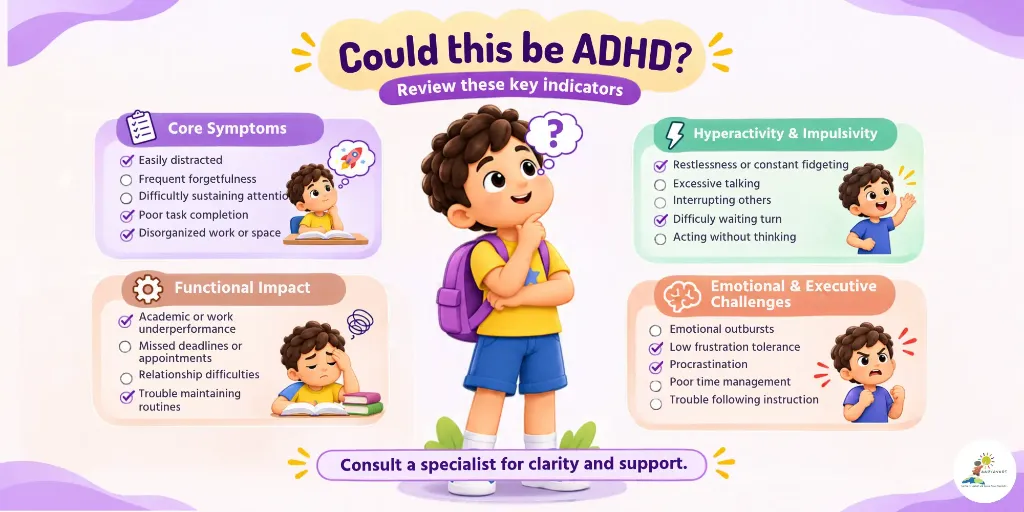
Symptoms of ADHD in children involve persistent difficulties with attention, hyperactivity, impulsivity, or a combination. What matters is how often they happen, whether they are unusual for the child’s developmental level and how they affect daily life.
Perhaps homework rarely reaches the school bag, even when it is finished. Perhaps waiting for a turn regularly becomes difficult. Instead of deciding what the behaviour means, start by recording what happens.
This checklist helps you prepare for a professional conversation. It cannot tell you whether your child has ADHD. It is an original observation aid, not a validated screening test.
How Should Parents Use This ADHD Symptoms Checklist?
Use the checklist to describe repeated experiences rather than judge your child’s behaviour. Think across home, school and other activities, and include your child’s perspective where possible.
For each concern, record:
- What happened and which task was involved.
- How often you notice it.
- Where it occurs.
- How it affects learning, relationships or routines.
- What support was already available.
- What made the task easier.
The American Academy of Child and Adolescent Psychiatry, or AACAP, recommends bringing observations and school information to your child’s clinician. Avoid adding up the items below to produce a diagnosis.
What Are the Symptoms of ADHD in Children?
ADHD symptoms fall into two clinical groups: inattention and hyperactivity-impulsivity. The everyday examples below illustrate possible concerns. A clinician decides whether they meet diagnostic criteria.
Inattention: What Might Parents Notice?
Inattention involves repeated difficulty directing and sustaining attention or organising tasks. It can be missed when a child is quiet and causes little disruption.
Consider whether your child often:
- Misses details in work they otherwise understand.
- Loses track during tasks or play.
- Appears not to hear when spoken to directly.
- Starts an instruction but does not follow it through.
- Struggles to organise materials or activities.
- Avoids tasks requiring sustained mental effort.
- Misplaces things needed for school or daily activities.
- Gets pulled away by unrelated sights, sounds or thoughts.
- Forgets everyday responsibilities.
Example: Your child finishes a worksheet but repeatedly leaves it at home. Record whether the difficulty involves remembering, organising or understanding the instruction.
Hyperactivity: When Is Movement a Concern?
Movement is normal, especially in younger children. The concern is a repeated level of activity that is developmentally unusual and makes participation difficult.
Notice patterns such as:
- Frequent fidgeting or squirming.
- Leaving a seat when remaining seated is expected.
- Running or climbing in unsuitable situations.
- Difficulty taking part quietly in leisure activities.
- Appearing constantly on the move.
- Talking much more than the situation allows.
Example: During a short group activity, your child repeatedly leaves their place. Note the activity’s length, the setting and whether movement breaks were available.
_Source: CDC, Symptoms of ADHD._
Impulsivity: What Does Acting Without Pausing Look Like?
Impulsivity can make it difficult to wait or stop an immediate response. Look for repeated situations rather than one impatient moment.
Possible examples include:
- Answering before a question has finished.
- Difficulty waiting for a turn.
- Frequently interrupting conversations or joining activities without waiting.
Example: Your child repeatedly takes another player’s turn despite reminders. Record what happened before and after, rather than writing “deliberately naughty.”
How Can You Tell Everyday Behaviour From a Pattern Worth Assessing?
A child can be distracted, restless or impatient without having ADHD. Consider whether the difficulty keeps returning and affects everyday participation despite age-appropriate expectations and support.
| What to examine | More useful question |
|---|---|
| Frequency | Does this happen repeatedly or mainly after a difficult day? |
| Development | Is the expectation realistic for this child’s age and developmental level? |
| Settings | Do teachers or other caregivers notice related difficulties? |
| Impact | Is learning, friendship, safety or family life being affected? |
| Context | Could tiredness, worry, task difficulty or the environment be contributing? |
The NHS notes that distractibility and high activity are common in young children, particularly under five. Concern deserves discussion, but behaviour alone does not explain its cause.
Can ADHD Be Missed in a Quiet Child?
Yes. A child does not need to be visibly hyperactive for attention difficulties to deserve assessment. Quiet daydreaming, unfinished work and forgotten instructions can also cause significant problems.
The NHS explains that ADHD may be recognised less often in girls, partly because inattentive symptoms can be harder to notice. Children of any gender can have any presentation.
Ask about effort and experience, not only disruption: _“Which part of this task feels hardest?”_
What Should You Record Before an Appointment?
Bring specific examples that help the clinician understand your child’s day. You do not need a perfect diary or a completed checklist before seeking advice.
Use a simple observation log like this:
| Situation | What happened | Effect | Support tried |
|---|---|---|---|
| Packing for school | Packed lunch but left books behind | Needed a second trip | Picture list beside the bag |
| Homework | Lost place after each question | Work remained unfinished | One question visible at a time |
| Group game | Took turns before others finished | Peers became upset | Adult modelled the turn order |
These are illustrative examples, not diagnostic indicators by themselves.
Bring existing school feedback, relevant health history and questions you want answered. The CDC’s diagnostic guidance emphasises information from different settings and consideration of other explanations.
For the broader clinical picture, read our companion guide, What Is ADHD in Children? Symptoms, Causes and Diagnosis.
What Can You Try While Waiting for Advice?
You can make a difficult task clearer while arranging an assessment. The aim is to understand what helps, not to test whether a strategy “proves” ADHD.
Choose one routine and try:
- Giving a short instruction.
- Showing the task with a picture or written step.
- Keeping needed items nearby.
- Allowing an appropriate break.
- Asking your child which part needs changing.
For digital routine-building, explore Sarya’s visual schedule app for ADHD and autism. It offers picture steps and voice prompts. Its guide to visual schedules for ADHD provides routine examples.
An app cannot diagnose ADHD or establish whether treatment is needed. Evaluate it as a practical tool that may or may not suit your child.
When Should You Seek Professional Help?
Seek advice when concerns repeatedly affect learning, friendships, daily routines or safety. You do not need to wait until difficulties become severe.
Start with your paediatrician or an appropriately qualified child mental health professional. Ask what the assessment involves and who will consider other possible explanations.
At Aaryavart, you can request an assessment discussion or contact the team about the appropriate next step. You may also find our guide to developmental screening and assessment useful. Screening identifies concerns; it does not automatically establish a diagnosis.
ADHD Symptoms in Children FAQs
Does My Child Need Every Symptom to Have ADHD?
No. ADHD can involve mainly inattention, mainly hyperactivity-impulsivity, or both. Clinicians assess the required pattern, duration, developmental appropriateness and impact. A parent checklist is not sufficient.
Can Poor Sleep Look Like ADHD?
Yes. Sleep problems can produce symptoms that resemble ADHD. Tell the clinician about sleep routines, night waking or other sleep concerns so these can be considered during assessment.
What if Home and School Reports Differ?
Share both accounts. Ask which situations are difficult and what support is already in place. Different reports are useful assessment information, not a reason to dismiss either adult’s concerns.
Can I Use This Checklist as an ADHD Test?
No. It is an original observation aid, without a validated score or diagnostic cut-off. A qualified professional can select appropriate assessment tools and interpret them alongside your child’s history.
Can My Child Have ADHD if They Focus Well on Games?
Yes. Attention can vary with interest and the demands of an activity. Focusing on a favourite game does not rule out ADHD. Clinicians consider difficulties across everyday tasks and settings, rather than judging attention from one preferred activity.
Can ADHD Symptoms Start Suddenly?
ADHD is a developmental condition with symptoms beginning in childhood, although difficulties may become noticeable later. A sudden change in attention or behaviour should be discussed with a clinician rather than assumed to be ADHD. Sleep problems, stress and other conditions can cause similar difficulties.
Does Difficulty With Homework Always Mean ADHD?
No. Homework difficulties alone do not establish ADHD. A child may be tired, anxious or struggling with the task. Record what happens, ask the teacher about classroom experiences and seek advice if concerns persist. Assessment considers a broader pattern across settings.