When Should Your Child Start Speech Therapy? An Age-by-Age Guide for Parents
Wondering when to start speech therapy for your child? Learn the right age, red flags by milestone, and how to book a free assessment at Aaryavart Centre.

If you searched "when to start speech therapy" at 11 pm because your child said fewer words today than their cousin does, here is the honest, short answer first: the right time is now, not after the next birthday, not after "let's just see how the next few months go." There is no age that counts as too early to get a professional opinion, and every major body in this field agrees on that point. What actually changes with age is what a speech-language pathologist looks for, not whether it's worth asking.
This guide walks through what starting speech therapy actually involves, the real age-by-age signs worth watching, the myths that quietly talk parents out of getting help, what happens once you do start, and how to book that first conversation with Aaryavart Centre, in person or online.
What Does "Starting Speech Therapy" Actually Involve?
Before going further, it helps to know what you're actually signing up for, because the phrase "speech therapy" sounds bigger and scarier in your head than it usually is in practice.
Speech therapy is professional support from a speech-language pathologist (SLP) to build a child's ability to produce sounds and words (speech) and to understand and use language to communicate (language). According to Cleveland Clinic, sessions for children are typically play-based: games, books, and everyday routines used to practice sounds and sentence-building, not a clinical drill.
"Starting therapy" doesn't mean a diagnosis lands on you on day one. It means:
- A conversation or a screening call to understand what you're noticing
- A comprehensive evaluation of speech, language, and (if needed) hearing and oral-motor skills
- A personalized plan, built around your child rather than a generic worksheet
That's it. The label comes later, if it comes at all. The plan comes first.
Is There a "Right Age" to Start Speech Therapy? What the Experts Say
Now to the actual question that brought you here. If you've been waiting for some official "right age" to appear before you call anyone, this section is the one worth reading twice.
The American Speech-Language-Hearing Association (ASHA) states plainly that age should never be the reason a child's communication services are delayed, and that "service provision occurs well before 2 years of age" for children who need it. There is no minimum age written anywhere that says a toddler is "too young" to be evaluated. The CDC's own guidance to parents is equally direct: if your child isn't meeting a milestone, don't wait it out, act early and talk to your doctor.
So if you're looking for the single best age for speech therapy, the honest expert answer is: the age your child is right now, the moment you notice a concern. That said, most children see the fastest, largest gains when therapy starts somewhere between 18 months and 3 years, simply because that's the window when spoken language is developing quickest and a delay first becomes visible to a parent. Starting outside that window is still worthwhile; it just tends to mean a longer road to catch up.
Age by Age Guide: Speech Milestones and When to Get Help
Milestones give you something more useful than a gut feeling: an actual benchmark. Here's what to expect at each stage, per CDC checklists, and what should prompt a call rather than a "let's wait."
12 to 18 Months: The First Real Words
This is usually the earliest window parents notice something feels different, and it's a completely fair age to raise a concern.
- By 12 months, most toddlers wave bye-bye, respond to their name, and try to imitate sounds
- By 18 months, most say several single words and point to show you something they find interesting, not just to request an object
- Get it checked if your child shows little response to their name, doesn't imitate sounds or gestures, or has very few words by 18 months
18 Months to 2 Years: Two-Word Phrases
This is one of the most common ages parents start searching for answers, because the gap between "a few words" and "a real sentence" becomes obvious fast.
By 24 months, most toddlers combine two words ("more milk"), have a vocabulary of roughly 50 to 100 words, and are understood at least half the time by unfamiliar adults, per CDC milestones. If your two-year-old isn't there yet, this is exactly the age we've written a full, dedicated guide for: Speech Delay in a 2-Year-Old: Signs, Causes, and What to Do Next covers the complete symptom checklist and causes for this specific age.
3 Years: Full Conversations Begin
By now, speech should be turning into genuine back-and-forth conversation, not just labeling objects.
Per CDC, a 3-year-old should be able to hold a short back-and-forth conversation, ask "who," "what," "where," or "why" questions, say their first name when asked, and be understood by others most of the time. If speech is still largely unintelligible to people outside the family, or your child avoids trying to talk in sentences, that's worth a proper look, not a "give it another year."
4 Years and Up: Clear, Connected Sentences
Past age 4, the bar shifts from "are they talking" to "are they talking clearly and in full thoughts."
According to the CDC, a 4-year-old should say sentences of four or more words, talk about something that happened during their day, and answer simple questions like "what is a crayon for?" A child who's still hard to understand by strangers, or who struggles with these basics closer to kindergarten, benefits from speech therapy for toddlers and preschoolers designed specifically around this age group, not a generic worksheet meant for a much younger child.
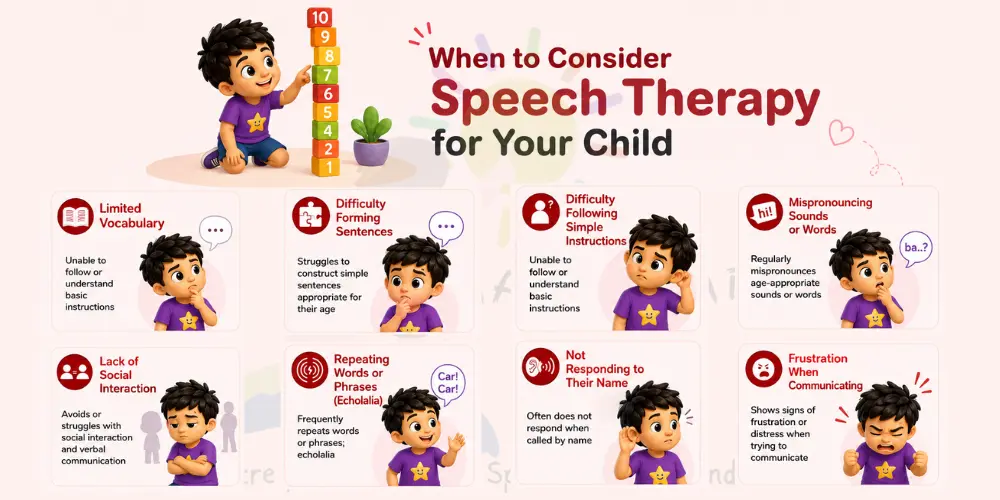
Signs Your Child May Need Speech Therapy, at Any Age
Milestones are useful, but some signs matter regardless of what birthday your child just had.
- Losing words or skills they already had. This is always urgent, at any age, and should never be filed under "wait and see."
- Being consistently hard to understand for their age, even by people who know them well
- Relying almost entirely on gestures instead of attempting sounds or words
- Visible frustration or meltdowns tied to not being understood
If any of these show up alongside reduced eye contact, little interest in pointing to share something, or repetitive behaviors, it's worth a broader look rather than a speech-only one. A combined autism and child development assessment is the faster path to clarity here; our companion guide, When Should My Child Be Screened for Autism?, walks through exactly when and how that screening happens.
Why Earlier Is Better: The Science of Early Intervention
It's easy to treat "start early" as a vague piece of parenting advice. It isn't; there's real data behind it.
According to the National Institute on Deafness and Other Communication Disorders (NIDCD) (updated July 2025), about 7.2% of U.S. children aged 3 to 17 have had a voice, speech, or language disorder in the past year, but that rate nearly doubles to 10.8% among children aged 3 to 6, the exact window when early intervention speech therapy does the most good. The same data shows only about 59.7% of affected children actually received intervention services, meaning a real share of children who could benefit simply never got referred in time.
That gap matters because a child's brain is at its most responsive to language input in these early years. Structured, professional early intervention during this window tends to produce faster gains than the same therapy started later, per guidance from ASHA and the CDC. Waiting doesn't make the therapy less effective forever, but it does trade away months your child's brain would have used most efficiently.
Common Myths That Delay Parents From Starting Therapy
Most parents who delay aren't ignoring the problem; they're being talked out of acting by something that sounds reasonable. Here's what actually holds up.
- "He'll grow out of it." Some late talkers do catch up on their own, but neither ASHA nor CDC recommend betting on it. An evaluation is what tells you whether your child is a late talker who'll catch up, or has a delay that needs support, and there's no way to know which one you're looking at without asking.
- "Boys just talk later than girls." The data actually runs the other way: per NIDCD, boys aged 3 to 17 are diagnosed with a communication disorder almost twice as often as girls (9.1% versus 5.2%). That's a reason to take a boy's speech delay more seriously, not less.
- "Bilingual kids are naturally behind." Raising a child with two or more languages doesn't cause a lasting speech delay. Bilingual toddlers may mix languages for a while, but their overall communication development should track close to their peers.
- "He's too young to be evaluated." As covered above, ASHA is explicit that services regularly start well before age 2. There's no age floor here.
- "We've already waited this long, a few more months won't matter." Given how much of early language development happens in these exact years, a few more months is precisely the cost that's easiest to avoid.
Is It Ever Too Late to Start Speech Therapy?
If the myths above are what stop parents of toddlers, this is the question that stops parents of older kids, and it deserves a straight answer.
No age is ever too late. ASHA describes communication as "a lifelong activity of value to people of all ages," and notes that language and communication skills keep developing well into young adulthood. Older children, teens, and adults still see real, measurable gains from speech therapy for articulation, stuttering, language, and social communication, including speech therapy for autism at any age. Starting earlier usually means a shorter road, but starting later still gets you somewhere. The only version of "too late" is not starting at all.
What Happens When You Start Speech Therapy at Aaryavart Centre
Once you've decided to act, the next question is usually "okay, but what does that actually look like." Here's the honest walkthrough.
- A free screening call. No commitment, just a conversation to understand what you're noticing and whether a full assessment makes sense.
- A comprehensive assessment, roughly 2 to 3 hours, in person at our Lucknow, Gorakhpur, or Unnao centres, or online for families elsewhere in India or abroad.
- A personalized therapy roadmap, not a generic template, built around what your child specifically needs.
- Ongoing, play-based sessions, with parents included in the process so progress carries over at home, not just in the therapy room.
Depending on what the assessment finds, your child's plan may draw on more than one service under one roof: speech and language therapy for vocabulary and sentence-building, ABA therapy where communication overlaps with behavior, PECS and picture-based communication for children who are minimally verbal, or parent training so the strategies your child's therapist uses become part of your everyday routine too. That's the practical benefit of speech therapy for kids delivered by a multidisciplinary team instead of a single specialist working in isolation.
How Much Does Speech Therapy Cost?
This is usually the question sitting right behind "when should I start," and it's a fair one to ask before you commit to anything.
Speech therapy cost depends on a few real variables: how often sessions happen, whether they're in person or online, and whether your child needs individual sessions or benefits from a small group setting. Rather than guess at a number that may not apply to your child's situation, the lower-risk first step is a free screening call with Aaryavart Centre, which gives you a clear picture of what your child actually needs before you commit to a plan or a price.
What Parents Can Do at Home, Before and Alongside Therapy
Waiting for an appointment doesn't mean waiting to help, and there's plenty you can start today, whether or not you've booked anything yet.
- Narrate everyday routines. "We're putting on your shoes now," even if your child doesn't respond yet.
- Expand, don't just repeat. If your child says "ball," respond with "yes, the big red ball!"
- Read together daily, pausing so your child can point or try to fill in a word.
- Offer choices instead of yes-or-no questions. "Juice or milk?" invites an actual word, not a nod.
If you've been searching for how to do speech therapy at home, these habits genuinely help and are worth doing regardless of your child's timeline. But they work best alongside a licensed speech-language pathologist's personalized plan, not instead of one, especially if what you're seeing is a real delay rather than typical variation. Think of home practice as reinforcement for professional therapy, not a replacement for it.
Why Families Choose Aaryavart Centre When They're Ready to Start
If you've read this far, you already know more about the "right age" question than most parents do when they first search it. Here's what makes the next step easy.
Aaryavart Centre brings speech therapy, ABA therapy, occupational therapy, sensory therapy, and parent training together under one roof, so an assessment doesn't end in a referral chain to five different specialists; it ends in one coordinated plan. Families can choose in-person care at our centres in Lucknow, Gorakhpur, and Unnao, or online therapy for families elsewhere in India or abroad. And because we know "when should I start" is often the hardest question to answer alone, we start every family with a free, no-obligation screening call, not a sales pitch.
Final Words
There's no prize for waiting the longest before you ask for help, and there's no such thing as asking too soon. If any part of this guide sounded like your child, the next right step is a real conversation, not another search. The earlier you start, the more room your child has to grow into their own voice.
Call or WhatsApp +91 76072 93336 (or +91 97938 88698), email wecare@aaryavart.org, or use our online assessment booking form to get started this week.
When to Start Speech Therapy FAQs
When should a child start speech therapy?
As soon as a parent, pediatrician, or caregiver notices a possible delay. ASHA is explicit that age should never be a reason to postpone services, and evaluations regularly happen well before age 2.
What is the best age to start speech therapy for a toddler?
Most children see the strongest results starting between 18 months and 3 years, when language development is developing fastest, per ASHA and CDC guidance. Earlier is still worth an evaluation if you have a concern.
Is it too early to get my 18-month-old evaluated?
No. CDC milestone checklists exist specifically so concerns can be raised early, and a screening at this age carries no downside; at worst, it confirms everything is on track.
Is 7, or older, too late to start speech therapy?
No age is too late. ASHA notes that communication skills continue developing well into young adulthood, and children, teens, and adults all continue to benefit from therapy.
My child is 2 and not saying two-word phrases yet. Should we start therapy now?
Yes. For the full 2-year-specific checklist and causes, see Speech Delay in a 2-Year-Old: Signs, Causes, and What to Do Next.
How do I know if my child needs speech therapy?
Watch for a smaller vocabulary than peers, being hard to understand for their age, heavy reliance on gestures over words, or, at any age, losing words or skills they previously had.
Does a speech delay always mean autism?
No. Many children have an isolated speech delay with no other signs. It becomes a broader concern when paired with reduced eye contact, limited pointing-to-share, or repetitive behaviors.
What happens at the first speech therapy assessment?
At Aaryavart Centre, it's a focused 2 to 3 hour evaluation, in person or online, ending in a personalized therapy roadmap rather than just a label.
How much does speech therapy cost?
It depends on frequency, format, and whether sessions are individual or group. The lowest-risk first step is a free screening call to understand what your child needs before committing to a plan.
Can I just do speech therapy at home instead of seeing a professional?
Home strategies like narrating routines and reading together genuinely help, but they work best alongside a licensed speech-language pathologist's plan, not as a replacement for one.
How long does speech therapy take to show results?
This varies by child, but consistent, play-based sessions paired with home reinforcement is the evidence-based path recommended by ASHA. A proper evaluation turns "how long" into a real, individual timeline instead of a guess.
Where can I start speech therapy for my child?
Book a free screening call or full assessment with Aaryavart Centre, available in person in Lucknow, Gorakhpur, and Unnao, or through online therapy for families elsewhere.