Speech Delay in a 2-Year-Old: Signs, Causes, and What to Do Next
Is your 2-year-old not talking? Learn the real signs, causes & treatment of speech delay, plus how to book a free screening at Aaryavart Centre.

Your two-year-old points at the fridge but won't say "milk." Other toddlers at the park chatter in two- and three-word bursts, while yours communicates mostly through pointing, pulling at your hand, and frustrated tears. If you've typed "speech delay in a 2 year old" into a search bar more than once this week, you're not alone — and by paying attention this early, you're already doing the single most important thing a parent can do.
Speech delay is one of the most common developmental concerns parents raise with pediatricians, and it's also one of the most treatable, provided it's caught and acted on early rather than waited out. This guide covers what's typical at age two, the red flags worth acting on, what actually causes speech delay, and what to do next, including how the team at Aaryavart Centre can help.
What Is a Speech Delay in a 2-Year-Old?
A speech delay means a child's ability to produce speech sounds and words lags behind what's typical for their age. It's often discussed alongside and sometimes confused with a language delay, which affects how well a child understands words (receptive language) or uses them to communicate (expressive language). Many toddlers have a combination of both. According to the American Speech-Language-Hearing Association (ASHA), speech and language develop on a predictable timeline in the early years, which is exactly why milestone checklists are useful — they give you a factual baseline instead of a gut feeling.
Normal Speech and Language Milestones at 2 Years
Before worrying, it helps to know the actual benchmark. By 24 months, according to the CDC's Learn the Signs. Act Early. milestones and Mayo Clinic, most toddlers can:
- Say at least two words together, like "more milk" or "go bye-bye"
- Have a spoken vocabulary of roughly 50–100 words
- Point to pictures or body parts when named
- Be understood at least half the time by adults who don't know them well
- Use gestures beyond waving and pointing, such as nodding or blowing a kiss
- Follow simple one-step instructions
If your child is comfortably hitting these, they're tracking well. If several feel out of reach, it's worth a closer look — not panic, but a proper look.
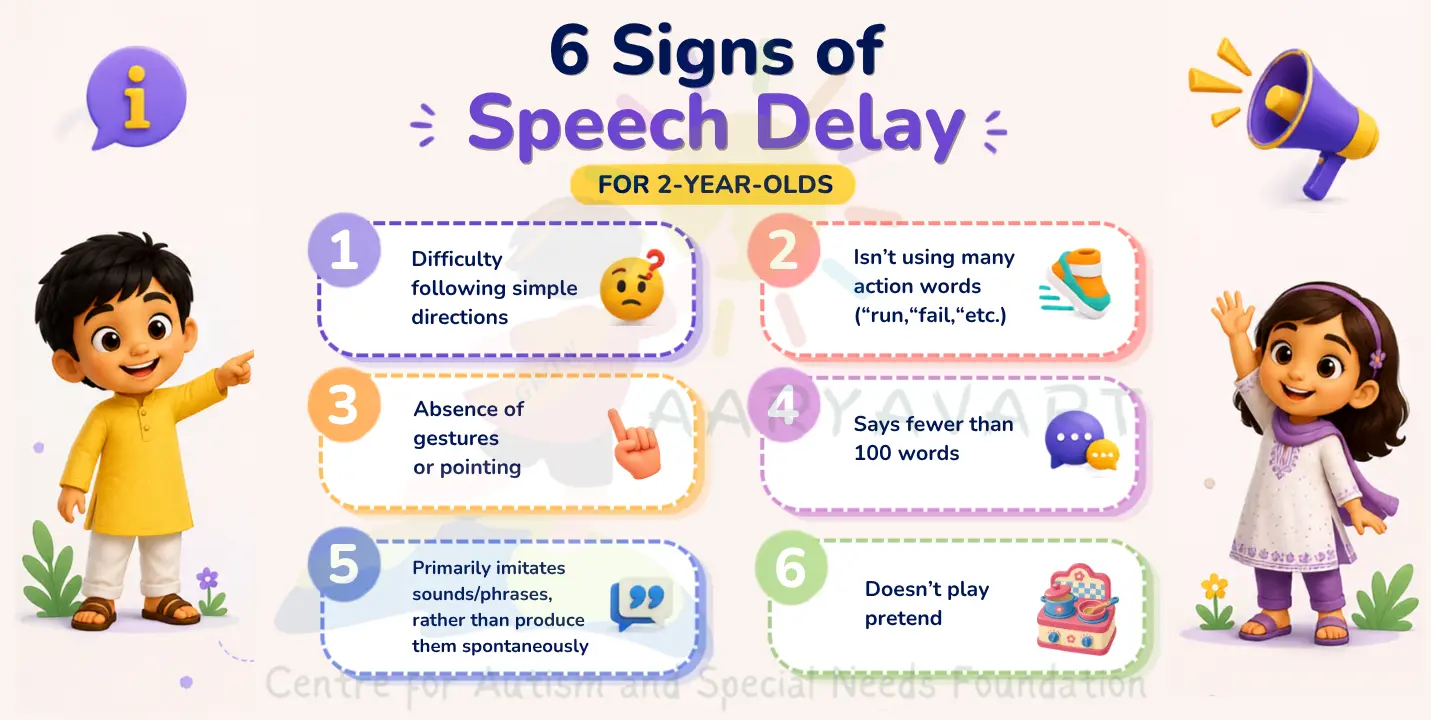
Signs Your 2-Year-Old May Have a Speech Delay
The CDC's guidance is refreshingly direct: "Don't wait." Talk to your child's doctor if your child:
- Says fewer than ~50 words or isn't combining two words by 24 months
- Is understood less than half the time even by familiar caregivers
- Relies almost entirely on gestures instead of sounds or words
- Doesn't follow simple instructions like "give me the ball"
- Doesn't imitate sounds, words, or actions
- Has lost words or skills they previously had (this regression should always be checked immediately, regardless of age)
None of these are a diagnosis on their own, but they're a solid reason to ask for a free developmental screening rather than waiting another few months to "see how it goes."
What Causes Speech Delay in Toddlers?
There's rarely a single answer, which is exactly why a professional evaluation matters more than internet guessing. Recognized contributors include:
- Hearing loss: even mild or fluctuating hearing loss from repeated ear infections can quietly affect speech development, which is why Mayo Clinic recommends an audiologist evaluation as a first step.
- Oral-motor or motor-planning difficulties, including childhood apraxia of speech, where the brain struggles to coordinate the movements needed for speech.
- Developmental conditions such as autism spectrum disorder, global developmental delay, or intellectual disability.
- Limited verbal interaction at home or heavy reliance on passive screen time in place of back-and-forth conversation.
- Bilingual households are not a cause. Children raised with two or more languages may mix them temporarily, but this alone should not cause a meaningful delay — a persistent myth worth retiring.
- In many toddlers, no single identifiable cause is found — these are often called "late talkers," and most still benefit from therapy.
Speech Delay vs. Autism: How Are They Different?
This is the question that keeps parents up at night, and it deserves a careful answer. An isolated speech delay usually means a child wants to connect and communicate but struggles with the sounds or words to do it — they make eye contact, point to share interest, imitate others, and engage in pretend play.
Speech and language delay is also one of the early indicators doctors watch for in autism screening, but it typically appears alongside other signs, not alone: reduced eye contact, limited pointing or joint attention (showing you something because they want to share the moment with you, not just to get an object), little interest in pretend play, and repetitive behaviors or intense reactions to sensory input.
Not every late talker is autistic, and not every autistic child has a speech delay, but when speech delay appears together with these social-communication signs, a combined autism and child development assessment is the fastest way to get clarity, usually within a single session, rather than months of uncertainty.
How Is Speech Delay Diagnosed?
A thorough evaluation typically follows this order:
- Pediatrician screening: your child's doctor rules out obvious concerns and refers you onward if needed.
- Hearing test by an audiologist: Mayo Clinic recommends this as a near-first step, since hearing issues are a common, correctable cause of delayed speech.
- Comprehensive speech-language evaluation by a certified speech-language pathologist, assessing expressive and receptive language, articulation, and oral-motor skills.
- Broader developmental or autism assessment, if the evaluation suggests signs beyond speech alone.
At Aaryavart Centre, this looks like a focused 2–3 hour assessment, in person at our Lucknow, Gorakhpur, or Unnao centres, or online for families anywhere in India or abroad — ending with a personalized therapy roadmap, not just a label.
Why Early Intervention Matters
ASHA and the CDC are aligned on this point: the first three years of life are the most active window for the brain to build the neural pathways behind speech and language. "Wait and see" is outdated advice for a reason — a child who starts therapy at 2 has more runway to catch up before school entry than a child who starts at 4. Every month of early intervention is doing double duty: teaching new skills while the brain is at its most adaptable.
Treatment Options for Speech Delay in Toddlers
There is no proven medicine or syrup that treats speech delay — the evidence-based path recognized by ASHA and Mayo Clinic is structured, professional therapy, not over-the-counter formulas. In practice, that usually looks like:
- Speech and language therapy: one-on-one, play-based sessions with a speech-language pathologist targeting vocabulary, sentence-building, and articulation.
- ABA therapy: when speech delay overlaps with autism, applied behavior analysis builds communication alongside behavior and social skills.
- Occupational therapy: often paired with speech therapy to address the sensory and motor skills that support communication.
- Parent training: coaching caregivers to turn everyday routines into language-building opportunities.
- PECS and picture-based communication: for children who are minimally verbal, giving them a reliable way to be understood while speech develops.
India's digital-health ecosystem is also building useful, complementary tools worth knowing about, though none replace hands-on therapy. Kidaura has built game-based screening tools to flag developmental concerns early. Aignosis uses AI and a simple webcam for rapid early autism screening. Sarya offers an app and routine-builder designed to support neurodiverse children and their parents day to day. These are useful for early screening and daily support — but a real diagnosis and treatment plan still needs a qualified professional, which is exactly what a proper assessment gives you.
How Parents Can Help at Home
Alongside professional therapy, small daily habits genuinely move the needle:
- Narrate everyday routines: "We're putting on your shoes now" — even if your child doesn't respond yet.
- Expand, don't just repeat: if your child says "ball," respond with "Yes! Big red ball!"
- Read together daily, pausing to let your child point or fill in a word.
- Offer choices instead of yes/no questions: "Juice or milk?" invites a word, not a nod.
- Get face-to-face and reduce background noise (including screens) during talk time.
- Celebrate every attempt to communicate, gestures included; pressure slows progress; encouragement speeds it up.
When and How to Book a Speech and Development Assessment
If your two-year-old is behind on more than one or two of the milestones above, the single most useful thing you can do today is stop waiting and start with a professional opinion. Aaryavart Centre offers both a quick, no-cost screening call and a full 2–3 hour comprehensive assessment that ends in a personalized therapy roadmap — available at our centres in Lucknow, Gorakhpur, and Unnao, or through online therapy for families anywhere in India or abroad.
Call or WhatsApp +91 76072 93336 (or +91 97938 88698), email wecare@aaryavart.org, or use our online assessment booking form to get started this week. Early speech delay rarely fixes itself on a deadline, but it responds remarkably well to timely, expert support.
Bottom Line
Every child's timeline is different, but "different" and "concerning" aren't the same thing, and the only way to know which one you're looking at is to ask someone qualified to tell you. If any part of this guide sounded familiar, don't let it sit in a browser tab. Book a free screening with Aaryavart Centre or call/WhatsApp +91 76072 93336 today — the earlier you start, the more room your child has to catch up.
Speech Delay in a 2-Year-Old FAQs
Is it normal for a 2-year-old to not talk much?
Some variation is normal, but by 24 months most children say at least 50 words and combine two words into short phrases like "more milk," per the CDC. If your child isn't there yet, a developmental screening is more useful than waiting.
What is considered a speech delay at 2 years old?
Generally, a smaller vocabulary than expected (fewer than roughly 50 words), no two-word combinations yet, or being understood less than half the time by unfamiliar adults, per Mayo Clinic.
How can I tell if my child is just a late talker or has a real delay?
True late talkers usually understand language well and communicate through gestures despite a small vocabulary, and many catch up with support. A delay linked to a broader condition typically comes with additional signs — limited eye contact, few gestures, or little response to their name — alongside the speech delay.
Is speech delay a sign of autism?
Not always — many children with an isolated speech delay show no other autism traits. However, speech and language delay is one of the early indicators in autism screening, especially when paired with reduced eye contact, limited joint attention, or repetitive behaviors.
Can a 2-year-old with speech delay catch up without therapy?
Some do, but ASHA and Mayo Clinic both recommend a professional evaluation rather than a "wait and see" approach, since early speech-language therapy meaningfully improves outcomes when a genuine delay exists.
What causes speech delay in toddlers?
Common contributors include hearing loss, oral-motor or motor-planning difficulties, developmental conditions like autism or global developmental delay, and limited verbal interaction at home. In many toddlers, no single cause is ever identified.
Does being bilingual cause speech delay?
No. Raising a child with two or more languages does not cause speech delay. Bilingual toddlers may mix languages temporarily, but their overall communication development should track close to their peers.
Is there a medicine or syrup that treats speech delay?
No clinically proven medicine cures speech delay. The evidence-based treatment recognized by ASHA and Mayo Clinic is professional speech-language therapy — not over-the-counter syrups or supplements.
When should I take my 2-year-old to a speech therapist?
As soon as you notice a red flag — a small vocabulary, no two-word phrases, being understood less than half the time, or the loss of previously learned words. Aaryavart Centre offers both in-depth assessments and free screening calls to help you decide quickly.
How is speech delay diagnosed?
Diagnosis usually starts with a hearing check by an audiologist, followed by a comprehensive evaluation from a speech-language pathologist, and a broader developmental or autism assessment if indicated.