Signs of Autism in a 2-Year-Old: Early Warning Signs Guide
Worried about your toddler? Learn the real signs of autism in a 2-year-old, how it's diagnosed, and the next steps — from India's trusted autism centre.

Watching your 2-year-old grow, you notice things — the way they play, whether they look at you when you call their name, how many words they say. If something feels a little "off," you're not overreacting. Most parents who later receive an autism diagnosis for their child say they noticed _something_ by age two. Trusting that instinct — and acting on it early — is one of the most important things you can do for your child.
This guide walks through the real, clinically recognized signs of autism in a 2-year-old, what's normal toddler variation versus what needs attention, and what to do next.
What Age Do Autism Signs Typically Appear?
According to the CDC and the American Academy of Pediatrics (AAP), signs of autism spectrum disorder (ASD) can often be observed by 12–18 months, and become clearer by 24 months — which is why 2 years old is such a critical checkpoint. Pediatric guidelines recommend formal autism screening at 18 and 24 months during regular well-child visits, precisely because this is the age window where signs are reliably identifiable and intervention is most effective.
Signs of Autism in a 2-Year-Old: Social & Communication Red Flags
These are usually the first signs parents and pediatricians notice:
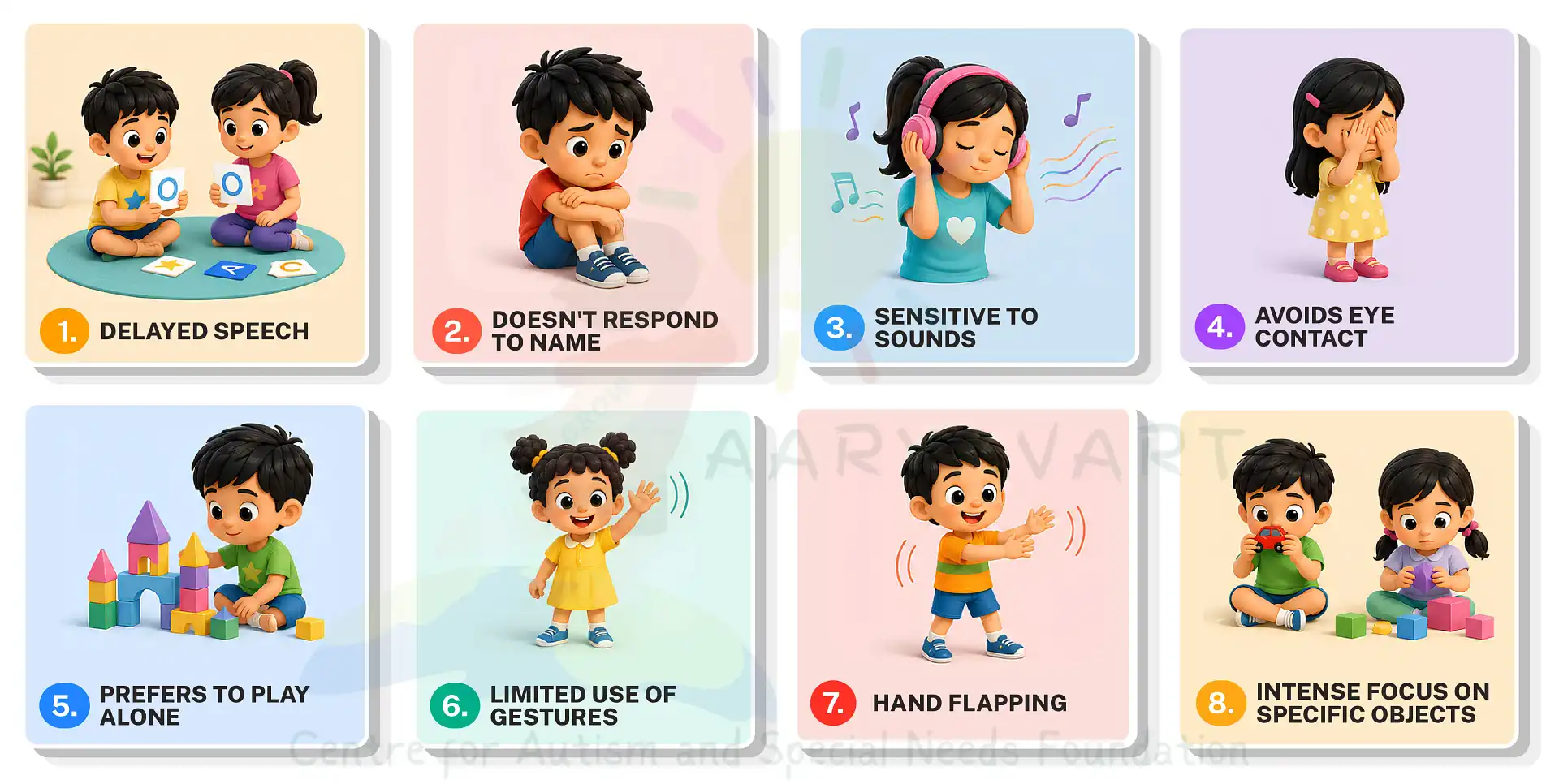
- Poor eye contact in toddlers — not looking at you during play, feeding, or when you speak to them
- Not responding consistently when their name is called
- Limited or no pointing to show interest (e.g., pointing at a bird or an airplane to share excitement)
- Not bringing objects to show you, or not looking where you point
- Preferring to play alone rather than seeking out parents or other children
- Little interest in pretend play (feeding a doll, "talking" on a toy phone)
- Flat or unusual facial expressions, or expressions that don't match the situation
- Not imitating sounds, gestures, or actions (waving bye-bye, clapping)
Speech and Language Signs (Autism Symptoms in a 2-Year-Old)
Speech delay autism is one of the most common reasons parents first seek help. By 24 months, most toddlers have 50+ words and are combining two words together. Watch for:
- Fewer than 15–20 words by 18 months, or fewer than 50 words / no two-word phrases by 24 months
- Loss of words or babbling they previously had (this is called regression and should never be dismissed as "just a phase")
- Unusual speech patterns — repeating phrases from TV or conversations out of context (echolalia)
- Not using gestures like waving or pointing alongside words
Behavioral and Sensory Signs
- Repetitive movements — hand-flapping, spinning, rocking, or repeatedly lining up toys instead of using them for pretend play
- Intense, narrow interests (fixating on wheels, letters, numbers, or specific objects)
- Strong reactions to sounds, lights, textures, or smells — either seeking them out or becoming distressed
- Insisting on sameness — strong distress with small changes in routine
- Unusual attachment to specific objects
- Difficulty with transitions between activities, often leading to meltdowns
What a 2-Year-Old With Autism Might Not Do
Sometimes what's _missing_ is more telling than what's present. Watch for the absence of:
- Showing you things just to share enjoyment (not just to get help)
- Following a point or a gaze to look at something interesting
- Simple pretend play
- Seeking comfort from a parent when hurt or upset
None of these signs alone confirms autism — many toddlers show one or two traits without being on the spectrum. What matters clinically is a cluster of these signs together, and whether they represent a delay or a regression from a skill your child already had.
How is Autism Diagnosed in Toddlers?
There's no blood test for autism. Diagnosis is based on developmental observation and structured tools, typically:
- Developmental screening — pediatricians use the M-CHAT-R (Modified Checklist for Autism in Toddlers) at the 18- and 24-month visits
- Comprehensive developmental evaluation — by a paediatric neurologist, developmental pediatrician, or child psychologist, assessing communication, behavior, motor skills, and social interaction
- Speech and occupational therapy assessments — to map specific delay areas
Because standard screening relies heavily on parent-reported checklists and a single clinic visit, many centres now combine it with objective, technology-assisted tools for a fuller picture.
The Role of Technology in Early Autism Screening
This is an area where autism screening has genuinely improved over the last few years. Traditional checklists depend on parents recalling behavior accurately — which is hard to do objectively about your own child. AI-based developmental screening tools now use eye tracking autism screening technology, where a toddler simply watches short videos on a tablet or screen, and the system measures digital biomarkers — visual attention patterns, gaze shifts, and response to social versus non-social stimuli — using machine learning child development models trained on large clinical datasets.
Aignosis, one of the platforms Aaryavart works with, is a good example of this approach: a non-invasive autism detection tool that uses eye-gaze tracking as an objective autism screening tool, rather than relying purely on subjective checklists. Because it's play-based, most toddlers complete it without any distress, and it gives clinicians additional data points alongside a hands-on developmental evaluation — never replacing clinical judgment, but supporting it.
Alongside this, Kidaura's digital assessment tools help our therapy team convert screening results into a structured, individualized therapy plan — so the transition from "we noticed some signs" to "here's what we're doing about it" is fast and evidence-based rather than a guessing game.
Why Early Intervention Before Age 3 Matters
A child's brain has its highest neuroplasticity in the first three years of life. Research consistently shows that children who begin speech, occupational, and behavioral therapy before age 3 show significantly stronger outcomes in communication, social skills, and independence than children who start later. This is the single biggest reason not to adopt a "wait and watch" approach if you're seeing multiple signs — early therapy doesn't just help, it changes the trajectory.
Normal Toddler Behavior vs. When to Be Concerned
| Typical toddler behavior | Signs worth evaluating |
|---|---|
| Shy with strangers but warms up | Consistently avoids eye contact even with familiar people |
| Says fewer words but points and gestures a lot | Doesn't point, gesture, or use words to communicate |
| Occasional tantrums over transitions | Extreme distress with almost any change in routine |
| Likes routines and repeated games | Rigid, repetitive behavior with no flexibility at all |
| Enjoys parallel play near other kids | Shows no interest in other children or shared attention |
If you're checking multiple boxes in the right-hand column, it's time for a professional assessment — not a search engine.
What to Do If You Notice These Signs
- Don't wait for the next pediatric visit. Book a developmental assessment as soon as you notice a pattern.
- Write down specific examples — what your child does or doesn't do, and since when — to share with the clinician.
- Get a multidisciplinary evaluation, not just a single opinion — ideally involving a paediatric neurologist, speech-language pathologist, and child psychologist together.
- Start early intervention immediately if a delay or ASD is identified — every month matters at this age.
How Aaryavart Centre Can Help
Aaryavart Centre for Autism and Special Needs Foundation is a government-registered NGO with a full multidisciplinary team — led by a paediatric neurologist trained at AIIMS and PGI Chandigarh, along with 50+ therapists, psychologists, and special educators. We combine hands-on clinical assessment with technology support from Aignosis and Kidaura, so your child's evaluation is thorough, objective, and fast.
If you've noticed any of the signs above in your 2-year-old:
- Book a free child assessment — our team will evaluate speech, behavior, sensory, and social development and recommend a clear next step
- Visit us in person at our centres in Lucknow, Gorakhpur, or Unnao — all government-registered and CCTV-secured
- Not in Uttar Pradesh, or based abroad? We offer full online therapy and parent training for NRI and international families
- Once therapy begins, track every goal, session update, and milestone through the Sarya app, so you're never left wondering how your child is progressing
Book a free assessment with Aaryavart Centre to get a clear, expert-led evaluation and next steps.
Signs of Autism in a 2‑Year‑Old FAQs
What is the biggest red flag for autism in a 2-year-old?
The single most consistent early red flag is a lack of joint attention — not pointing to share interest, not following a parent's point or gaze, and not bringing objects to show them. Combined with poor eye contact and limited words, this cluster is the strongest early indicator.
What does an autistic 2-year-old look like?
There's no single "look" — autism presents differently in every child. Common patterns include limited eye contact, delayed or absent speech, repetitive movements like hand-flapping or lining up toys, strong reactions to sensory input, and less interest in social play compared to peers.
How do I rule out autism in my 2-year-old?
You can't reliably rule it out at home. A formal developmental screening (like the M-CHAT-R) combined with a hands-on evaluation by a paediatric neurologist or developmental specialist is the only way to properly assess this. Aaryavart's assessment covers speech, behavior, sensory, and social development in one visit.
Can a 2-year-old show autism signs and not be autistic?
Yes. Speech delay, shyness, or sensory sensitivity alone don't confirm autism — many toddlers show isolated traits without being on the spectrum. What matters is whether multiple signs cluster together and whether they represent a delay or a regression.
Is autism screening painful or stressful for a toddler?
No. Modern screening — including play-based, eye-tracking tools like Aignosis — is designed to feel like a game to the child, with no invasive procedures involved.
At what age can autism be diagnosed?
Autism can be reliably diagnosed as early as 18–24 months by a qualified clinician, though some signs can be observed even earlier. Earlier diagnosis means earlier intervention, which significantly improves outcomes.
What should I do first if I suspect autism in my toddler?
Book a professional developmental assessment immediately rather than waiting for the next routine pediatric visit. Book a free assessment with Aaryavart Centre to get a clear, expert-led evaluation and next steps.