How to Build a Morning Routine Chart Your Child Will Actually Follow
Struggling with school-morning meltdowns? Build an ADHD-friendly morning routine chart that cuts stress and builds independence for your child.
If your mornings sound like a countdown to a meltdown, you're not doing anything wrong, and you're definitely not alone. Between finding the missing shoe, three reminders to brush teeth, and a breakfast that goes cold while everyone argues about socks, most families aren't losing the morning battle because of bad parenting. They're losing it because nobody's routine is actually built the way a child's brain works.
A morning routine chart fixes that. Done right, it's not a cute printable you stick on the fridge and forget about by Thursday. It's a visual system that tells your child exactly what comes next, without you having to say it twelve times. In this guide, you'll get a step-by-step way to build one, age-by-age examples, and specific tweaks for kids with ADHD, whose mornings often fall apart for reasons that have nothing to do with effort or attitude.
This guide is written with input from child development specialists and psychologists whose team works daily with families building exactly these routines for autistic, ADHD, and neurotypical kids.
Why Mornings Fall Apart for Kids Who Struggle With Routines
Before you build a chart, it helps to know why the current system (the one where you call out instructions one at a time) isn't working. It's rarely about willpower.
A verbal routine asks a child to hold four or five steps in their head, remember the order, and start each one without being told. That's a heavy lift for a young or still-developing brain, and it's an especially heavy lift for a kid with ADHD. In the US, an estimated 7 million children aged 3 to 17, about 11.7% of that age group, currently have an ADHD diagnosis, according to the CDC's national survey data. That's roughly one child in most classrooms, and a huge number of the households reading this.
What the Research Actually Says
The reason a chart works where nagging doesn't comes down to how executive function develops.
- The American Academy of Pediatrics puts it plainly: "Daily routines are an absolute necessity for many children with ADHD," according to HealthyChildren.org, the AAP's parent resource site.
- CHADD, the national organization for children and adults with ADHD, explains the visual piece even more directly. As their Attention Magazine article notes, "executive function is fundamentally visual: you need to 'see' the task or goal completed" (Dryer & Nicolet, CHADD).
In plain terms: a verbal instruction disappears the moment you finish saying it. A picture on the wall doesn't. That's the whole case for a chart, and it's also why a text-only chart undersells what a visual one can do.
What Makes a Morning Routine Chart Actually Work
Not every chart works, and that's usually a design problem, not a discipline problem. The charts that actually stick tend to share four things in common.
Pictures Before Words
If your child isn't reading fluently yet, or gets overwhelmed easily, a wall of text is just noise. Icons or real photos of your child doing each step (brushing their own teeth, tying their own shoes) work far better than a written list, because recognizing a picture takes less mental effort than decoding a sentence.
The Same Order, Every Day
Predictability is doing most of the work here. When the sequence never changes, your child stops having to decide what's next and just follows it. Every time you rearrange the order "just this once," you reset that automatic pattern.
A Warning Before Every Switch
Kids rarely resist the next task itself. They resist being pulled out of the current one with no notice. Giving a heads-up ("two more minutes of breakfast, then shoes") before each transition is a small habit that prevents most of the friction. It's a principle the CDC also flags for classrooms managing ADHD, and it holds just as well at your kitchen table as it does at a school desk, per the CDC's guidance on ADHD support strategies.
Limited Choices, Not Open Questions
"What do you want to wear?" invites a debate. "The blue shirt or the green one?" doesn't. The AAP recommends this exact swap for parents building structure at home, and it's one of the easiest tweaks to apply to any step on your chart, from HealthyChildren.org.
If your child needs support beyond the morning window too, our guide to a visual schedule for autism covers the same visual-first principles applied across a full day.
Building Your Morning Routine Chart, Step by Step
Once you understand why visual, predictable, low-choice routines work, building the actual chart is mostly a matter of following these steps in order:
- List every task in the real sequence. Not the order you wish it happened in, the order it actually does, from the moment your child wakes up to the moment they're out the door.
- Break big tasks into small ones. "Get dressed" becomes underwear, then pants, then shirt. "Brush teeth" becomes wet the brush, brush for two minutes, rinse. Smaller steps are easier to picture and easier to check off.
- Pick pictures over text for any step your child can't independently read yet, or any step that tends to cause a meltdown.
- Post it where the task actually happens. A getting-dressed chart belongs in the bedroom, not the kitchen. If it's not physically in front of your child at the right moment, it won't get used.
- Walk through it together first, calmly, on a weekend or a day with no time pressure. The first time your child sees the chart should never be a rushed Monday morning.
- Add a simple way to mark progress, a magnet, a sticker, or a tap on a board. The point is visible progress, not a prize for every single step.
- Review and adjust weekly, at least for the first month. A chart your four-year-old outgrows by five isn't a failed chart, it's just time for the next version.
Morning Routine Chart Ideas by Age
A chart that works for a four-year-old will frustrate a nine-year-old, and vice versa. Here's roughly what to aim for at each stage:
Toddler and Preschool (Ages 2 to 5)
Keep it to three or four big steps: wake up, get dressed, eat breakfast, put on shoes. Skip time references entirely at this age; a toddler can't yet connect "8:15" to anything meaningful. Physical objects (a real toothbrush icon, a real shoe icon) work better than abstract symbols.
Early Elementary (Ages 6 to 9)
This is where a chart can grow to six or eight steps, combine simple icons with short words, and introduce an actual visual timer so your child starts connecting routine steps to time passing, not just to sequence.
Tween (Ages 10 and Up)
By now, most kids do better with more ownership and less hand-holding: a shorter list they check off themselves, and often a shift from a chart on the wall to a version on a device or planner they manage independently.
Making a Morning Routine Chart ADHD-Friendly
A standard chart is a great start, but a chart built for a kid with ADHD needs a few specific adjustments, because the challenge usually isn't remembering the steps. It's time blindness and getting stuck between one task and the next.
- Show fewer steps at once. A long visible list is overwhelming; consider covering or hiding future steps so your child only sees what's immediately next.
- Use a visual timer instead of a clock. Kids with ADHD-related time blindness process a shrinking colored bar far more intuitively than numbers on a clock face.
- Build in a movement break. Expecting a child to sit still through five focus-heavy steps in a row is unrealistic; a 30-second jump or stretch between steps resets attention.
- Consider a step-by-step visual chart if task-switching is the sticking point. A chart that clearly highlights "what's next?" removes guesswork entirely.
Paper Chart, Free Printable, or Digital Routine? Choosing the Right Format
Most parents searching for a morning routine chart are picturing a printable, and that's a completely reasonable place to start. Here's how the three real options actually compare:
- Paper or DIY chart: Free and fully customizable, and often the right first step for a toddler. The downside is that nothing reminds your child what's next once you walk away, and it doesn't survive a spilled bowl of cereal.
- Printable PDF template: Faster to set up than DIY, but has the same core limitation. Someone still has to remember to flip the chart or point to the next step.
- Visual routine app or board: This is where interactive tools change the equation. The chart advances step-by-step, provides visual cues, and quietly tracks progress without turning the morning into a bribery negotiation.
If you've been relying on printables and still find yourself repeating instructions, that's usually the format hitting its limit, not your child failing to follow it.
Common Mistakes That Make a Morning Routine Chart Fail
Most charts that stop working fail for one of a small handful of reasons, and almost none of them mean you need to give up on the idea:
- Too many steps at once. More than eight to ten visuals on a single chart tends to overwhelm rather than guide.
- All text, no pictures. This defeats the purpose for pre-readers and for any child who's stressed and not in reading mode.
- Changing the chart too often. Predictability is the entire mechanism behind why this works; editing it every few days resets your child's learning curve each time.
- Introducing it on a rushed morning. The first run-through should always happen calmly, never live during a school-day scramble.
- Turning it into a punishment or reward battleground. The chart is meant to guide, not to become one more thing you and your child argue over.
Sample School Morning Routine You Can Copy Today
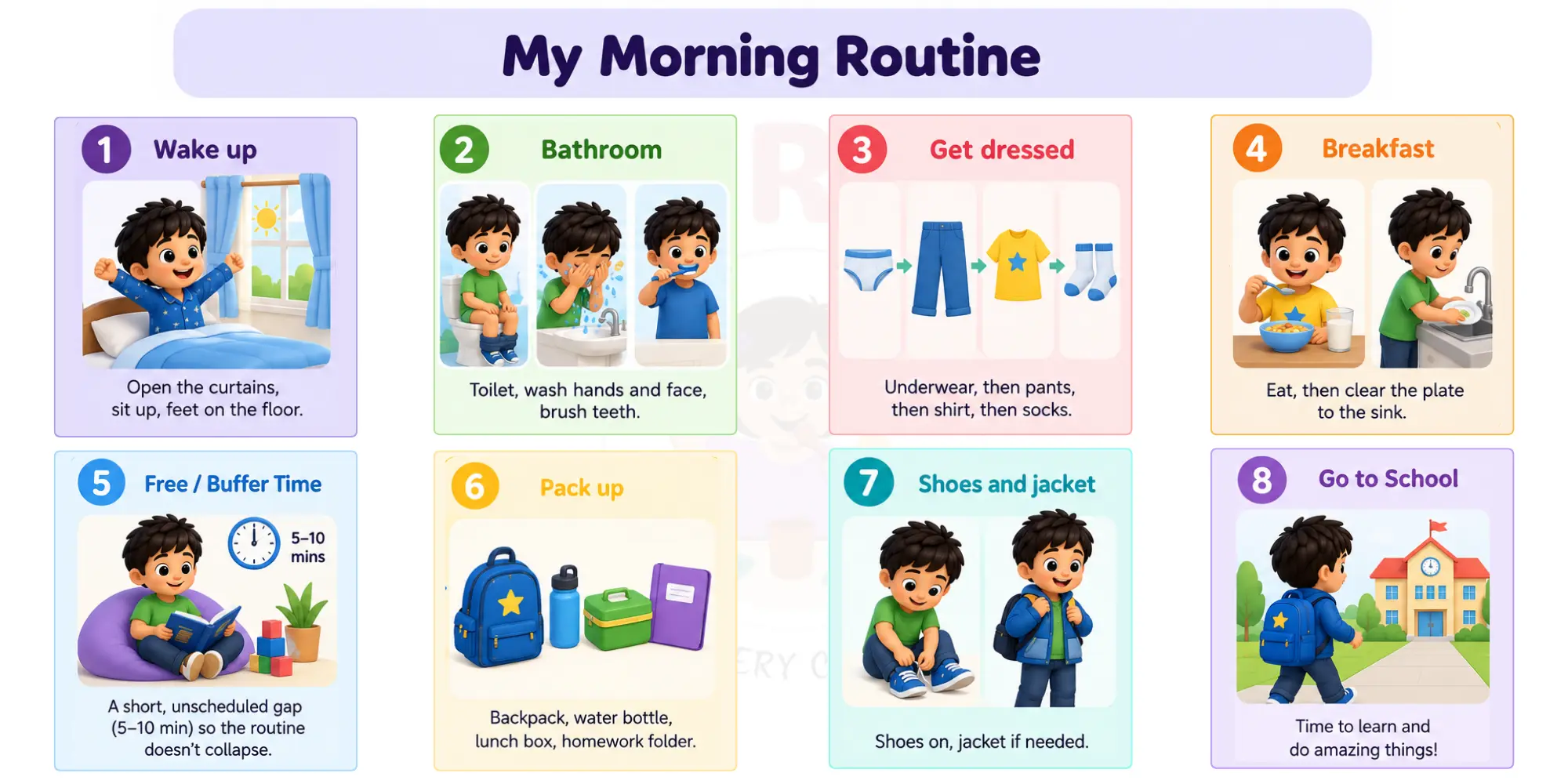
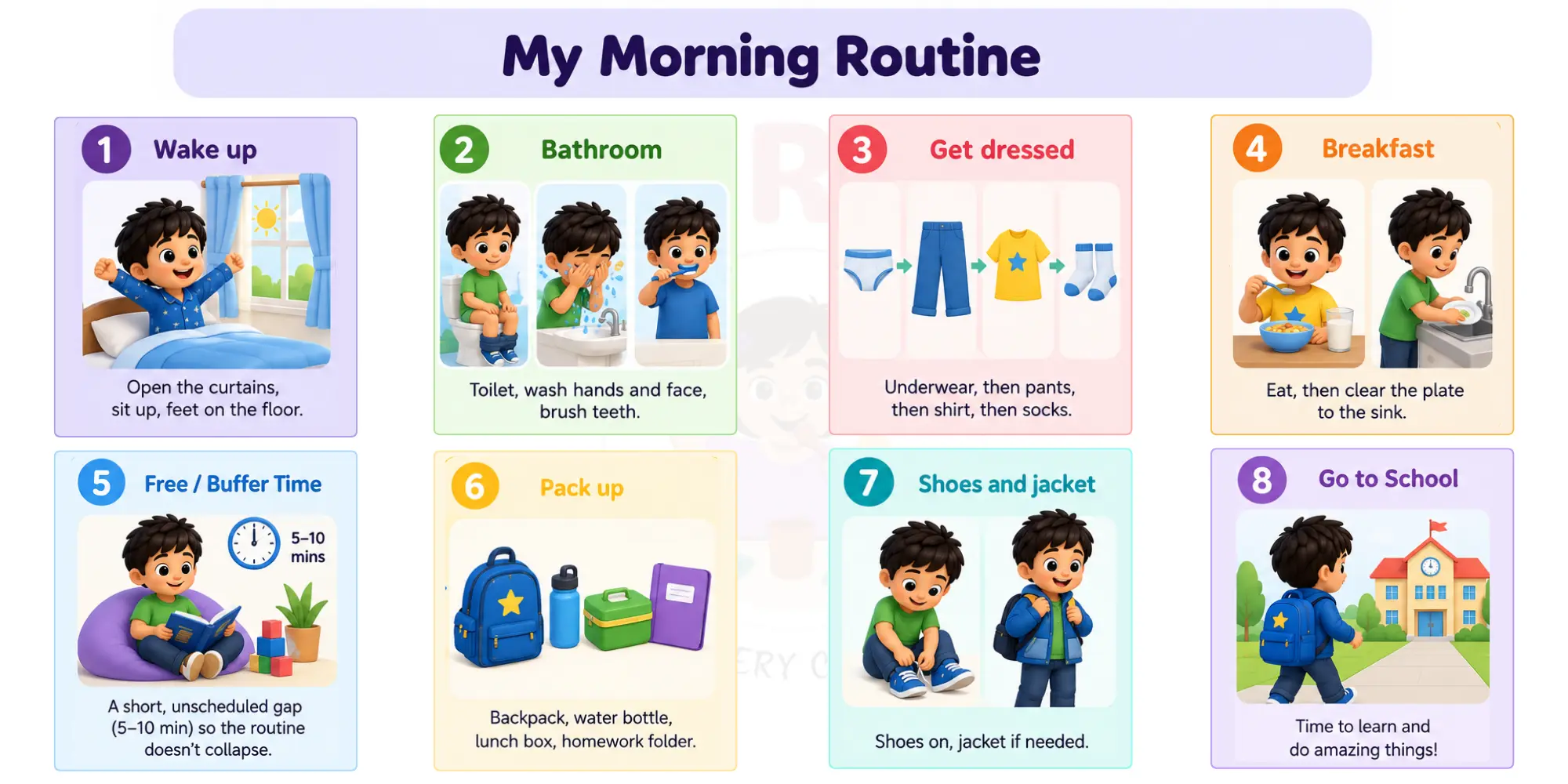
A school morning routine is simply the fixed sequence of steps your child follows from wake-up to walking out the door, usually inside a 45 to 60 minute window. Here's a sample chart you can copy directly and adjust to your child's age and school start time:
- Wake up (7:00 am): open the curtains, sit up, feet on the floor.
- Bathroom (7:05 am): toilet, wash hands and face, brush teeth.
- Get dressed (7:15 am): underwear, then pants, then shirt, then socks.
- Breakfast (7:25 am): eat, then clear the plate to the sink.
- Pack up (7:45 am): backpack, water bottle, lunch box, homework folder.
- Shoes and jacket (7:55 am): shoes on, jacket if needed.
- Out the door (8:00 am).
For toddlers, stretch this to a longer, looser window and drop the pack-up step. For tweens, compress it and let them self-check each item without a reminder. The structure stays the same; only the pacing and independence level change.
When a Chart Isn't Enough: Signs to Talk to a Professional
A morning routine chart is a genuinely powerful daily support tool, but it isn't a diagnosis, and it isn't therapy. It's worth being honest about where its job ends.
Consider talking to a professional if:
- Meltdowns during the morning are frequent, intense, or last well beyond the transition that triggered them.
- A consistently used, well-built chart still isn't helping after four to six weeks.
- You notice signs that go beyond "mornings are hard," like difficulty with communication, sensory overwhelm, or behavior that's affecting school and home life more broadly.
If any of that sounds familiar, Aaryavart Centre's behaviour therapy team works specifically with both ADHD and autism, in person across their centres and online for families anywhere. You can also start with their assessment booking if you'd rather begin with a professional evaluation than a therapy commitment.
Build the Routine, Not Just the Chart
A morning routine chart isn't magic, and no chart replaces a calm five minutes of practice or a parent who's willing to adjust it when it stops working. But built the right way—visual, predictable, and sized to your child's actual age and needs—it can turn your worst hour of the day into one that mostly runs itself.
If you want professional guidance on building routines and supporting child behavior, book a consultation with Aaryavart Centre today.
Build a Morning Routine Chart FAQs
What age should I start using a morning routine chart?
As early as 2 to 3 years old, once your child can recognize simple pictures. Keep it to three or four big steps at that age, and add detail gradually as they move into early elementary school.
How do I make a morning routine chart for a child who can't read yet?
Use photos or simple icons instead of words for every step, and keep the sequence identical every single day. A pre-reader recognizes "what's next" from the picture, not from reading the label next to it.
What's the difference between a morning routine chart and a chore chart?
A morning routine chart walks a child through a fixed daily sequence (wake up, dress, brush teeth, eat, shoes, bag). A chore chart tracks optional or rotating responsibilities, like feeding a pet. Routines are about predictability; chores are about contribution. Mixing the two on one chart usually makes both less effective.
Is a picture-based chart or a digital chart better for a child with ADHD?
Both rely on the same visual principle, but a digital chart can do something paper can't: advance itself, send a gentle reminder, and use a visual timer, all of which directly target the time blindness and task-switching difficulty that make mornings hardest for kids with ADHD.
Should I use rewards or stickers with a morning routine chart?
A simple check-off usually works better than a reward tied to every single step; the goal is visible progress your child can see, not a negotiation at each item. If you do use rewards, tie them to consistency over a week rather than to any one morning.
My child ignored the chart after the first week. What should I do?
This is common, and it usually means one of three things: too many steps, a first introduction on a rushed morning instead of a calm one, or a chart your child had no say in building. Trim it back to essentials and rebuild it with your child's input rather than assuming the format itself failed.
Can a morning routine chart help a child without a diagnosis?
Yes. Visual routines and predictable structure benefit any child, with or without ADHD or autism. That said, if mornings stay consistently difficult despite a well-built chart, that pattern is worth mentioning to your pediatrician.
When should we see a professional instead of just using a chart?
If meltdowns are frequent and intense, or a consistent chart hasn't helped after four to six weeks, it's a reasonable time to talk to a professional. Aaryavart Centre's behaviour therapy team supports both ADHD and autism, with in-person centres and online options for families anywhere.
Does a visual morning routine chart work for children with autism, ADHD, or Down syndrome?
Yes. A visual routine builder is designed to work across autism, ADHD, and Down syndrome, with clear visual icons built in from the start. If your child needs an all-day system rather than a morning-only one, see our full child development and therapy resources.