
Food List for Autism: What Parents Should Feed to Their Autistic Child
A practical food list for autism with meal ideas, picky eating tips, foods to limit, and when to seek expert feeding or nutrition guidance.

Many parents search for a food list for autism because mealtimes have become stressful. Their child may eat only a few foods, reject fruits or vegetables, avoid certain textures, gag easily, prefer crunchy snacks, or insist on the same meal every day.
This does not mean the child is being stubborn. For many autistic children, food is connected with sensory sensitivity, routine, smell, texture, digestion, oral-motor comfort, and anxiety around new experiences.
The goal is not to find a “magic autism diet.” Food cannot cure autism. But the right food plan can support growth, energy, digestion, immunity, sleep, attention, and daily regulation. Mayo Clinic notes that children with autism may eat only a few foods, prefer processed foods, and eat fewer fruits, vegetables, and whole grains. It also warns that restrictive diets can increase the risk of nutritional deficiencies if not planned carefully.
At Aaryavart Centre, we usually tell parents one simple thing: first understand why the child is refusing food, then build the food plan around the child’s real needs.
What is the Best Food List for Autism?
A good autism food list is not a strict chart that every child must follow. It should include nutritious foods from different groups, while respecting the child’s sensory comfort, chewing ability, digestion, allergies, and current eating pattern.
Here is a practical food list parents can use as a starting point. This autism food chart is not a strict diet plan. It is a parent-friendly guide to help you choose balanced foods and slowly expand your child’s accepted food range.
| Food Group | Autism-Friendly Options | Why It Helps |
|---|---|---|
| Protein | Dal, eggs, paneer, curd, tofu, fish, chicken, beans | Supports growth, muscle health, and satiety |
| Whole grains | Rice, roti, oats, dalia, poha, idli, millet, ragi | Gives steady energy and fibre |
| Fruits | Banana, apple, papaya, orange, berries, chikoo | Adds vitamins, fibre, and natural sweetness |
| Vegetables | Carrot, pumpkin, cucumber, spinach, peas, beetroot | Supports micronutrients and digestion |
| Healthy fats | Ghee in moderation, nuts paste, seeds, avocado, fish | Supports calories and healthy fat intake |
| Calcium foods | Milk, curd, paneer, ragi, fortified foods | Supports bone and dental health |
| Iron foods | Lentils, beans, spinach, eggs, meat, jaggery in moderation | Supports energy and growth |
Start with foods your child already accepts. Then slowly expand the range instead of suddenly changing the whole plate.
Why Autistic Children May Be Picky Eaters
Food selectivity in autism is often deeper than ordinary picky eating. A child may reject a food because of its smell, colour, sound, temperature, texture, shape, or the way it looks on the plate.
Some children are comfortable with soft foods. Some want only crunchy foods. Some avoid mixed textures like pulao, poha, or sabzi mixed with roti. Some get upset if two foods touch each other.
A 2026 review in _Nutrition Reviews_ reported higher food selectivity in children with autism across several studies. In one included study, 64.4% of children with ASD showed food selectivity compared with 43% of children in the comparison group.
Common reasons behind food refusal include:
- Texture sensitivity
- Smell sensitivity
- Fixed food routines
- Fear of new foods
- Oral-motor difficulty
- Chewing difficulty
- Constipation or reflux
- Anxiety during meals
- Past gagging or vomiting
- Difficulty sitting at the table
- Sensory overload during mealtime
This is why a child who eats chips but refuses roti may not simply be “choosing junk.” The child may be choosing predictability, crunch, salt, or a texture that feels safer.
Foods That May Support Autistic Children
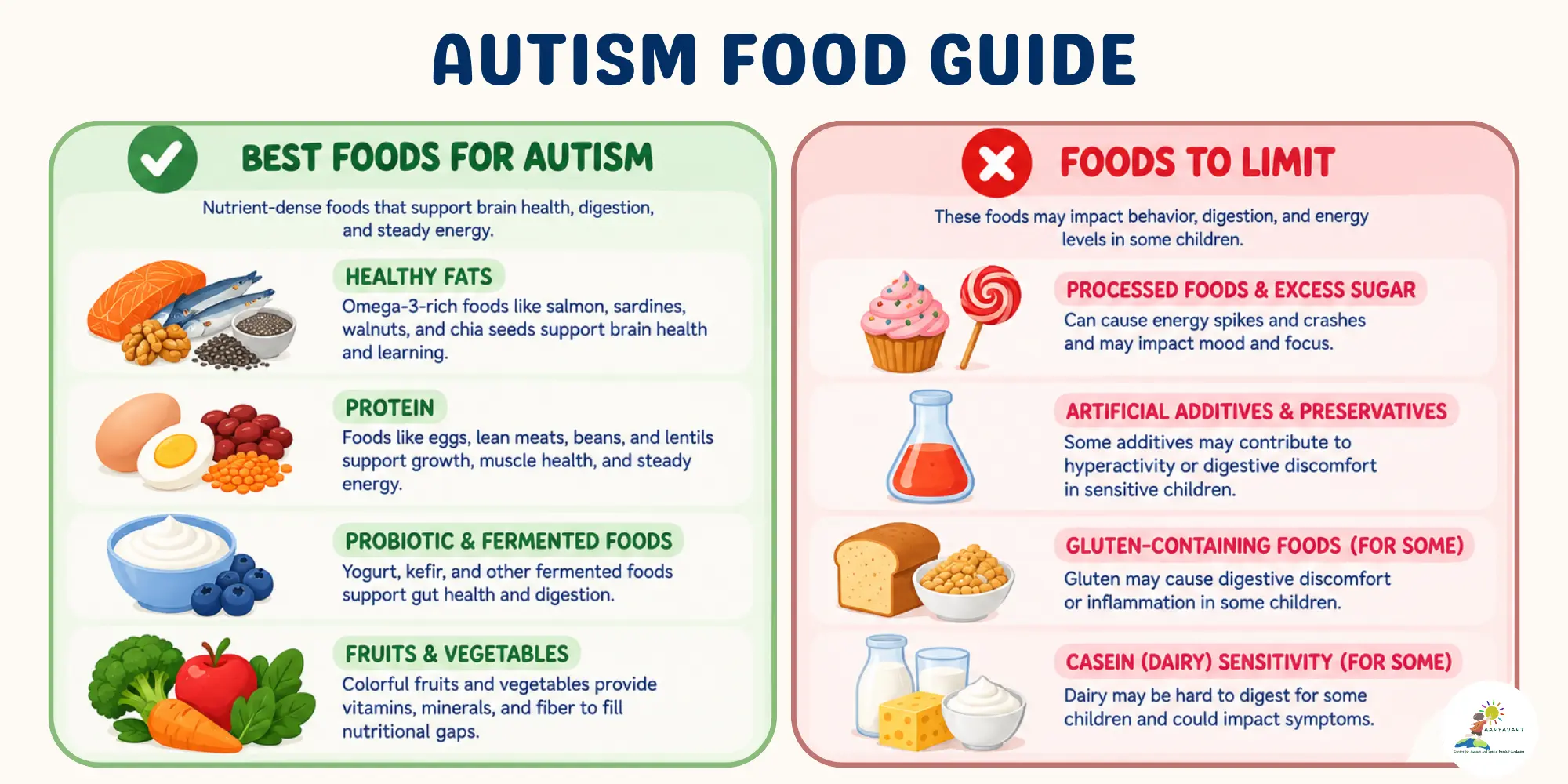
This section is not about special miracle foods. It is about building a balanced autism meal plan that supports the child’s body while keeping meals realistic for the family.
Protein-Rich Foods
Protein helps with growth, energy, and fullness. For children who eat very few foods, protein intake may become low if they avoid dal, dairy, eggs, meat, beans, or nuts.
Simple protein options include:
- Moong dal chilla
- Dal khichdi
- Curd rice
- Paneer cubes
- Egg bhurji
- Soft chicken
- Fish, if accepted
- Tofu
- Peanut paste, only if there is no allergy
- Sprouts, if the child can chew safely
If your child rejects protein foods, do not force big portions. Try small exposure, familiar textures, or mixing protein into accepted foods.
Fibre-Rich Foods
Fibre supports digestion and may help with constipation. This matters because many autistic children experience gastrointestinal issues. Mayo Clinic notes that children with autism tend to have more GI symptoms such as abdominal pain, constipation, and diarrhea compared with peers.
Fibre-rich options include:
- Fruits
- Vegetables
- Oats
- Dal
- Beans
- Whole wheat roti
- Brown rice, if accepted
- Chia or flax seeds, only when age-appropriate and advised
For children with strong texture aversion, fibre can be added gradually through soups, smoothies, mashed dal, soft khichdi, or finely grated vegetables.
Calcium and Vitamin D Foods
Calcium and vitamin D are important for bones, teeth, and growth. This becomes especially important if a child avoids milk, curd, paneer, or follows a dairy-free diet.
Useful options include:
- Milk
- Curd
- Paneer
- Ragi
- Fortified foods
- Doctor-advised supplements, if needed
Mayo Clinic recommends that children with autism and their families work with a care team that can assess whether the child’s diet is meeting nutrient needs, even if growth appears normal.
Fruits and Vegetables
Many children with autism avoid fruits and vegetables because they vary in smell, colour, texture, and moisture. One banana may feel different from another banana. One apple may be crunchy, another may be soft. That unpredictability can be hard for a sensory-sensitive child.
Try:
- Banana slices
- Apple sticks
- Papaya cubes
- Cucumber sticks
- Carrot sticks
- Pumpkin soup
- Spinach paratha
- Vegetable puree mixed into dal or khichdi
Keep the portion tiny in the beginning. Even touching or smelling a new food can be progress.
Indian Food List for Autistic Children
Indian families do not always need imported foods or complicated diet plans. Many home foods can work well when prepared in a child-friendly texture.
Breakfast Ideas
A predictable breakfast can make the day easier, especially for children who struggle with transitions.
Good options include:
- Idli with chutney
- Dalia with banana
- Besan chilla
- Vegetable poha
- Ragi dosa
- Oats with fruit
- Egg with toast
- Curd with fruit
Lunch Ideas
Lunch should be filling, familiar, and easy to chew. For many children, soft textures work better than dry or mixed textures.
Try:
- Dal rice with ghee
- Khichdi with soft vegetables
- Roti with paneer
- Curd rice
- Soft vegetable pulao
- Rajma rice, if tolerated
- Rice with fish or chicken
Snack Ideas
Snacks are a good place to slowly introduce variety without putting pressure on the main meal.
Try:
- Roasted makhana
- Banana
- Apple slices
- Fruit smoothie
- Boiled egg
- Paneer cubes
- Homemade cutlet
- Peanut chikki, only if safe
- Cucumber sticks
Dinner Ideas
Dinner should be calming and easy to digest. Avoid making dinner the main battleground for new foods.
Try:
- Dal khichdi
- Soft roti with sabzi
- Soup with rice
- Paneer bhurji
- Curd rice
- Moong dal dosa
- Vegetable upma
Every child’s needs are different. Adjust food based on age, chewing ability, allergies, digestion, medical advice, and family food habits.
Foods to Limit for Autistic Children
Parents often ask about foods to avoid for autism. The honest answer is that no single food needs to be avoided by every autistic child.
But some foods should be limited because they can crowd out nutrition or worsen digestion in some children.
Foods Better Kept Occasional
Try to reduce:
- Sugary drinks
- Excess packaged snacks
- Frequent fried foods
- Very high-salt foods
- Artificially coloured sweets
- Caffeinated drinks
- Foods that clearly trigger allergy, reflux, constipation, or discomfort
The aim is not to create fear around food. The aim is to slowly make the child’s diet more balanced.
Should You Try a Gluten-Free or Casein-Free Diet?
Many parents hear about gluten-free or casein-free diets for autism. This is one of the most searched and most misunderstood areas of autism nutrition.
Gluten is found in wheat, barley, and rye. Casein is found in milk and dairy products. Some children may need to avoid these foods because of celiac disease, allergy, lactose intolerance, or specific medical reasons. But that is different from saying every autistic child should avoid them.
Mayo Clinic states that there is little evidence that diet triggers autism or that restricting gluten and casein improves autism symptoms. It also warns that restrictive diets can lead to nutritional deficiencies in growing children.
Before starting a restrictive diet:
- Speak to a pediatrician or qualified dietitian.
- Check for allergy, intolerance, celiac disease, or GI concerns.
- Do not remove major food groups suddenly.
- Plan proper replacements for calcium, protein, fibre, and vitamins.
- Track the child’s growth, stool, sleep, and energy.
Aaryavart’s Nutrition Guidance takes the same practical approach: nutrition support should fit the child’s sensory preferences, digestive comfort, growth needs, and therapy plan, instead of becoming a generic diet sheet.
How to Introduce New Foods Without Pressure
Introducing new foods to an autistic child requires patience. A child may need to see, smell, touch, lick, or tolerate a food many times before eating it.
The CDC suggests serving new foods with foods the child already likes and allowing repeated exposure. It notes that some children may need 8 to 10 exposures before trying a new food.
A Simple Step-by-Step Method
Use this process calmly:
- Keep one safe food on the plate.
- Add a very small amount of one new food.
- Let the child look, touch, or smell it first.
- Do not force a bite.
- Praise small progress, such as tolerating the food nearby.
- Repeat the same food across multiple days.
- Change only one thing at a time, such as shape, texture, or portion.
- Track what the child accepts, rejects, or tolerates.
For children who struggle with routines, visual structure can help. Sarya supports autistic, ADHD, and neurodiverse children with visual routines, ADL skills, voice prompts, and progress tracking, which can make daily routines like mealtime more predictable.
When Food Issues Are Sensory, Behavioural, or Medical
Food refusal can have more than one reason. A child may refuse food because of sensory sensitivity, but also because of constipation, reflux, chewing difficulty, anxiety, or learned mealtime stress.
Sensory Signs
Food refusal may be sensory-related if the child:
- Rejects food by smell or texture
- Eats only crunchy or soft foods
- Avoids mixed textures
- Gags on certain foods
- Gets upset when foods touch
- Refuses foods of certain colours
For sensory-based food challenges, Sensory Therapy and Occupational Therapy may help.
Behavioural Signs
Food refusal may be behaviour-linked if the child:
- Eats better with certain people
- Refuses food after conflict
- Uses mealtime to escape demands
- Accepts food only with screens
- Has strong routines around brand, plate, place, or timing
Here, parent training and behaviour support may be useful.
Medical Signs
Speak to a doctor if the child has:
- Frequent vomiting
- Chronic constipation
- Diarrhea
- Reflux symptoms
- Poor weight gain
- Sudden appetite change
- Pain after eating
- Suspected allergy
- Chewing or swallowing difficulty
Food issues should never be dismissed as “just autism” when there may be a medical concern.
When Should Parents Seek Professional Help?
A basic food list is useful, but some children need proper assessment and feeding guidance.
Consider professional help if your child:
- Eats fewer than 10 to 15 foods
- Avoids entire food groups
- Depends mostly on packaged foods
- Has daily mealtime meltdowns
- Gags, vomits, or chokes often
- Has poor weight gain or low energy
- Refuses food by texture, smell, or colour
- Cannot sit for meals
- Has constipation, reflux, or stomach pain
- Has chewing, swallowing, or oral-motor concerns
At Aaryavart Centre, feeding and nutrition guidance is coordinated with Autism Therapy, Occupational Therapy, Sensory Therapy, Speech Therapy, and parent training. Support is available at Lucknow, Gorakhpur, Unnao, and online.
How Aaryavart Helps With Autism Nutrition and Feeding
Food challenges in autism are rarely only about food. That is why Aaryavart looks at the full child.
The team may assess:
- Current accepted foods
- Food texture preferences
- Sensory sensitivities
- Oral-motor skills
- Mealtime behaviour
- Digestion concerns
- Growth and nutrition gaps
- Sitting tolerance
- Parent routine and home environment
Based on the assessment, parents may receive:
- A practical food expansion plan
- Feeding and nutrition guidance
- Sensory strategies for mealtime
- Parent coaching
- Home routine support
- Coordination with OT, speech, autism therapy, or behaviour therapy
- Online follow-up when needed
You can start with Child Assessment or Nutrition Guidance.
Conclusion
A food list for autism should not be treated like a cure plan. The right approach is to support the child’s health, respect sensory needs, reduce mealtime stress, and slowly build food variety.
Start with foods your child can already tolerate. Add variety gently. Avoid unnecessary restrictive diets. Watch for sensory, behavioural, and medical reasons behind food refusal. And if eating is affecting your child’s health, growth, mood, sleep, therapy, or daily routine, take professional guidance early.
Worried about limited food choices, sensory food refusal, or mealtime meltdowns? Book an assessment with Aaryavart Centre and get a practical feeding and nutrition plan built around your child’s real needs.
Food List for Autism FAQs
What is the best food list for autism?
There is no single best food list for every autistic child. A balanced list may include protein foods, fruits, vegetables, whole grains, healthy fats, calcium-rich foods, and fibre-rich foods, depending on the child’s sensory needs, digestion, allergies, and current food acceptance.
Which foods are good for autistic children?
Good options include dal, rice, eggs, curd, paneer, fruits, vegetables, oats, ragi, fish, chicken, beans, and soft home-cooked meals. The best foods are nutritious foods your child can safely accept and gradually expand from.
What foods should autistic children avoid?
No food needs to be avoided by every autistic child. Limit excess sugar, packaged snacks, fried foods, caffeinated drinks, and foods that clearly trigger allergy, reflux, constipation, or discomfort. Avoid restrictive diets unless advised by a qualified professional.
Is gluten-free food good for autism?
A gluten-free diet is not proven to treat autism. It may be needed if the child has celiac disease, wheat allergy, or medically confirmed intolerance. Do not remove gluten without medical or dietitian guidance.
Is dairy bad for autistic children?
Dairy is not automatically bad for autistic children. If a child tolerates milk, curd, or paneer, these can provide protein and calcium. If dairy causes symptoms, speak to a pediatrician or dietitian before removing it.
Why does my autistic child eat only a few foods?
This may happen because of sensory sensitivity, fixed routines, anxiety, oral-motor difficulty, constipation, reflux, or fear of new foods. An assessment can help identify the actual reason.
Can occupational therapy help with food issues?
Yes. Occupational therapy can help when food refusal is linked to sensory sensitivity, texture aversion, sitting difficulty, oral-motor concerns, or self-care routines.
Does Aaryavart provide feeding and nutrition guidance?
Yes. Aaryavart provides nutrition and feeding guidance for children with autism, sensory food issues, restricted eating, digestive concerns, and mealtime challenges. Support is available at Lucknow, Gorakhpur, Unnao, and online.
Can visual routines help with mealtime?
Yes, some children eat better when routines are predictable. Visual schedules, step-by-step prompts, and consistent mealtime structure can reduce anxiety. Tools like Sarya can support visual routines and daily living skills for neurodiverse children.