Developmental Delay Symptoms in Children: Signs to Watch For
Worried your child isn't hitting milestones? Learn the real developmental delay symptoms in children, causes, and next steps — from India's trusted care team.

Every parent compares. You watch your child next to a cousin, a neighbor's kid, a classmate — and sometimes a quiet worry creeps in: _is my child a little behind?_ Most of the time, kids catch up at their own pace. But sometimes that instinct is picking up on something real. Knowing the actual developmental delay symptoms in children — not guesses from a WhatsApp forward — is the first step to getting your child real help, early.
What Is a Developmental Delay?
A developmental delay means a child isn't reaching expected milestones such as in movement, speech, thinking, or social skills at the pace typical for their age. According to clinical guidance, a developmental delay simply means a child is slower than their peers to reach one or more milestones; it doesn't automatically mean a lifelong condition, and many delays improve significantly with early support.
When a delay affects two or more areas of development at once — for example, both speech and motor skills — it's called Global Developmental Delay (GDD), a term Indian parents increasingly search for and one pediatricians use often in early evaluations.
The Four Areas of Child Development to Watch
Delays are usually grouped into four categories. A child can have a delay in just one area, or several:
- Gross motor skills – sitting, crawling, walking, running, climbing stairs
- Fine motor skills – grasping objects, using a spoon, stacking blocks, drawing
- Speech and language – babbling, first words, following instructions, forming sentences
- Cognitive and social-emotional skills – problem-solving, imaginative play, eye contact, responding to their name, interacting with others
Developmental Delay Symptoms in Children by Age
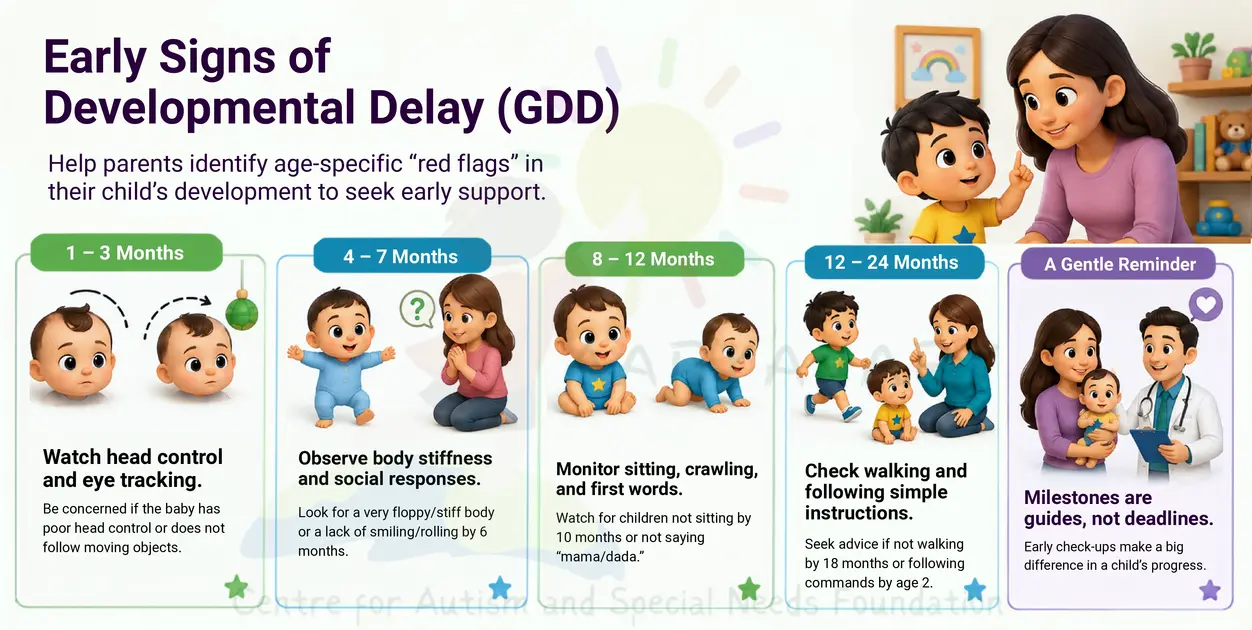
- By 12 months – Not sitting without support, not babbling, not responding to their name, not making eye contact.
- By 18 months – Not walking, fewer than 6 words, not pointing to show interest, not imitating actions like waving.
- By 24 months – Fewer than 50 words or no two-word phrases, not following simple instructions, not engaging in pretend play, frequent falling or difficulty with stairs.
- By 3 years – Difficulty with simple puzzles, unclear speech that even family struggles to understand, trouble with short sentences, poor balance or coordination.
Not every child hitting a milestone a little late has a developmental delay — but a cluster of missed milestones, or losing a skill they once had (regression), should never be dismissed as "he'll grow out of it."
Global Developmental Delay vs. Autism: What's the Difference?
This is one of the most common points of confusion for parents. Global Developmental Delay describes a _pattern of delays_ across multiple developmental areas while autism spectrum disorder (ASD) is a specific neurodevelopmental condition with its own diagnostic criteria, centered on social communication differences and repetitive behaviors. A child can have GDD without autism, autism without GDD, or both together. This is exactly why a proper evaluation matters more than a label picked up from a web search; the therapy plan differs significantly depending on which it is, or whether it's both.
What Causes Developmental Delay in Children?
Causes vary widely and, in many children, are never fully identified. Recognized contributors include:
- Premature birth or low birth weight
- Genetic conditions (e.g., Down syndrome, Fragile X syndrome)
- Complications during pregnancy or birth
- Hearing or vision impairment that goes undetected
- Chronic illness or nutritional deficiencies in early childhood
- Limited early stimulation or interaction (sometimes seen with excessive screen exposure at very young ages)
Importantly, a cause is not required for treatment to begin. Early intervention starts based on the delay itself, not on finding a reason for it first.
How Is Developmental Delay Diagnosed?
There's no single test. Diagnosis is a structured process:
- Developmental screening – pediatricians use standardized tools like the Ages and Stages Questionnaire (ASQ) at routine checkups, typically at 9, 18, and 30 months
- Comprehensive evaluation – by a paediatric neurologist or developmental pediatrician, assessing all four developmental domains
- Specialist assessments – speech-language, occupational therapy, and psychological evaluations to map exactly where the delay lies
- Hearing and vision screening – to rule out sensory causes that can look like developmental delay but have a completely different fix
How Technology Supports Early Screening
Traditional screening leans heavily on questionnaires and a single clinic visit — useful, but subjective. AI-based developmental screening tools are increasingly used alongside clinical evaluation to add an objective layer of data. Aignosis, one of the technology partners we work with, uses eye tracking autism screening — a child watches short videos on a tablet while the system measures digital biomarkers: gaze patterns, attention shifts, and response to social versus non-social stimuli, powered by machine learning child development models trained on large clinical datasets.
This makes Aignosis a genuinely non-invasive autism detection and objective autism screening tool — play-based, quick, and something most toddlers complete without distress. It doesn't replace a clinician's evaluation; it gives your child's clinical team more objective data to work with, alongside the hands-on assessment.
Once a delay area is identified, Kidaura's assessment-to-therapy-plan tools help our team convert screening results into a structured, individualized program — so you move from "there's a delay" to "here's exactly what we're doing about it" quickly.
Why Early Intervention Before Age 5 Matters
The first five years — and especially the first three — are when a child's brain shows the highest neuroplasticity. Children who start therapy early make significantly faster gains than those who start later, and many catch up close to their peers with consistent, early support. Waiting rarely helps; it only shrinks the window where intervention works best.
What to Do If You Notice These Signs
- Don't wait for reassurance from relatives or the internet. Book a professional developmental assessment.
- Track specific examples, what your child can and can't do, and since when — to share with the clinician.
- Insist on a full evaluation, not a single "let's wait and watch" comment from a rushed clinic visit.
- Start therapy immediately if a delay is confirmed — speech therapy, occupational therapy, and/or ABA-based support, depending on the domain affected.
How Aaryavart Centre Can Help
Aaryavart Centre for Autism and Special Needs Foundation is a government-registered NGO with a full multidisciplinary team led by a paediatric neurologist, with 30+ therapists, psychologists, and special educators. We combine hands-on clinical evaluation with technology support from Aignosis and Kidaura, so your child's assessment is thorough, objective, and fast — not a guessing game stretched across months.
If you've noticed any of these signs in your child:
- Book a free developmental assessment – our team evaluates all four developmental domains and recommends a clear next step
- Explore our therapy programs – including autism therapy services and parent training to help your child progress at home too
- Visit us in person at our centres in Lucknow, Gorakhpur, or Unnao
- Not in Uttar Pradesh, or based abroad? We offer full online therapy for NRI and international families
- Track every therapy goal and milestone through the Sarya app once your child's program begins
Developmental Delay Symptoms in Children FAQs
What are the early signs of developmental delay in a child?
Early signs include not sitting or babbling by 12 months, not walking or saying words by 18 months, fewer than 50 words by 24 months, and any loss of a skill the child previously had. A cluster of these signs together — not one isolated trait — is what warrants evaluation.
What is global developmental delay (GDD)?
Global developmental delay is diagnosed when a child shows significant delays across two or more developmental domains — such as motor skills, speech, and cognition — compared to peers of the same age.
Is global developmental delay the same as autism?
No. GDD describes delays across multiple developmental areas, while autism is a specific condition centered on social communication differences and repetitive behaviors. A child can have one, the other, or both — a full evaluation is needed to tell the difference.
Can a child recover from developmental delay?
Many children improve significantly and some catch up close to their peers, especially with early, consistent intervention. Outcomes depend on the type and severity of delay and how early support begins.
At what age should I get my child evaluated for developmental delay?
Any time you notice a concern — but formal screening is recommended at 9, 18, and 30 months as part of routine pediatric care, and immediately if you notice regression at any age.
What kind of doctor diagnoses developmental delay?
A paediatric neurologist or developmental pediatrician typically leads the evaluation, often alongside speech-language pathologists, occupational therapists, and psychologists.
Is developmental delay screening painful or stressful for my child?
No. Modern screening — including play-based tools like Aignosis — is designed to feel like a game, with no invasive procedures involved. Book a free assessment with Aaryavart Centre to get a clear evaluation and next steps.