Signs of Autism: Early Symptoms Parents Should Know
Learn the early signs of autism in children, toddlers, and adults. Know when to seek evaluation and how Aaryavart supports autism therapy.

Autism can look different in every child. Some children show early signs through speech delay, limited eye contact, repetitive movements, or sensory sensitivity. Others may speak well but struggle with social communication, routine changes, or emotional regulation.
For parents, the first step is not to panic. The right step is to observe patterns, speak with a qualified professional, and seek support early.
This guide explains the common signs of autism, when to consider an evaluation, and how structured autism therapy can help children build communication, independence, and daily life skills.
At Aaryavart, families receive autism therapy support designed around the child’s individual needs, strengths, and developmental goals.
Quick Answer: What Are the Main Signs of Autism?
Here is a simple overview before we explain each sign in detail.
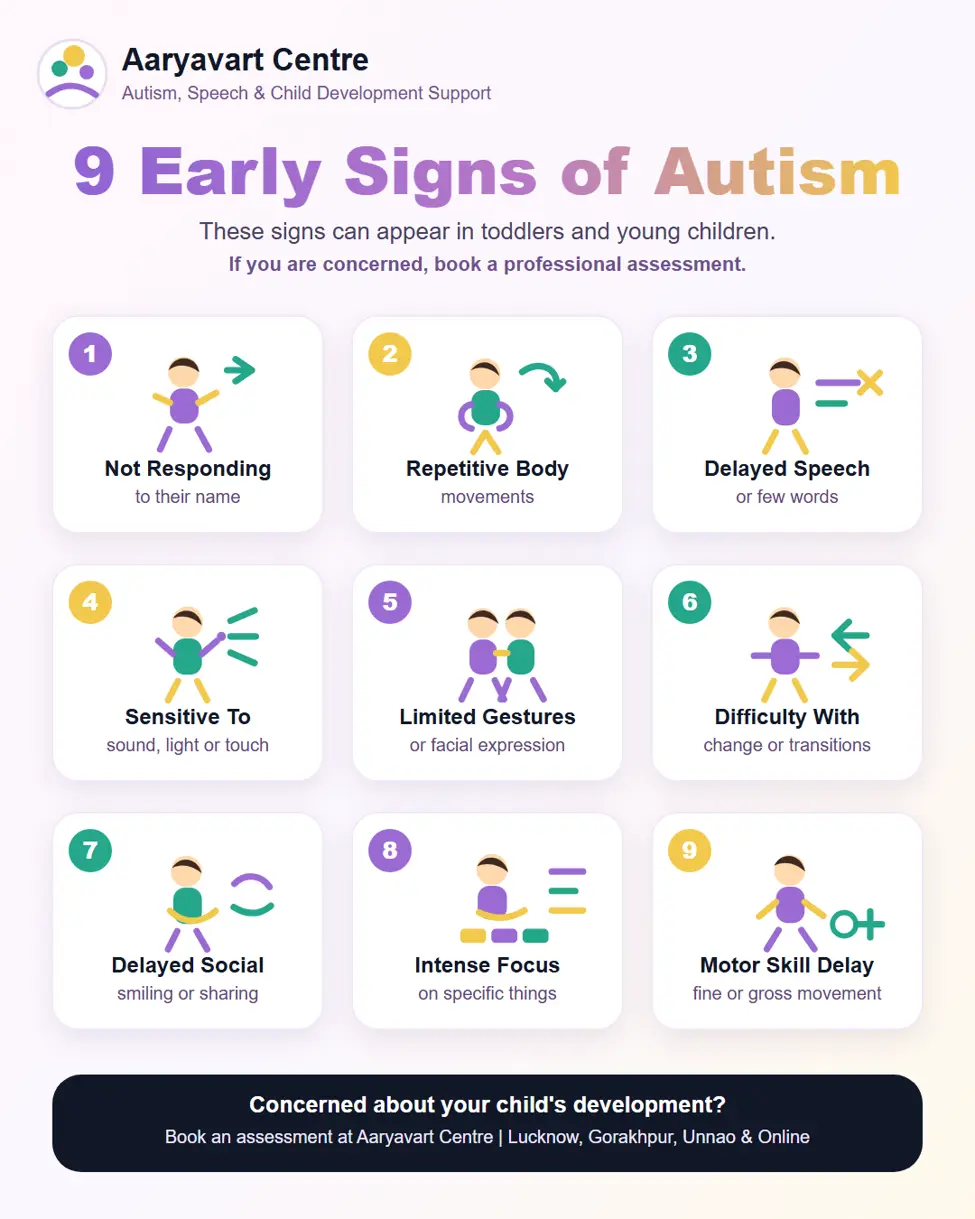
The main signs of autism include differences in social interaction, communication, play, behavior, sensory responses, and daily routines.
Common signs may include:
- Limited or inconsistent eye contact
- Not responding consistently to name
- Delayed speech or loss of words
- Repeating words, sounds, or actions
- Hand flapping, rocking, spinning, or toe walking
- Lining up toys or playing in repetitive ways
- Strong distress when routines change
- Sensitivity to sounds, textures, lights, or crowds
- Difficulty playing or interacting with other children
However, one sign alone does not confirm autism. Autism spectrum disorder is diagnosed by looking at a wider developmental pattern. The CDC explains that autistic people often have differences in social communication and interaction, along with restricted or repetitive behaviors or interests.
If you are noticing repeated signs, a professional developmental evaluation can help you understand your child’s needs better.
What is Autism Spectrum Disorder?
Understanding autism helps parents respond with clarity instead of fear.
Autism spectrum disorder, also called ASD, is a neurodevelopmental condition. It affects how a person communicates, interacts, learns, behaves, and processes the world around them.
The word “spectrum” is important because every autistic child is different. For example:
- One child may need significant support with speech and daily activities.
- Another child may speak fluently but struggle with social situations.
- Some children may have strong sensory needs.
- Some may have intense interests, strong memory, or visual learning strengths.
Autism is not caused by poor parenting. It is related to differences in brain development. WHO describes autism as a diverse group of conditions related to brain development, with characteristics often detected in early childhood, although diagnosis may happen later.
Early Signs of Autism by Age
Autism signs can appear at different ages, so parents should watch for repeated patterns rather than one isolated behavior.
Signs of Autism in Babies
In babies, early signs may be subtle. Parents may notice differences in how the baby responds, connects, or communicates.
Possible signs include:
- Limited eye contact
- Reduced social smiling
- Not responding consistently to name
- Less babbling or back-and-forth sound play
- Limited gestures such as pointing, waving, or reaching
- Less interest in showing or sharing objects
- Unusual reactions to sounds, lights, textures, or touch
Some babies may seem unusually quiet, while others may become very distressed by everyday sensory experiences.
Not every delayed milestone means autism. However, repeated social communication differences should be discussed with a pediatrician or developmental professional. NIMH notes that autism symptoms generally appear in the first two years of life.
Signs of Autism in Toddlers
Toddler years are often when parents notice clearer autism symptoms.
Common signs of autism in toddlers include:
- Delayed speech
- Loss of previously used words
- Repeating words or phrases
- Limited pretend play
- Playing with toys in repetitive ways
- Lining up objects
- Spinning wheels or watching moving parts
- Hand flapping, rocking, jumping, or toe walking
- Strong distress when routines change
- Preference for playing alone
- Limited interest in playing with other children
A toddler may also react strongly to:
- Loud sounds
- Certain food textures
- Clothing tags
- Haircuts
- Crowded places
- Bright lights
If these signs are affecting communication, learning, play, or daily routines, early therapy support may help the child build practical developmental skills.
Signs of Autism in School-Age Children
Some children are not identified in toddlerhood because their early signs are subtle or misunderstood.
In school-age children, autism signs may appear as:
- Difficulty making friends
- Trouble understanding social rules
- Taking language very literally
- Difficulty with transitions
- Intense interest in specific topics
- Sensory overload in busy places
- Emotional meltdowns after school or social events
- Difficulty with classroom participation
- Challenges with handwriting, self-care, or attention
These challenges are not “bad behavior.” They may reflect differences in communication, sensory processing, flexibility, or emotional regulation.
Signs of Autism in Teens and Adults
Autism can also be recognized later in teens or adults, especially when earlier signs were missed.
Common signs may include:
- Difficulty reading social cues
- Social exhaustion
- Strong need for routine
- Sensory sensitivity
- Anxiety in unpredictable situations
- Intense interests
- Masking or copying social behavior
- Difficulty in school, work, or relationships
Some people seek evaluation later because they have spent years feeling misunderstood. Recognition can help them access the right support, accommodations, and coping strategies.
Common Signs of Autism Parents Should Watch For
These signs are easier to understand when grouped into communication, behavior, sensory, and daily life patterns.
Social Communication Differences
A child may want to connect but may not know how to do it in a typical way.
Common signs include:
- Not responding consistently when called
- Limited or unusual eye contact
- Rarely pointing to show interest
- Not bringing objects to share
- Difficulty with back-and-forth conversation
- Trouble understanding facial expressions
- Difficulty reading tone of voice or body language
Some children may interact more comfortably with adults than peers. Others may prefer structured play over open-ended social situations.
Speech and Language Differences
Speech delay is one of the most common reasons parents seek help.
A child may:
- Speak late
- Use very few words
- Repeat the same words or phrases
- Echo what others say
- Use scripted lines from videos
- Speak in an unusual tone or rhythm
- Struggle to start or continue conversations
Some autistic children have strong vocabulary but still struggle with social communication. They may talk mainly about a favorite topic, find it hard to ask questions, or miss the social purpose of conversation.
Repetitive Behaviors and Restricted Interests
Repetitive behaviors are common in autism and may help the child feel regulated or comfortable.
Examples include:
- Hand flapping
- Rocking
- Spinning
- Jumping
- Repeating sounds
- Lining up toys
- Opening and closing doors
- Watching moving objects closely
Restricted interests may include a strong focus on:
- Numbers
- Vehicles
- Maps
- Animals
- Logos
- Fans
- Trains
- Specific cartoon characters
These interests can be meaningful and enjoyable. They become a concern when they strongly limit flexibility, learning, or daily routines.
Sensory Sensitivities
Many autistic children experience the sensory world differently.
They may be over-sensitive or under-sensitive to:
- Sound
- Light
- Smell
- Taste
- Touch
- Pain
- Movement
- Food textures
- Clothing textures
For example, a child may cover their ears, avoid certain clothes, refuse foods because of texture, dislike haircuts, seek spinning, crash into cushions, or become overwhelmed in malls, schools, or family gatherings.
Sensory issues are real. They can affect behavior, learning, sleep, eating, and participation in daily life.
Play and Learning Differences
Play can reveal important developmental signs.
A child may:
- Show limited pretend play
- Prefer playing alone
- Repeat the same play pattern
- Focus on parts of toys
- Arrange objects instead of using them imaginatively
- Struggle with turn-taking or shared play
Some children learn better through visuals, routines, repetition, and structured teaching. A therapy plan can use these strengths to support communication, social understanding, and independence.
Signs That Are Often Missed or Misunderstood
Some autism signs are overlooked because they do not match common stereotypes.
A child who talks can still be autistic. Autism is not only about speech delay. A child may speak clearly but struggle with:
- Social conversation
- Emotional understanding
- Flexible thinking
- Sensory regulation
- Peer relationships
A quiet child is not always “just shy.” Shyness usually improves with comfort, while autism may involve broader differences in communication, play, routine, behavior, and sensory responses.
Girls may also be missed because they sometimes:
- Copy peers
- Mask difficulties
- Show quieter social struggles
- Appear socially engaged but feel exhausted
- Develop anxiety around social expectations
This is why careful evaluation matters.
When Should Parents Seek Professional Evaluation?
Parents should not wait too long if developmental concerns are repeated or affecting daily life.
You should consider professional guidance if your child has:
- Delayed speech
- Limited response to name
- Reduced gestures
- Repetitive behaviors
- Strong sensory reactions
- Limited pretend play
- Difficulty with social interaction
- Frequent meltdowns
- Distress with routine changes
- Difficulty with learning or daily routines
The American Academy of Pediatrics recommends autism-specific screening at 18 and 24 months, along with regular developmental surveillance. The CDC also notes that developmental screening is recommended at 9, 18, and 30 months, with autism-specific screening at 18 and 24 months.
Screening does not label a child unfairly. It helps families understand whether more evaluation or support is needed.
Early support can help with:
- Communication
- Learning readiness
- Social participation
- Behavior regulation
- Daily routines
- Parent-child interaction
If you are unsure whether your child’s signs need attention, Aaryavart can help you take the next step through autism therapy consultation and developmental support.
How Autism Therapy Can Help?
Therapy should support the child, not try to change who the child is.
Autism therapy can help children build useful skills for daily life. The goals should be personalized because every child has different strengths and support needs.
Depending on the child, therapy may support:
- Speech and communication
- Social interaction
- Sensory regulation
- Emotional regulation
- Play skills
- Learning readiness
- Self-care skills
- Behavior management
- School readiness
- Parent guidance
Therapy may include:
- Speech and language therapy
- Occupational therapy
- Sensory integration support
- Behavior support
- Special education
- Social skills training
- Family guidance
- Daily living skill development
Therapy works best when professionals and parents work together. Families need practical strategies they can use at home, school, and in daily routines.
Why Choose Aaryavart for Autism Therapy?
The right support system can help parents move from confusion to clarity.
Aaryavart supports families looking for structured autism therapy, developmental guidance, and special-needs support. The focus is on understanding the child first and creating therapy goals around their current abilities, challenges, and strengths.
At Aaryavart, support may focus on:
- Communication development
- Sensory needs
- Social skills
- Behavior support
- Learning readiness
- Daily routine building
- Parent guidance
- Child-focused intervention planning
Instead of using a one-size-fits-all approach, families can seek structured support based on their child’s developmental needs.
If you are noticing signs of autism in your child, with Aaryavart and get clear guidance on the next step.
Conclusion
Autism signs can appear in many ways, from speech delay and limited eye contact to sensory sensitivities, repetitive behaviors, social difficulties, and distress with routine changes.
The most important thing is to notice patterns early and seek qualified guidance. Early support can help children build meaningful skills at their own pace.
If you are concerned about your child’s development, Aaryavart can support your family with autism therapy guidance, developmental planning, and child-focused intervention. Book an assessment with Aaryavart now.
Signs of Autism FAQs
What are the first signs of autism?
The first signs of autism may include limited eye contact, not responding consistently to name, delayed babbling or speech, reduced gestures, limited social smiling, repetitive movements, unusual play, and strong sensory reactions.
At what age do signs of autism appear?
Signs of autism can appear in early childhood, often before age two. However, some children are diagnosed later when communication, school, or social demands increase.
Does speech delay always mean autism?
No. Speech delay does not always mean autism. However, if speech delay appears with limited gestures, reduced social interaction, repetitive behavior, or sensory issues, a professional evaluation may be helpful.
Can a child have autism and still make eye contact?
Yes. Some autistic children do make eye contact, especially with familiar people. Autism is diagnosed based on a broader pattern of social communication, behavior, sensory, and developmental differences.
What are signs of autism in toddlers?
Signs of autism in toddlers may include delayed speech, repeating words, limited pretend play, lining up toys, hand flapping, reduced response to name, preference for playing alone, sensory sensitivity, and distress with routine changes.
When should I seek autism therapy for my child?
You should seek guidance if signs are repeated and affecting communication, learning, play, behavior, sleep, eating, social interaction, or daily routines. A developmental assessment can help identify the right support plan.
Can autism therapy help my child?
Autism therapy can help children build communication, social, sensory, learning, behavior regulation, and daily living skills. Progress depends on the child’s needs, therapy consistency, family involvement, and individualized goals.
Is autism curable?
Autism is not considered a disease that needs to be “cured.” It is a neurodevelopmental condition. The goal of therapy is to support the child’s development, communication, independence, participation, and quality of life.
How does Aaryavart support children with autism?
Aaryavart supports families through autism therapy guidance, developmental support, social skills training, family guidance, and child-focused intervention planning. Parents can book a consultation to understand the right next step for their child.