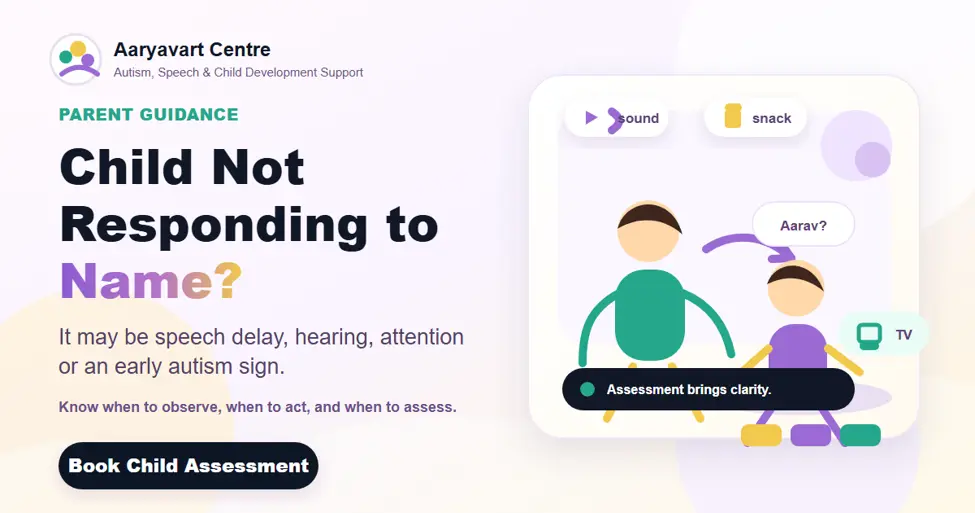
Child Not Responding to Name? What Parents Should Know
If your child hears sounds but does not respond to their name, learn possible causes, autism signs, speech delay concerns, and when to seek assessment.
Many parents notice something confusing: their child responds quickly to music, TV sounds, mobile videos, doorbells, or even the sound of a favourite snack packet, but does not turn when called by name. This can feel especially worrying when it happens again and again, even in a quiet room or when the child is nearby.
Not responding to names can happen for different reasons. Sometimes it may be linked to attention, hearing, speech delay, language understanding, sensory processing, or social communication difficulties. In some children, it may also be one of the early signs seen in autism spectrum disorder.
However, one sign alone does not confirm autism. What matters is the overall pattern: how your child communicates, makes eye contact, follows instructions, uses gestures, plays, responds socially, and expresses needs. A professional assessment can help parents understand the real reason and take the right next step without panic or confusion.
Why Response To Name Matters?
Responding to names is an important early social communication skill. The CDC lists “does not respond to name by 9 months” as one possible early sign of autism spectrum disorder.
The American Academy of Pediatrics also includes not responding to names among early symptoms that may be seen in autism.
This does not mean every child who ignores their name has autism. But it does mean parents should not dismiss it as “stubbornness” without observing the full picture.
Does Not Responding To Name Always Mean Autism?
No. A child may not respond to name for many reasons, including:
- Hearing difficulty
- Attention difficulties
- Speech and language delay
- Developmental delay
- Autism spectrum disorder
- Sensory processing differences
- Being deeply focused on an activity
- Limited understanding of social communication
The important question is not only “Does the child respond to name?” but also “How does the child communicate, interact, understand, play, and respond socially?”
Autism Signs To Watch Along With Name Response
Parents should be more alert if not responding to name appears with other signs such as:
- Limited eye contact
- Limited pointing or waving
- Not showing objects to parents
- Not following simple instructions
- Repetitive movements
- Repeating words without meaningful use
- Limited pretend play
- Strong resistance to change
- Sensory sensitivity
- Delayed speech
- Playing alone most of the time
The CDC notes that autism signs can include reduced eye contact, not responding to names, limited facial expressions, few gestures, and not sharing interests with others.
What Parents Can Observe At Home?
Try observing your child in normal daily moments.
Call the child’s name when they are:
- Playing quietly
- Not watching a screen
- Not already distracted
- Sitting nearby
- In a familiar room
Then notice:
- Do they turn toward you?
- Do they look briefly but not respond?
- Do they respond only when you raise your voice?
- Do they respond to other sounds but not name?
- Do they understand simple instructions?
- Do they use gestures or words to communicate?
Avoid repeatedly testing the child all day. Instead, observe naturally and share these details during assessment.
When Should Parents Book An Assessment?
Book an assessment if your child:
- Frequently does not respond to name
- Has delayed speech
- Does not point or show things
- Avoids eye contact often
- Does not follow simple instructions
- Has repetitive behaviour
- Has sensory sensitivity
- Has difficulty interacting with other children
- Has lost words or social skills
Research has also found that infants who consistently fail to respond to their names in the second year of life may be at higher risk for autism spectrum disorder or other developmental difficulties by age 3.
How Aaryavart Centre Can Help
At Aaryavart Centre, the team supports children with concerns such as not responding to name, speech delay, autism signs, ADHD, sensory issues, behavioural challenges, and developmental delays.
The assessment looks beyond one symptom. It considers communication, social response, behaviour, sensory needs, attention, play, motor skills, and daily living skills. Families can visit Aaryavart centres in Lucknow, Gorakhpur, and Unnao, or begin online guidance from anywhere in India or abroad.
Based on the child’s needs, the team may recommend autism therapy, speech therapy, occupational therapy, ABA-based support, parent training, early intervention, or a home development program.
Conclusion
If your child does not respond to name, do not panic. It may be related to attention, hearing, speech delay, developmental delay, or autism. But it should not be ignored, especially when it appears with delayed speech, poor eye contact, limited gestures, or social communication concerns.
A professional assessment can help you understand what is happening and what support your child needs next. Not sure why your child is not responding to their name? Book an assessment with Aaryavart Centre now.
Child Not Responding to Name FAQs
Does not responding to names mean autism?
Not always. It can be one possible sign of autism, but it can also happen due to hearing, attention, speech delay, or developmental concerns. A full assessment is needed.
My child hears sounds but ignores their name. Should I worry?
If it happens often, especially with speech delay or limited social interaction, you should seek professional guidance. It is better to assess early than wait in uncertainty.
Can speech delay cause poor response to name?
Sometimes, yes. A child with language delay may not fully understand name calling or instructions. But response to name also involves attention and social communication.
Should I get hearing checked?
Yes, hearing should be considered whenever a child is not responding consistently or has delayed speech. A hearing concern can look like speech or attention difficulty.
Can therapy help improve response and communication?
Yes. Depending on the child’s needs, speech therapy, autism therapy, occupational therapy, parent training, and early intervention can help improve attention, communication, and social response.
Does Aaryavart provide online assessment guidance?
Yes. Aaryavart Centre supports families through centres in Lucknow, Gorakhpur, and Unnao, and also offers online guidance and home programs for families across India and abroad.